
Nyantri Kilat as a Digital Pesantren: The New Normal in Indonesian Islam
contributed by Khalimatu Nisa, 22 May 2025
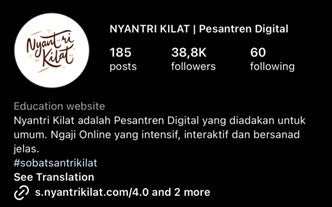
Figure 1. Nyantri Kilat in Instagram.
Source: https://www.instagram.com/nyantrikilat
“Journey to Inner Peace: Kajian Kitab Kasidah Burdah Imam Al-Bushiri” (A Study of the Kasidah Burdah by Imam Al-Bushiri) — this was the title of a poster released by Nyantri Kilat, an Islamic learning platform in Indonesia. During the celebration of Mawlid Nabi (Prophet Muhammad’s birthday) in 2023, Nyantri Kilat offered an online program focusing on the Burdah, a classic collection of devotional poems from the seventh century written by Imam Al-Bushiri of Egypt. Uniquely, the program integrated a focus on mental health, a concern particularly relevant to the younger generation on social media, and a topic that is often overlooked in Indonesia, broadly speaking. By collaborating with a mental health consultant, the program aimed to explore mental well-being through the story of the Prophet Muhammad.
Launched on Instagram in 2021, Nyantri Kilat can be described as a new form of digital pesantren (Islamic boarding school) in Indonesia. Amid the pandemic’s social restrictions, Nyantri Kilat emerged as a response to the longing for the traditional pesantren learning environment, which could no longer function as usual due to restrictions on face-to-face gatherings. Moreover, the platform sought to share and expand the unique experience of pesantren learning with a more general public, including young, urban social media users. Nyantri Kilat provides online Islamic studies using a method adapted from the traditional pesantren model: based on classical texts and taught by pesantren alumni.
Traditionally, a pesantren has always been understood as a physical space—rooms where students (known as santri) live and study Islamic knowledge. The term santri is often associated with the Sanskrit word "shastri," meaning someone literate, or the Javanese word “cantrik”, referring to a student who follows their teacher closely. Santri would come and reside at the pesantren to study various branches of Islamic knowledge over an extended period. After centuries of this tradition, the exceptional circumstances of the pandemic opened up the possibility of shifting the concept of pesantren to also include a virtual space.

Figure 2. One of the oldest pesantren in Yogyakarta, Indonesia, Pondok Pesantren Al Munawwir.
Source: almunawwir.com
In Indonesia, pesantren are deeply rooted Islamic educational institutions that have existed for centuries. More than just institutions, pesantren are seen as subcultures with their own distinct set of values (Wahid, 1974). The uniqueness of pesantren lies particularly in their philosophy of knowledge. Ontologically, the knowledge studied in pesantren is Islamic religious knowledge regarded as revealed knowledge. Epistemologically, pesantren maintain the authenticity of knowledge by preserving the classical literature of scholars from several centuries ago, commonly referred to as kitab kuning (which literally means "yellow book"—referring to classical Islamic texts traditionally studied in pesantren, and specifically the yellowish paper that was commonly used in printing these texts, especially before the widespread availability of white paper). Furthermore, they permit teaching only by those with authoritative connections, linked through a chain of knowledge back to the Prophet, referred to as a kyai. The kyai embodies religious authority and charismatic leadership, serving as a key figure in guiding both spiritual and social life in Indonesian Muslim communities. Similar to Sufi traditions, the teacher-student relationship in pesantren is sacred.
This article examines the phenomenon of Nyantri Kilat as a shift in pesantren culture, particularly how Indonesian traditional Islam has embraced online platforms during, and continuing after, the pandemic. It analyzes the existence of Nyantri Kilat in three aspects: preserving the scholarly heritage of pesantren, reshaping pesantren-style learning methods, and disrupting certain traditional values of the pesantren.
Preserving the Scholarly Heritage of Pesantren
The COVID-19 pandemic, which required physical distancing, made gatherings impossible. Pesantren, as educational institutions accommodating hundreds to thousands of students (santri), had to adapt. Many pesantren decided to send their students home, and traditional face-to-face learning activities were significantly affected.
The emergence of Nyantri Kilat as a digital pesantren was rooted in this context, at a time when pesantren had to limit their activities. Literally, "nyantri" means becoming a santri, while "kilat" means fast or express, roughly translating to becoming a santri in a short amount of time. Previously, the term kilat-an was commonly used in pesantren to refer to short-term programs for studying specific classical texts during Ramadan.
Inspired by the same spirit, Nyantri Kilat began by offering online learning programs for kitab kuning during Ramadan. The first program launched by Nyantri Kilat was the Ramadan Intensive Class in April 2021. This class covered various fields of Islamic knowledge rooted in kitab kuning, such as: hadith studies based on Arbain Nawawi by Imam Nawawi, fiqh based on Safinatun Najah by Salim Bin Abdullah Bin Said Bin Sumair Al-Hadrami, women's fiqh based on Risalatul Mahidl by KH. Masruhan Ihsan, and also theology based on Aqidatul Awam by Sayyid Ahmad al-Marzuki.
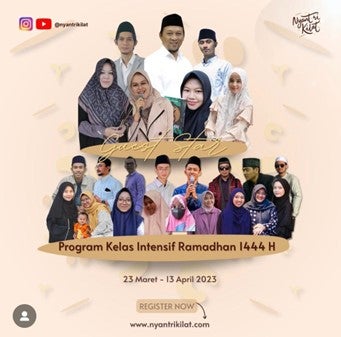
Figure 3. Nyantri Kilat’s Ramadan Intensive Class poster.
Source: https://www.instagram.com/nyantrikilat
These sessions were conducted online through scheduled teleconferences. The meetings were structured according to the bandongan (class style learning) method commonly practiced in pesantren, in which the teacher explains the material while students listen and take notes. In its promotions, Nyantri Kilat guaranteed that the teachers in its programs are ustadz and ustadzah, religious teachers who “bersanad jelas” or possesses a verifiable chain of knowledge, connecting them to the pesantren's scholarly tradition. These teachers are alumni of prominent pesantren in Indonesia.
Nyantri Kilat was initiated by two young women alumni of pesantren who also come from pesantren leadership families, Sulma Safinatus Shofiyah and Atika Rodhiya. While online Islamic learning is not entirely new, the initiative to replicate the pesantren learning model in the digital realm was represented by this program.
After receiving substantial enthusiasm, the Ramadan Intensive Program has continued annually, with improvements, including tiered classes (beginner, intermediate, and advanced levels) distinguished by the complexity of the classical texts studied. The consistent use of kitab kuning has become a hallmark of how Nyantri Kilat preserves the pesantren tradition in the digital world. Beyond the Ramadan program, Nyantri Kilat expanded to offer private Quran classes, collaborating with Quran memorizers (hafiz) from authoritative pesantren. These classes range from learning to read the Quran to working toward complete memorization.
In addition to reaching audiences beyond the pesantren community, particularly young social media users, this digital pesantren also serves as a platform for pesantren alumni to revisit and reinforce their previous studies. Thus, besides preserving the scholarly heritage of pesantren, this program also maintains the pesantren community in the digital space.
Reshaping the Pesantren Learning Method
Initiated by millennials and utilizing social media as its medium, Nyantri Kilat has introduced a number of innovative approaches to learning. From a thematic perspective, they make their programs more contextual. On special occasions, Nyantri Kilat organizes thematic programs, one of which was the Mawlīd Special Class during the 2023 commemoration of Prophet Muhammad's birth.
A program titled "Journey to Inner Peace" combined studies of the life of the Prophet Muhammad with discussions on mental health issues. This month-long program merged the study of Qasidah Burdah—a collection of poetic praises for the Prophet Muhammad written by Imam Al-Busiri (d. 1294)—with psychological perspectives on mental health. Such contextualization reflects how this digital pesantren is reshaping learning to remain relevant amidst internet culture, catering primarily to young users. Unlike traditional (offline) pesantren that study kitab kuning as they are, digital pesantren like Nyantri Kilat find it necessary to adapt to the urban community's needs.

Figure 4. Nyantri Kilat’s Journey to Innerpeace program poster.
Source: https://www.instagram.com/nyantrikilat
The internet culture, particularly social media, which can be fluid, informal, and anti-hierarchical, has also influenced the character of this digital pesantren. From the beginning, the founders appeared to recognize that they could not maintain the rigid structure of traditional pesantren. This is evident in the emphasis on "interactive" learning in their promotional posters. Although teachers are regarded as the primary sources of knowledge in line with pesantren philosophy, this digital pesantren aims to foster two-way discussions. With millennial educators as the majority, this approach becomes possible.
Another notable shift in this digital pesantren is the matter of duration. True to its name, "kilat" (express), the program is designed as a short course. Participants engage only for a brief period. In contrast, traditional pesantren have always envisioned the process of seeking knowledge as requiring an extended commitment, adhering to the principle of thulu az-zaman (continuous learning over a long time), which serves as a cornerstone of pesantren philosophy.
For the pesantren community, the pursuit of knowledge is a gradual process achieved through lengthy and thorough preparation. Imam Al-Zarnuji’s Ta'līm al-Muta'allim, a classic reference on methods of seeking knowledge and character building in pesantren, outlines six essential attributes for students aspiring for success: intelligence (dzaka'in), a deep desire to learn (hirshin), patience (ishtibar), financial resources (bulghah), the guidance of a teacher (irsyadu ustazin), and a long duration of learning (thulu az-zaman).
The pesantren community is accustomed to hearing stories of past scholars who travelled extensively, seeking knowledge from one teacher to another over many years. Some even chose to remain unmarried to focus solely on their scholarly pursuits. However, such long-term commitments are not feasible for digital pesantren. Amid the fluidity, and rapidity of internet culture, they can only offer short-term programs with participants who come and go.
With its online model, this program has been able to attract participants from geographically diverse locations. Between 2021 and 2025, Nyantri Kilat included participants from various regions of Indonesia—not only from Java, but also from Sumatra, Bali, Kalimantan, and Papua. The program also reached members of the Indonesian diaspora in countries such as Thailand, Japan, Taiwan, and the United States.
Disrupting Core Pesantren Values
As previously mentioned, pesantren, as a subculture, possesses distinctive values. Unfortunately, these values are difficult to preserve in the digital realm, which operates free from spatial and territorial attachments.
The most fundamental value of pesantren tradition is the teacher-student relationship. Teachers, as transmitters of revealed knowledge, are not only regarded as conveyors of knowledge but also as intermediaries to God. The hallmark of pesantren is the presence of teachers who act as caretakers of the institution. These teachers, commonly referred to as kyai (male) or nyai (female), are not merely educators but spiritual guides with scholarly authority and legitimacy.
In traditional pesantren, every student must first approach (sowan) the teacher. Parents or guardians seek the teacher's permission and pledge to entrust their child to the pesantren. They choose a teacher based on their expertise in a specific branch of knowledge or because of their karamah—a special blessing or virtue possessed by devout individuals.
In the digital space, as observed in Nyantri Kilat’s practices, the central figure of the teacher is absent. Digital pesantren exist merely as spaces for knowledge dissemination, where founders or organizers resemble event coordinators. There is no need for students to sowan to participate in its programs, nor is there a venerated figure in this process. The teacher’s role in the digital pesantren is more of a facilitator.
In pesantren, a student's learning process is not only about achieving cognitive understanding but also about gaining for barakah (blessing) through their teacher. In this framework, students show respect and perform good deeds to win the teacher's favor.
In digital pesantren like Nyantri Kilat, however, the mystical teacher-student relationship is missing. Learning is reduced to the mastery of material, akin to the logic of modern education. The teacher-student relationship becomes more pragmatic, where students no longer seek blessings from their teachers. The digital pesantren, as a virtual space and a less traditional arrangement, is perceived as less sacred.
Conversely, the digital pesantren format creates a more democratic and decentered atmosphere where students can be more participatory. The relatively similar age between teachers and students, along with the mediatized nature of the online space, fosters more intense interactions. Students feel free to ask questions, seek input based on their life experiences, and even engage in casual conversations.
Islamic learning through the internet has generated a significant debate. On one hand, the digital environment can lead to individual alienation in the process of religious education, with the risk of misguidance in selecting religious authorities amid an overwhelming abundance of information. On the other hand, online religious learning is increasingly viewed not merely as a challenge, but also as an opportunity to expand and renegotiate religious authority within the dynamics of digital culture.


Figure 5.6. Nyantri Kilat’s online classes situation. Source: https://www.instagram.com/nyantrikilat.
The temporality of digital spaces eliminates the long-term commitment between teachers and students. In traditional pesantren, this relationship is envisioned as eternal, transcending dimensions, and continuing into the afterlife. Even after leaving pesantren, students remain connected within the epistemological network, spreading the knowledge they have acquired in their communities as part of pesantren’s axiological principles. Annual commemorations of deceased figures (haul) serve as gatherings to reinforce this epistemological network.
In digital pesantren practices like those of Nyantri Kilat, participants come and go, rather than forming a cohesive community with a shared purpose, except for a few among them who are networked. Such institutions also do not automatically provide epistemological legitimacy to their students, nor do they instill the axiological imperative to apply their knowledge in daily life.
The absence of these values in digital pesantren practices illustrates a disruption in pesantren tradition. Digital pesantren is capable of accommodating parts of pesantren epistemology, but not its entire philosophy of knowledge. Nonetheless, it serves as an alternative form of learning that is more reliable in the digital space.
Conclusion
From the discussion above, it can be concluded that the pandemic has paved the way for the emergence of pesantren digitalization, as represented by the Nyantri Kilat platform. This platform offers a unique form of pesantren learning by maintaining classical texts and authoritative teachers. This initiative demonstrates how Nyantri Kilat preserves the intellectual heritage and community of pesantren in the digital realm.
Mediatization also introduces new forms of pesantren learning, such as incorporating contemporary issues like mental health, fostering more interactive environments, and offering shorter durations of study.
It cannot be denied that in digital pesantren, certain pesantren values have been disrupted in practice. The absence of a central teacher figure eliminates the concept of blessings, thereby reducing the sacred teacher-student relationship in pesantren tradition to a transactional dynamic.
Nevertheless, the presence of digital pesantren, which started during the pandemic, has proven to remain relevant and popular to this day, even as physical pesantren have reopened their doors. This indicates that, although it cannot fully replace them, digital pesantren has become an authoritative alternative for Islamic education, based on sources within a scholarly chain that is considered authentic, in the digital realm.
Disclaimer: The views and opinions expressed in this article are those of the authors and do not necessarily reflect the position of the blog editorial team or the Asia Research Institute.
South Asia | Southeast Asia | East Asia | Other Places | Hinduism | Buddhism | Islam | Christianity | Other Religions | Pandemic Leftovers | All Posts
Khalimatu Nisa is a lecturer at the Faculty of Ushuluddin and Philosophy, UIN Sunan Ampel Surabaya, Indonesia. She teaches in the Department of Religious Studies, where she takes an interest in studying digital religion. Additionally, alongside her community, she develops an Islamic youth-oriented website, tsaqafah.id