
Secularizing Religion on Social Media: Trends and Dynamics of COVID-19 Pandemic Leftovers in Nigeria
contributed by Peter Ayoola Oderinde, Donald Abidemi Odeleye, and Oluwaseun O. Afolabi, 3 June 2025
In the post-Covid age, Nigerian youths encounter an invasion of social commentary on religious content through targeted advertisements on their private social media walls. While online religious content serves to promote spirituality, this content is also subjected to increasing criticism. The effects of the COVID-19 pandemic are closely linked to the secularization of religion on social media, especially in Nigeria. As social media becomes a quintessential platform for religious content, questions of relevance, “fake” miracles, and the questionable financial practices of churches have also emerged on these online platforms.
For instance, in Nigeria, the number of online critics is growing gradually, challenging the norms of organized religion, especially the ubiquitous grip of Pentecostalism and its doctrines. This contribution analyzes the effect of adopting social media by churches in Nigeria, especially in terms of the impact on criticism, membership, ritual transformation, and online giving. Employing online ethnography and focusing on social media platforms such as Facebook and YouTube, this research sheds light on the evolving landscape of religious identity and new belief systems among Nigerian youth in the post-COVID-19 era.
Scholars in the 20th century predicted that modernity and globalization would usher in the decline of religion. This claim is of course incorrect, as in sub-Saharan Africa, the majority of people of the continent are religious. With the internet, we are witnessing heightened levels of interactions, with new platforms for communication between people across vast distances in the late modern era. The slogan, “the shrinking of the world to a controllable size” used by Spanish sociologist Manuel Castells (2004) indicates how the process of globalization has influenced economies, politics, media, and religion. The case of Nigeria is no different, as religion assumes new roles in the public, political, and private spheres.
The assertion of Castells was put to test with the global outbreak of COVID-19 in 2020, especially in Nigeria, a country that is particularly known for the multiplicity of its religious denominations and identities. Social media became the epicenter and the only option for observing religious sacraments. Families could perform priestly functions, such as taking the Holy Communion at home. The COVID-19 pandemic created opportunities for the faithful to explore their religious rites through the internet, while also leaving lasting vestiges with spiritual and religious implications. This piece examines the leftovers of COVID-19 within religious circles in Nigeria.
One of the vestiges of COVID-19 is the intensification of the “internetization” of religion. This exemplifies what Oderinde Peter describes in Digital Spiritualities as part of a global cultural flow (assemblage), showing that spiritual contents are part of the ontology of communications leading to the formation of online communities.
Conceptual Clarification
Before dissecting the secularization process of the internet, it is important to understand its meaning within the context of this piece. By secularization, here we imply the decline of the influence of religious authorities on church members and the public. This includes the ability to query controversial religious doctrines imposed by some religious organizations and leaders. By fully adopting the internet for spiritual purposes during the pandemic, the internet appears as a new sacred space. Unlike much of the 20th century, whereby media communication agencies are mostly one-way communication (asynchronous), synchronous and dialogical digital technologies encouraged the infusion of ‘criticisms’ on religious discourse in the 21st century.
For example, in this YouTube reel, posted by @trishareact on Tuesday 29th, 2025, one can see that AI is interpreted as a fallen angel and a demon. This is because religious inquirers such as @trishareact have the freedom to send messages and receive feedback at the same time. Concurrently, they can set up personal online platforms to express views on religious experience. Anxieties and regulations on the use of media by religious authorities are not a new phenomenon. For example, in the pre-social media era, some Pentecostal churches, such as the Deeper Life Bible Church, prohibited television and cable services for its members.
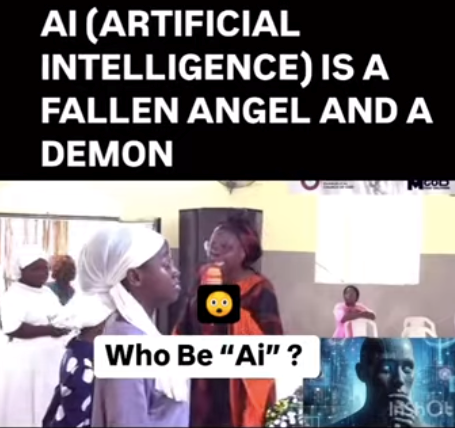
Figure 1. The image of a preacher taken from her screenshot on why AI is a fallen angel Source: YouTube, @chikadailytrend
Implications for Adopting Technology
The adoption of the internet has allowed the rise of independent internet pastors since the outbreak of the novel coronavirus. These independent preachers continue to benefit from the “grace” after the pandemic by making use of the internet to establish online churches. Invariably, this has brought about fluid membership in which some religious adherents have a dual church affiliation – one as a physical church member and the other as an online member.
It is important to state that apart from being a physical member of a particular denomination, some Christian adherents are also fans (or followers) of other charismatic Pentecostal pastors whom they follow strictly online. These online fans follow the messages of their spiritual mentors online and even donate generously for the growth and expansion of their ministries. For instance, an Anglican is free to worship in their denomination, but can also become an online follower of a Charismatic Pentecostal Pastor.
The use of the internet by Nigerian churches provided a platform for online critics raising concerns on gospel-related matters, decentralizing the ownership of the ‘word of God’, which originally was domiciled in the churches and monopolized by church leaders. The internet also showcases “fake” miracles that purportedly align with lived realities of Nigerians and even encourages critical opinions on such content. Evidence of people who are critical of religious institutions and authorities, or religious “dropouts,” abound on the internet, showing Nigerians (both at home and in the diaspora) who comment on social media or through videos on the relevance of religion in the 21st century.
In Nigeria, the number of religious critics is gradually growing, challenging the norms of organized religion, especially the grip of the Pentecostal Theocracy and its influence on the country’s political economy. The Pentecostal mega pastors commanded the ears and attention of millions of citizens, often more so than the government of Nigeria. However, these pastors of organized religion in the country also assumed they held moral control over society, as one of its major influencers. The ostentatious lifestyle of mega and small-time Pentecostal preachers exemplified their expounding of the prosperity gospel at the detriment of holiness, forgiveness, redemption, and doctrines.
The Contest for Authenticity and Recognition
The question might be raised as to whether the internet is a secular or sacred space. It enables laities and ordinary people to criticize the doctrines of the Pentecostal churches and their excesses, as other major Nigerian Christian denominations seldom use the internet. As the internet becomes a platform for spirituality, the auctioning of spiritual products by prophet Jeremiah Omoto Fufeyin, such as miracle fish, miracle key, miracle soap and water, spiritual bread and spiritual Automated Teller Machines (ATMs), and cases of financial misappropriation have stirred controversies among Nigerians on the internet. Prophet Jeremiah Omoto of Christ Mercyland Deliverance Ministry became popular on social media in post-pandemic Nigeria due to his outlandish claim of miracles. A spiritual ATM is among the online merchandise of prophet Omoto while the spiritual bread was meant to replicate Jesus’ miracle (in the book of John 6: 1-14) when he fed 5,000 people with five loaves of bread and two fish.
An example of religious critique is seen in the case of a famous online activist and blogger Martin Vincent Otse, popularly known as ‘The Very Dark Man’ (VDM), who criticizes the prophet Jeremiah Omoto on social media. VeryDarkMan is a Nigerian activist who rose to prominence on social media after the pandemic. VDM challenged the National Agency for Food and Drug Control (NAFDAC) to investigate prophet Jeremiah Omoto’s products. He bought a few spiritual products (water and soap) from the prophet Jeremiah Omoto’s online store; then, he brought the soap to the NAFDAC office for testing. He also went to a location where there were several physically challenged individuals to administer these miracle products.

Figure 2. A screenshot of verydarkblackman serving a handicapped man with miracle water of prophet Jeremiah Omoto to test whether the holy water could heal them. Source: YouTube, VERYDARKBLACKMAN
Many Nigerians could participate (physically and online) as credible observers, unlike the pandemic times, when some notable pastors boasted claims of immunity and a panacea to the virus. This became a monumental change as the internet in Nigeria became a space that allows for criticism. For instance, pastors and religious leaders do not have the monopoly of information hitherto ascribed to them. Pastor Adeyemi in an interview explained why he opposed tithe payment, by adding that Nigerian pastors focus on Prosperity Gospel due to the country’s poor economy. Therefore, the internet has brought not only digital innovation, but also opportunities for dissident knowledge and a platform where new voices of critics can circulate and be heard.
Online Giving among the Mainline Churches
Before the COVID-19 pandemic, mainline churches preferred receiving tithes and offerings in cash. This is because, during tithe and offering sessions, congregants are expected to dance forward row-by-row to the altar. This is to show their appreciation to God, as they are expected to drop their offerings at the feet of God. This was the tradition in many mainline and Pentecostal churches in Nigeria. However, during the COVID-19 pandemic when larger gatherings were not possible, mainline churches created an alternative. Thus, they adopted online giving of tithe and offerings by sharing the church’s bank account details with members through various internet platforms.
In the post-pandemic era, cash became scarce in Nigeria. For instance, during the 2023 elections, the Central Bank of Nigeria (CBN) announced the faceoff of old naira notes (Nigerian currency). This encouraged Nigerians, particularly religious adherents who are versatile in technology, to adopt and make use of online transactions. It is important to note that even before the pandemic, cashless money transfers were not new in Nigeria. However, from 2023 onwards, most people found that it was easier to transfer money than to undergo unnecessary ordeals to keep cash at hand. People prefer to give offerings online rather than in cash, since the money withdrawn from the bank will go ultimately back to the bank anyway. Nevertheless, those who are not technologically literate (as well as the elders) still pay their offerings by cash. Whether donations are paid online or physically, the donors continue to dance at the altar as a sign of gratitude to God. Thus, online giving and cashless transactions became part of the COVID-19 leftovers in Nigerian churches. In addition, Pentecostal churches made use of the pandemic to digitize their online giving by making the process of donation easier for their members through online methods. As a result, many Pentecostal churches created diverse means of donation such as sort code, USSD code, church website, online giving software, etc.
During COVID-19, church doors were closed and religious leaders opted for online delivery of sermons to their members. That time period gave rise to many online preachers who did not have a physical church but optimized the opportunity to find new digital avenues to increase their visibility. Hence, COVID-19 popularized the use of the internet by religious actors and the public in Nigeria in a greater way. After the pandemic, churches continue to make use of the internet and social media to deliver their sermons to their members in the diaspora and those who cannot make it to the church either on Sunday or during the week owing to their work schedule or physical distance. Finally, to summarize, we have argued that the use of the internet and social media applications for church services has allowed a duality, or plurality, of church membership. The implication is that Nigerians can be both physical members of a denomination and online members of another denomination at the same time. We also argued that the internet brought criticism into the realm of faith, as some have challenged the claims of pastors who were not previously openly critiqued.
Disclaimer: The views and opinions expressed in this article are those of the authors and do not necessarily reflect the position of the blog editorial team or the Asia Research Institute.
South Asia | Southeast Asia | East Asia | Other Places | Hinduism | Buddhism | Islam | Christianity | Other Religions | Pandemic Leftovers | All Posts
Peter Ayoola Oderinde is a member of the European Network on Global Pentecostalism, the Fondation Oumou Dilly Scholar Network and the Lagos Studies Association. Oderinde is a lecturer at the Department of Religious and Intercultural Studies, Lead City University, Nigeria. He is the author of Digital Spiritualities: Social Media and Nigerian Pentecostal Churches in Switzerland. oderinde.peter@lcu.edu.ng
Donald Abidemi Odeleye is a distinguished professor of Counselling Psychology, and Dean of the Faculty of Education at Lead City University, Ibadan, Nigeria, where he is also a member of its Governing Council. odeleye.bidemi@lcu.edu.ng
Oluwaseun O. Afolabi is a senior lecturer and pioneer Head of the Department of Religious and Intercultural Studies, at the Lead City University, Nigeria. He is a member of the African Studies Association, United Kingdom, the Society for Peace Studies and Practice, Nigeria, Institut Français de Recherché en Afrique (IFRA-Nigeria), and a fellow of the Lagos Studies Association. afolabi.oluwaseun@lcu.edu.ng