Events

Sonic Efficacy: Mantras, Music and Placemaking in Global Southern Asia
| Date | : | 02 Sep 2026 - 04 Sep 2026 |
| Venue | : | Hybrid (Online via Zoom & AS8 04-04) |
| Contact Person | : | YEO Ee Lin, Valerie |
| Programme | ||
This workshop is funded by the ERC Synergy Project MANTRAMS – Mantras in Religion, Media and Society in Global Southern Asia (ID 101118934).
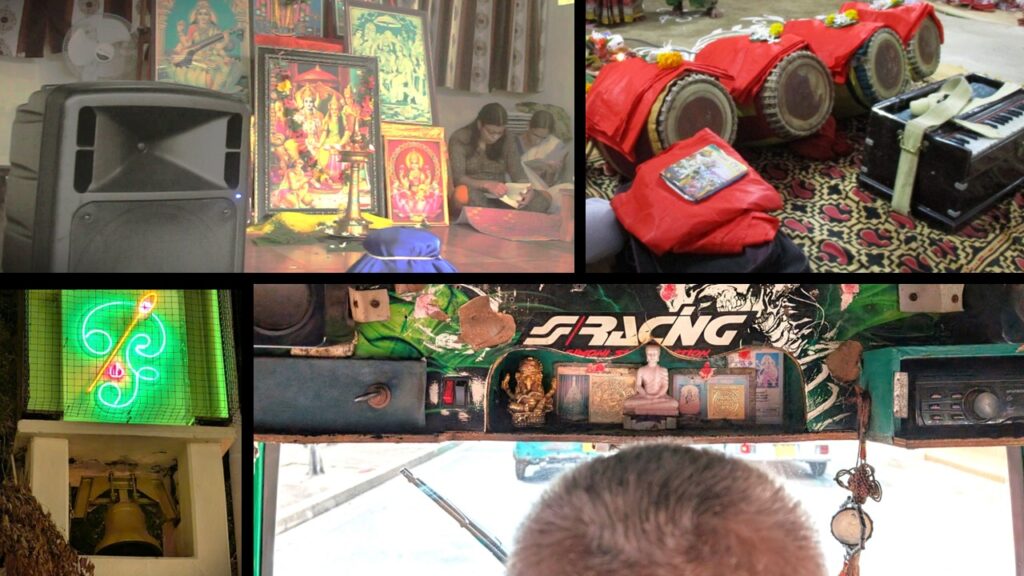
This workshop brings perspectives derived from immersive ethnography, sound studies, sensory anthropology, embodied research practice and historical methods to study efficacious sounds in relation to music, body, place and ritual in global southern Asia.
Sacred sound has been employed for centuries across human cultures to bring about transformations of the body, the self, society, and the cosmos. Among the most powerful expressions are mantras, which stand as paramount examples of efficacious sound.
Today, mantras are used by over a billion people globally for ritual, meditation and healing. Mantras are employed by diverse secular, religious and spiritual communities (Hindus, Jains, Sikhs, Buddhists, New Age spiritualities, SBNR, etc.). Similar efficacious sacred sounds and syllables are used in Islamic, Christian, ancestor-worship, and animistic traditions.
In the lack of a single definition that works for its various manifestations over history and across geographical regions, “mantra” is a relational category shaped by the ways powerful syllables and sacred sounds are embedded within local sonic ideologies and musical genres.
The presentations, audio papers, and other multimodal and multisensory contributions that make up this workshop collectively explore the understudied intersections between sonic efficacy and sound practices, with particular attention to the role of mantras in processes of sonic soteriology and place-making in Southern Asia. Key themes include:
- Sound, Music, and Music Instruments. How do mantric practices share a sonic ideology that is common to genres of sacred sound (e.g., zikr, kirtan, bhajan, nam japa, paritta)? How is the efficacy of mantras and other sacred sounds affected or mediated by their performance, musical accompaniment, and/or amplification?
- Healing and Soteriology. How do mantras induce transformations of the body and the self? How are sonic and medical efficacies of mantras linked through ritual? Why are mantra practitioners often situated in the fuzzy borderland between religion and traditional medicine?
- Place-making. What is it that efficacious sounds do to the place where they are played, repeated, or amplified? How do mantras and sacred sounds contribute to inter-religious tensions and controversies surrounding competing soundscapes in diverse societies? How do local sonic ideologies and sacred cosmogonies intersect with spatial and communal belonging?
Building upon selected contributions from the participants, we will collectively work towards:
- An edited volume on Sonic Efficacy in Global South Asia.
- Sonic contributions to the OMnibus of MANTRAMS (mantrams.eu), MANTRAMS’ immersive multimedia archive.
- A series of audiovisual deliverables, e.g., in the format of audio papers, audiovisual essays, or audio documentaries to be published as part of a multimodal Special Issue.
WORKSHOP CONVENORS
Prof Carola Lorea | University of Tübingen
Dr Mukul Menon | University of Tübingen
Dr Devyani Bhosale | University of Tübingen
Ms Edda Schwarzkopf | University of Tübingen
Dr Yaoreipam Makang | University of Tübingen
Dr Tom Peterson | University of Tübingen
Dr Ishita Mahajan | University of Tübingen
Prof Kenneth Dean | National University of Singapore