
In Conversation with Dr Jonathan Galka


The author of memorably titled articles such as Bohemia at the Pacific Seabed, Oceans of Ooze, and Mollusk Loves, at ARI, Postdoctoral Fellow Jonathan Galka continues his deep dive into the ocean's depths, working on a monograph about mid-20th century deep-sea mining aspirations.
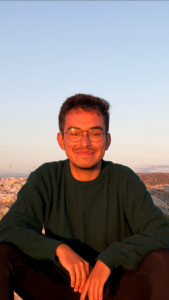 Can you tell us a bit about where you’re from and your academic background?
I’m a historian of science from a mixed Ecuadorian and Polish American family in South Florida. My parents exposed me very early to the natural world, through the fantastic nature programming available for children in South Florida, and it was then that I cultivated my first passions in natural history and in evolutionary biology. I started scuba diving when I was 11 and it has stuck with me ever since. One specific group that has to be mentioned is the Broward Shell Club, a group of shell collecting enthusiasts that my father introduced me to at a very young age, whose amazing life experiences instilled in me a desire to travel widely.
And I’m so grateful for parents who travelled for work at different times in their careers and lives that when I was 15, they allowed me to go away for my first summer of ecology research in Guyana and be mentored by the fantastic neotropical ecologist Godfrey Bourne in studies about community freshwater ecology. Even though I no longer practice biology, those summers and winters in Guyana shaped my orientation to the value of sustained and experiential inquiry.
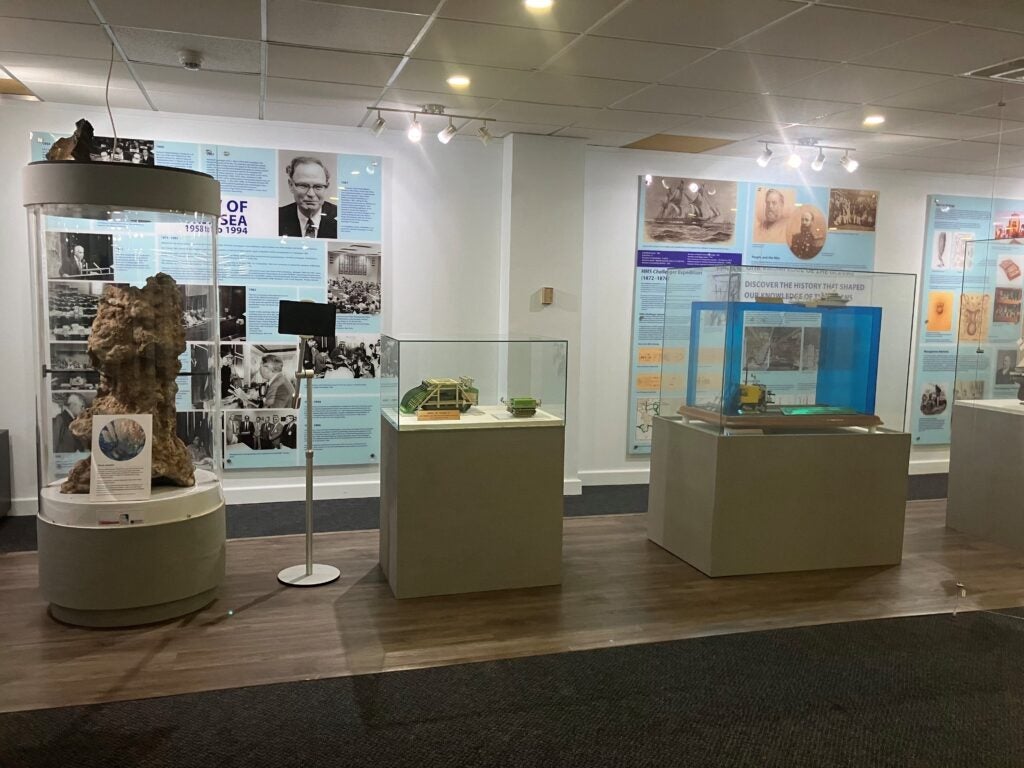
The Nii Allotey Odunton Museum at the International Seabed Authority, highlighting deep-sea manganese nodules, whose governance and scientific inquiry are the central concern of my dissertation and book project.
As far as academic background goes, I hold a BS in the history of science, medicine, and public health, and in ecology and evolutionary biology, from Yale University. I also hold an MA and a PhD in the History of Science from Harvard University. In between degrees, I worked as a public health scientist in Malaysia on a Fulbright research fellowship, focusing on making available the then-newly available pre-exposure prophylaxis for women who sell sex and transgender women across Malaysia. My interests have always been diverse, which I think is marked by the degrees I pursued and the research I’ve sought to undertake. I have a sustained interest in the ways that people engage with the ocean now, in ways that I think unite my backgrounds by incorporating multispecies frames with tools from the history of science, global history, and political history.
What attracted you to Singapore and NUS for your work, and what makes the city a good base for your research?
I came to Singapore in my fourth year of graduate school because I wanted to pursue integrating tools from public history and research-based artistic practice into my scholarship, while also seeking ways to bring scholarly and community-based knowledges into productive conversation. I found this originally at NTU with the Centre for Contemporary Art, where I worked with a team on the Climate Crisis & Cultural Loss project on deep-sea mining matters. This was enormously fruitful for me, and has contributed to what I think has been the robust integration of curation in my research and collaborations, and to my being able to participate meaningfully with communities on the frontlines of Anthropocenic ocean change.
Over the years, ARI has been a crucial place for me to engage with other like-minded researchers. I’ve shared work on species translocation (mollusks again), critical minerals (deep-sea minerals), and more and these conversations have shaped my thinking. I knew early-on that I wanted to research and write about Singapore’s own stake in deep-sea mining, through Ocean Minerals Singapore, and position this within other amazing work on Singapore’s ocean governance and extractive ecosystem, from the port, to land reclamation, to new energies and future resources.
Are you collaborating with others at ARI, and what are the main themes or projects you’re focusing on during your fellowship?
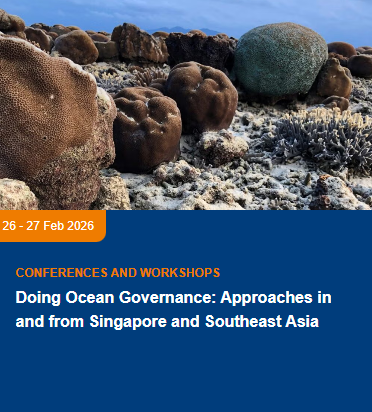
 I think that, despite how Singapore’s engagement with the seascape is so dynamic, people in Singapore remain largely unaware of how profound these changes have been. But it’s precisely because of all these frontline technocratic efforts to manage ocean territory and resources that local approaches to knowing the ocean otherwise can be productive. This was a motivation for me to host, along with Canay Özden-Schilling and Jiat Hwee Chang, the upcoming workshop at ARI, Doing Ocean Governance: Approaches in and from Singapore and Southeast Asia. This event promises to bring people together who are studying and working on similar issues not only from the vantage of mega-projects, but also from local efforts in the Johor Strait, the trans-boundary Riau, and the wider region.
The cover of “Ocean Uses and their Regulation” shows an example of a text on conflicting ocean uses, whose management and governance is at the core of my research and is central to the upcoming conference I am organizing with ARI called “Doing Ocean Governance”
Aside from this, I’ve really benefitted from being in conversation with the other members of the STS Cluster at ARI, including Hui Yun Cher, Fathun Karib, and Justin Lau, who are pushing forward in many ways a concerted agenda around centring political geology and natural resource politics in study of Southeast Asia.
What sparked your interest in the deep sea and its resources?
The short answer is that my father was a career union merchant marine in the US, and I was probably always going to come back to the study of the deep and open ocean. But this happened in a roundabout way. Undergraduate biology training, especially in taxonomic contexts, led me to think about writing a thesis on deep-sea vent mollusks and their symbionts, which in turn led me to a short research paper titled something along the lines of “will deep-sea mining be bad for mollusks.” This was probably in 2017, when I was focusing on public health as a potential career path, but with the advice of mentors in history of science, I kept reading and researching widely and realized that there were stories to be told about how ocean science and ocean law came to inform one another.
Graduate training followed in the history of ocean science, STS, and law courses on the UN Convention on the Law of the Sea, and I realized that what I was really interested in talking about were ideas of resources and practices that enacted those ideas across scientific disciplines in the last century (when many of those disciplines were forming or radically re-forming).
What’s been the most surprising or challenging part of your research so far?
When I started to become interested in writing a project on deep-sea minerals around 2017, there were definitely ongoing humanities and social science research projects, but they were few in number. The International Seabed Authority wasn’t really yet in any limelight, nor was debate over the mining code in such full swing. But in the time between then and now, the deep seabed has become such a key piece of geopolitical and economic reorganization, with deep-sea mining often at the centre of those conversations.
 So, what was surprising and challenging was having to write a historical project on the last wave of international seabed investment while another one was entering full swing. It was hard to stick to the source material without being tempted to write about what was happening all around me, especially as friends were sending me popular press articles about deep-sea nodules constantly. The stress around presentism, though, did lead me to collaborate with other humanities folks who go to the International Seabed Authority for research, and led me and them to form a collective of artists, academics, and activists we’ve called the Deep Currents Collective.
A photo of my mobile artistic installation, called the Insurgent Seabed Archive, installed at the National Gallery of Jamaica in July 2025, as part of the Deep Currents Collective’s (an activist group of which I am a part) intervention into deep seabed heritage.
How have you been finding life in Singapore?
I’ve had a fantastic three years and counting in Singapore. The NTU CCA, ARI at NUS, and other communities have been so welcoming to me, and I’ve learned so much in turn. I’m lucky that my partner and I get to live in a comfortable neighbourhood that over the years has made working from home possible and calming. We’ve found our favourite hawker stalls and have a weekly routine of going to the beach, fishing sometimes, and hiking when we can. And I get to dive more often, so life in Singapore has been great.
The views expressed in this forum are those of the individual authors and do not represent the views of the Asia Research Institute, National University of Singapore, or the institutions to which the authors are attached.
Jonathan Galka
Postdoctoral Fellow
Science, Technology and Society
Asia Research Institute
Dr Jonathan Galka commenced his appointment as a Postdoctoral Fellow with the Science, Technology and Society (STS) Research Cluster with effect from 15 April 2025.
Dr Galka has a PhD and MA in History of Science from Harvard University. His dissertation examining the 20th-century identification of deep-sea manganese nodules as scientific, political, and economic resources queries how the construction of nodules as a mineral resource frontier imbricated the biological and geological sciences with Cold War and postcolonial ocean law and politics. During 2024–2025, he was a visiting scholar at ARI and with the NTU CCA on its Climate Change and Cultural Loss project. At ARI, he will begin a project on the histories and futures of deep seawater technologies, especially ocean thermal energy conversion.