
When Is Art Islamic? Creativity and Faith in Indonesia


Introduction: Portraying Imam Bonjol
One late October afternoon in 2019, I sat down for coffee with Indonesian theater practitioner Sahrul to talk about a controversy surrounding his first play with Bumi Teater, a Minang theater group established by Wisran Hadi in 1979. At that time of year, the campus café at Institut Seni Indonesia in Padangpanjang was packed with students cramming for exams over drinks and cigarettes. Sahrul spoke casually, as if he had recounted the story many times before (he has, in fact, written the book on it).
On the evening of October 13th, 1995 Bumi Teater performed a dress rehearsal of their play Imam Bonjol, a story that narrates the life of the titular Islamic Padri leader from West Sumatra of the late 18th and early 19th centuries. Sahrul was a young stage actor back then and the newest member of the group. He explained that this rehearsal took place the night before Bumi Teater was scheduled to perform at the 1995 Festival Istiqlal II in Jakarta, the second of two large festivals organized by Suharto’s New Order government to showcase Islamic arts and culture in the archipelago. What might have been an ordinary dress rehearsal became extraordinary by the presence of the Indonesian army, standing armed and at attention surrounding the front of the stage.
When I asked why Bumi Teater would have need for such an armed escort, Sahrul explained: “[Pemerintah] menggangap bahwa ini akan bisa membuat masyarakat, orang Minang di Jakarta, ngamuk” ([The government] believed the play would anger the public, and specifically anger the Minang people in Jakarta). The authorities anticipated a riot.
In the audience was the head of the Indonesian Ulama Council (Majelis Ulama Indonesia, or MUI), religious figures, state officials, as well as invited members of the Minang community. It was standing room only. Altogether, this was quite unusual for a dress rehearsal.
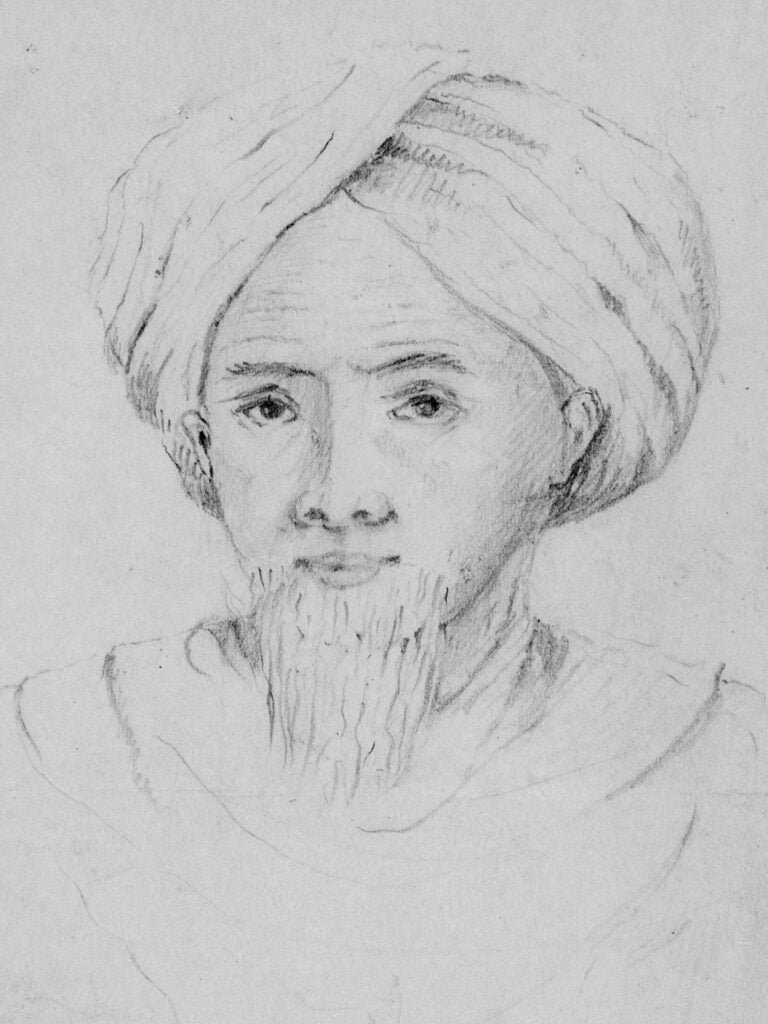
This dress rehearsal was called after the governor of West Sumatra sent the festival’s planning committee a letter sounding the alarm – he went so far as to say he would not be held responsible for public outcry if Imam Bonjol continued as scheduled. Back in Padang, Wisran Hadi had been accused in the local papers of dishonoring the memory of Tuanku Imam Bonjol who is today regarded, albeit controversially, as an Indonesian National Hero (Hadler 2008). According to the West Sumatran media outlet Mingguan Canang (active from the late 1980s through the early 2000s and notable for its promotion of literature written in the local Minang language), Hadi had erred in representing Imam Bonjol as weak, indecisive, even cowardly (Sahrul 2017). Offended at such an unflattering take on an esteemed historical and cultural figure, local papers urged a boycott.
Instead of removing Bumi Teater outright, the festival committee in Jakarta took a middle path – they hosted an open dress rehearsal the night prior to their scheduled performance to gauge the reactions of diverse groups with the Muslim community. Fearing the worst, they brought in an armed escort.
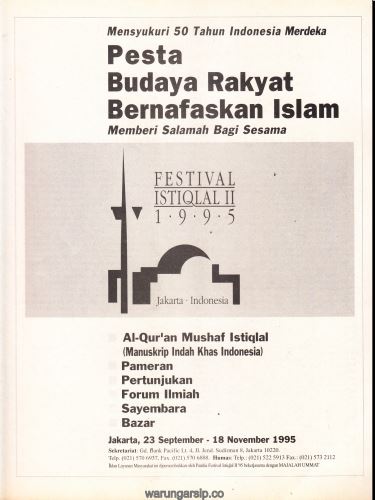
In the end, there was no riot or public outcry in Jakarta. Religious authorities and the Minang community in Jakarta agreed that the play did not violate Islam or abuse the historical memory of Imam Bonjol. The play was permitted to continue as scheduled, and Bumi Teater went on to perform for three consecutive nights at Festival Istiqlal II. Each night brought in a packed audience.
Sitting opposite Sahrul nearly 25 years after these events, it was clear to me that this controversy strongly shaped Sahrul’s views on theater and the publics for whom he performs. He shook his head as he narrated to me, feeling renewed disappointment even so many years later that their play had come close to being censored. And for what? he asked rhetorically. For representing Imam Bonjol as a human being like everyone else? Was it not against his values as a Muslim to elevate a mortal man to the status of God? For Sahrul, he understood the humanization of Imam Bonjol as an act of piety, one that exalts God’s singular perfection and explores the fallibility of humankind.
Listening to Sahrul, I was struck by how familiar these concerns sounded. The tension he described – between creativity and religious authority, between artistic intention and public interpretation – echoes questions that have long shaped artistic life in Indonesia.
These are not new debates (they are also not unique to Indonesia). Similar concerns were already being articulated in the 1950s and 60s, during a period when Indonesian artists, religious thinkers, and cultural organizations were actively working out what it meant to create art as Muslims in postcolonial Indonesia. The heart of these discussions asks: what kinds of Islamic art are permissible? And is it the artists, the general public, or individuals/agencies of authority who determine where such lines are drawn? As Sahrul’s experience indicates, these issues remain up for negotiation.
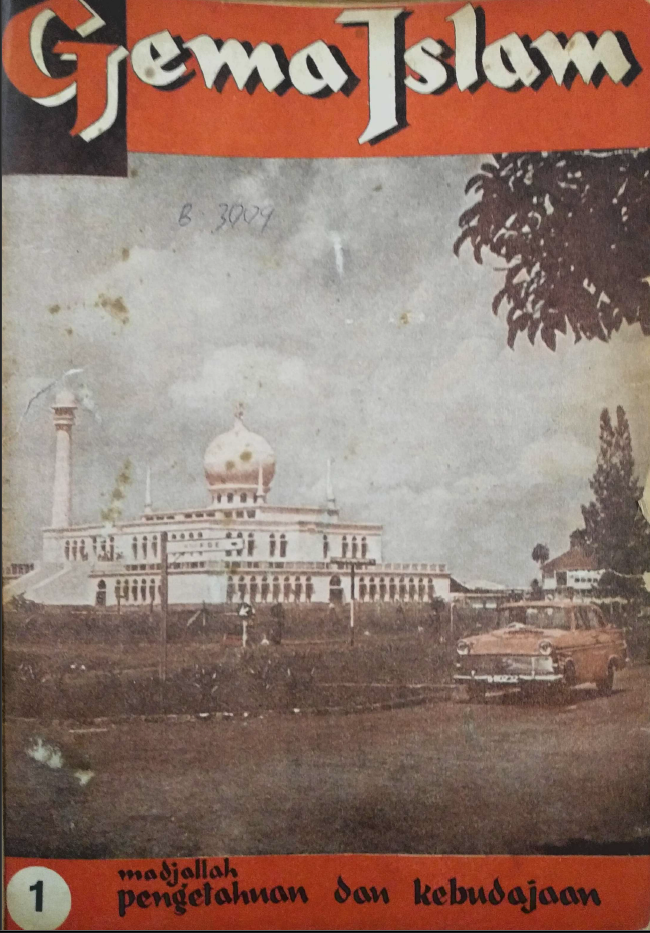
One way to explore this is to turn to this moment in Indonesian history – the early 1960s – when artists, intellectuals, and religious leaders were themselves grappling with such concerns. At the center of this discussion was Gema Islam, a cultural magazine published between 1962 and 1967 and spearheaded by the first modernist Muslim cultural organization in Indonesia, Himpunan Seni Budaja Islam (HSBI). While cultural organizations like LEKRA have received well-deserved attention in academic scholarship (Bodden 2012, Weintraub 2010, Woolgar 2019, Vickers 2025), it is worthwhile to consider the interests, anxieties, and contributions of modernist Muslim groups who paved the way for a national Islamic identity. These activities are especially interesting because of the codification of the arts, including Islamic arts, in the national arts academy system of higher education, where many artists serve as teacher-scholar-practitioners.
Art, Politics, and Uncertainty in the 1960s
When reading Gema Islam, it becomes clear that these debates were shaped by the broader moment of political and cultural uncertainty. Indonesia was a young nation, and its cultural identity was still under negotiation. Art became one of the spaces where competing visions of the nation were expressed, and an arena where new publics were granted voice. Left-leaning cultural organizations were promoting art as a tool for the people. At the same time, Muslim artists and intellectuals were asking how art might reflect religious values and contribute to a different vision of national life.
Questions of art are certainly related to questions of authority. HSBI was founded by Muslim cultural scholars and practitioners who were invested in staking their own claim in national efforts to define “culture,” which included defining a framework around permissible religious art. These concerns shape the conditions under which artists work, and how their work would be perceived. HSBI desired to position itself as a leader to clarify these definitions for the artists within their fold.
A Different Vision of Art
HSBI was founded in 1956 as a response to competing political priorities of the time. Rather than “art for art’s sake” (considered too indulgent of individualism) or “art for the people” (already the banner of LEKRA), HSBI insisted on “art for dakwah.” Dakwah reflects the call to Islam both for those new to the religion and those already pious Muslims seeking to deepen their faith. In this formation, art was a channel for dakwah, for sharing and celebrating in Islam’s message. HSBI imagined the magazine Gema Islam as their principle means to voice their advocacy of art as dakwah and disseminate their position with a wide public.
Essential to dakwah arts is intention. Dakwah is an active state of mind, one that brings both the artist and the audience into a shared journey of reflection upon their faith: art that is meaningful, purposeful, and resistant to distraction from faith must be cultivated. Gema Islam formed around a growing community of Muslim artists seeking validation of their creative practices. It served to develop a shared language of permissibility and legitimization, which anticipated how art may be received, interpreted, and critiqued by those from a Muslim background. Importantly, as much as intention is the essence of dakwah, HSBI’s efforts to define dakwah arts indicates that they were cognizant of the role of public perception in drawing the lines of permissible practice.
Drawing the Boundaries of Permissibility
HSBI formalized their opinion on the arts through a musjawarah (“deliberation”) held in late 1961. During this event, over 100 artists, intellectuals, and religious leaders gathered in Jakarta to discuss the role of art in Islam. The outcome was a set of guidelines that attempted to answer which art was allowed, and which was not allowed, within Indonesian Islam.
Their conclusion, perhaps unsurprisingly, was broadly inclusive and purposefully vague. The statement declared that Islam permits artistic expression in all forms, as long as it promotes moral integrity and devotion to God. At the same time, it cautioned against elements considered immoral or obscene – sculpture being called out as an especially tricky art form.
What emerges from these discussions is a picture of artistic practice as a process of negotiation. There can be no single, fixed definition of “Islamic art.” Instead, artists worked within shifting boundaries, responding to different audiences, expectations, and contexts. This reminds me again of Sahrul’s reflections. For an artist, the issue becomes less about which art is allowed or forbidden, and more about understanding where the boundaries are drawn, who drew them up, and how these lines become associated with a particular time and place.
One of the striking features of the guidelines published in Gema Islam is their recognition of local cultural art forms. The document highlights poetry, proverbs, songs, and storytelling traditions as important expressions of Islamic culture. This inclusion is an important acknowledgement of these traditions as more than marginal or syncretic genres. Islamic art in the archipelago was undoubtedly shaped by local histories, languages, and practices. But this inclusion in the musjawarah’s decision serves as a formalized acknowledgment of traditional arts that may be perceived to be beyond the boundaries of Islamic practice in other contexts or in other communities. It serves as a statement of legitimization for Islamic artists who are skilled practitioners in localized dakwah forms, but who may find they require a vocabulary to advocate for their art as Islamic art.
Conclusion
Both the debates of the early 1960s and contemporary controversies like Imam Bonjol point to the role of audiences in shaping what is considered acceptable. Artistic meaning does not reside solely in the intentions of the artist (individual dakwah must still be understood by others as dakwah). It is also produced through reception, interpretation, and critique. Tensions are most apparent where these practices intersect.
Looking across these different moments, Islam and the arts are viewed in parallel. They intersect and influence one another; at times indifferent, maybe even incoherent, but never separate. HSBI’s debates as captured in Gema Islam reminds us that questions about Islamic art have long been part of Indonesia’s cultural and political life. And Sahrul’s recollection of acting in Imam Bonjol outlines the shape of these debates in ways that still capture the interests of Islamic arts practitioners today in Indonesia.
Rather than asking whether art is simply allowed or forbidden, we must ask how artists navigate the boundaries of becoming Islamic and what their choices reveal about the societies in which they work (Ahmed 2015). Artistic creativity regularly redefines categories and opens new possibilities for expression. Being in conversation with artists like Sahrul clarifies how individuals do not expect to resolve these questions once and for all – but rather underscores their ongoing commitment to musjawarah.
The views expressed in this forum are those of the individual authors and do not represent the views of the Asia Research Institute, National University of Singapore, or the institutions to which the authors are attached.

Katia Chaterji
Assistant Professor
Department of Asian and Asian American Studies
Bellarmine College of Liberal Arts
2026 ARI-LUCE scholar

Katia Chaterji earned her M.A. and Ph.D. in history at the University of Washington, and her B.A. in anthropology at the University of Chicago. An interdisciplinary scholar of maritime Southeast Asia, she engages with oral history, performance ethnography, and historical archives to research the shared histories between Islam and the performing arts in Sumatra (Indonesia), and the lives of Indonesian performing artists in diaspora. Her ongoing scholarship explores Islamic dakwah arts in relation to shifting narratives of permissibility and belonging. Her work has appeared or is forthcoming in Asian Music and Monsoon: Journal of the Indian Ocean Rim.
doi.org/10.25542/hv5k-wa08