

A vignette of ecological urban gardening in Singapore


My research at ARI focuses on emerging discourses and practices in Singapore’s food system including citizen-led food initiatives, urban food commons, food rescue, and reimagining pathways to food security. Fieldwork on urban farming in Singapore has led me to discover interesting spots and creative individuals. In this interview, we visited a pioneering citizen garden initiative and met with two gentlemen who shared about their journey in urban agriculture and gardening. Ganesh Kumar started the Woodlands Botanical Garden, which today is probably the most biodiverse spot in Singapore. Tang Hung Bun is a veteran natural farmer who contributes to creating gardens and farms that mimic natural eco habitats and systems. I had the pleasure of co-leading the interview with an ARI colleague, Dr Shumeng Li. Below is an excerpt.
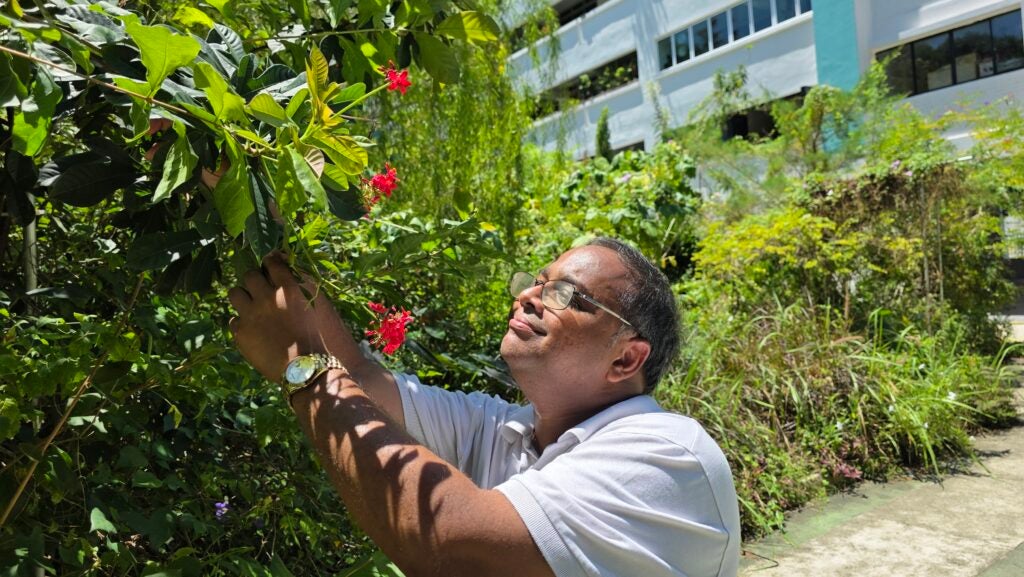
Ganesh Kumar in the Woodlands Botanical Garden. Credit: Ganesh Kumar.
Emily: Could you share with us, how did you create this biodiverse botanical garden from just grass patches?
Ganesh: It started as guerilla planting of just a few plants, and I was told to remove them. Actually, I bought my house because I saw this hill and I always wanted to plant a tree here. So, I planted about six or seven plants—very tiny—knee height only. But the authorities told me I cannot plant anything on this hill without permission. I know there were people planting all sorts of things randomly and not maintaining them. Those plants may get pests that spread and they would just be abandoned. That is not good for the ecosystem. But for us, we always maintained and when the authorities came down, I was lucky because nature was great—the butterflies and birds spoke for themselves. So, I told them if you want me to remove, I will but look at what is happening here. So, they approved it on the spot. This garden sits on state land, and I am just a caretaker here.
Emily: I understand that you use natural gardening interventions. Can you give some examples?
Ganesh: The initial planting, to put it very crudely, was sacrificial planting to break the soil first and introduce the microbes. When we first started the soil was like concrete. It took us twenty minutes to dig a tiny hole just for one plant. The first few plants went through a lot, so I'm very thankful to them. What you see thriving here now is the work of those previous plants.
Shumeng: How do you stop pests here?
Ganesh: Oh, we don't. It happens naturally. We do have natural interventions such as “companion planting” because there are certain plants we choose to attract pests to them, so the other plants are saved. When I plant blood flowers, that particular plant might have some pest problem, but it's confined to that one area. The plants around them are very nice and healthy. It's very interesting, I actually discovered that on my own, planting here. We had a lot of pest problems at the start, but now some pests are still there because they are part of the ecosystem, but they don't infest the garden. You will see mealy bugs but they're all under control, and the plants are still healthy. The mealy bugs feed the ladybugs and other insects.
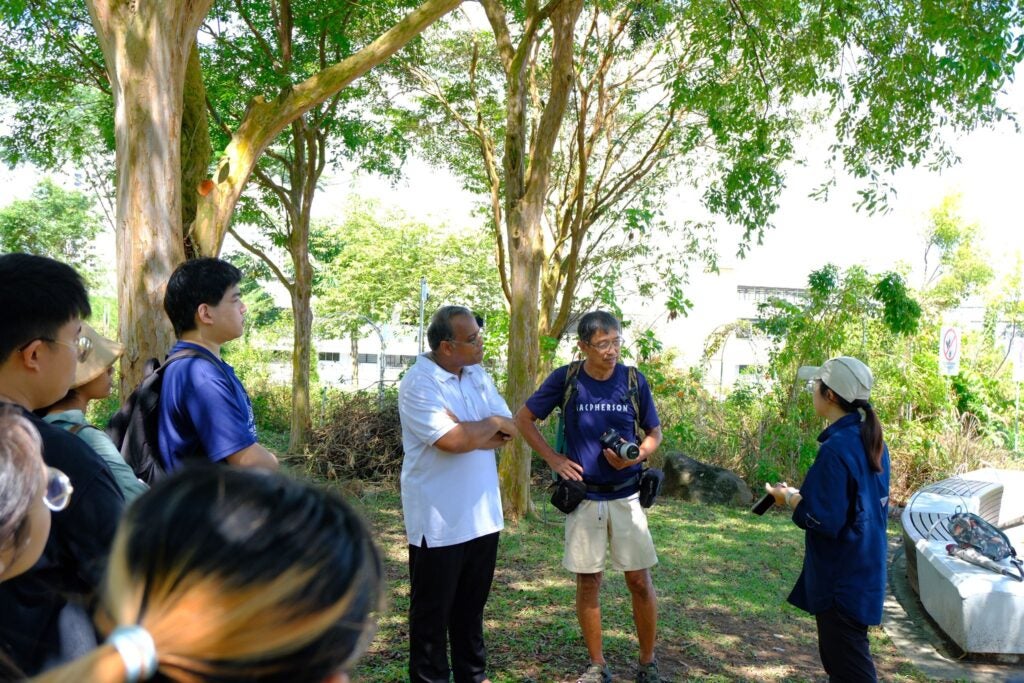
Ganesh and Mr Tang with visitors to the garden. Credit: Ganesh Kumar.
Mr Tang: That’s because of the equilibrium between those different species.
Ganesh: Yes, within one or two years we can achieve equilibrium, nature is amazing.
Mr Tang: Gardeners just help a bit by creating conditions for nature to happen.
Ganesh: When I started that main aim was to have a butterfly garden. But once butterflies came, and they were many at first, they attracted other diverse species. So, the butterfly population slowly dropped and then the bird population started to increase. Then once the number of small birds started to increase, the eagles, the hawks started to come, and that is how nature balances out.
Shumeng: So how many different species do you have in this garden?
Ganesh: More than 300. I think we have the highest plant diversity per square metre in Singapore. More than [the national] Botanic Gardens.
Shumeng: It is not even a large piece of land, but it already has 300 species… think about that!
Mr Tang: That is just plant species. For the animal species, wait for our EIA.
Emily: What are the signs or indicators that a site has reached natural, self-regulating equilibrium?
Mr Tang: Permaculture, syntropic farming, and natural farming all touch on this. It is complex, but it boils down to two principles. First, it is diversity. Diversity in everything: plants, animals, soil organisms, and food crops, if you grow food. Second is Law of Return. We need to return as much organic material as we can to the soil, to the ecosystem, through composting and other methods.
Shumeng: What are the differences in the types of nature-based farming or gardening that you mentioned?
Mr Tang: I see many similarities. Syntropic farming suits larger spaces of several hectares, and can be applied to forest farming. Permaculture can be applicable even for smaller size plots. Natural Farming for me is more philosophical than technique-oriented. The concepts and philosophy of Masanobu Fukuoka, a Japanese natural farmer, have deeply inspired my thinking and practice. I lost my farm, a permaculture food forest in Lim Chu Kang, when it was acquired for the building of those high-tech greenhouses. After that, if anyone is willing to let me use her space for permaculture, I'll do it. I don't charge anything because it is a chance for me to learn from nature, as opposed to those large-scale, input-intensive farming systems. There are actually many suitable places even though the soil is bad. With my experience, I now have confidence to transform the soil.
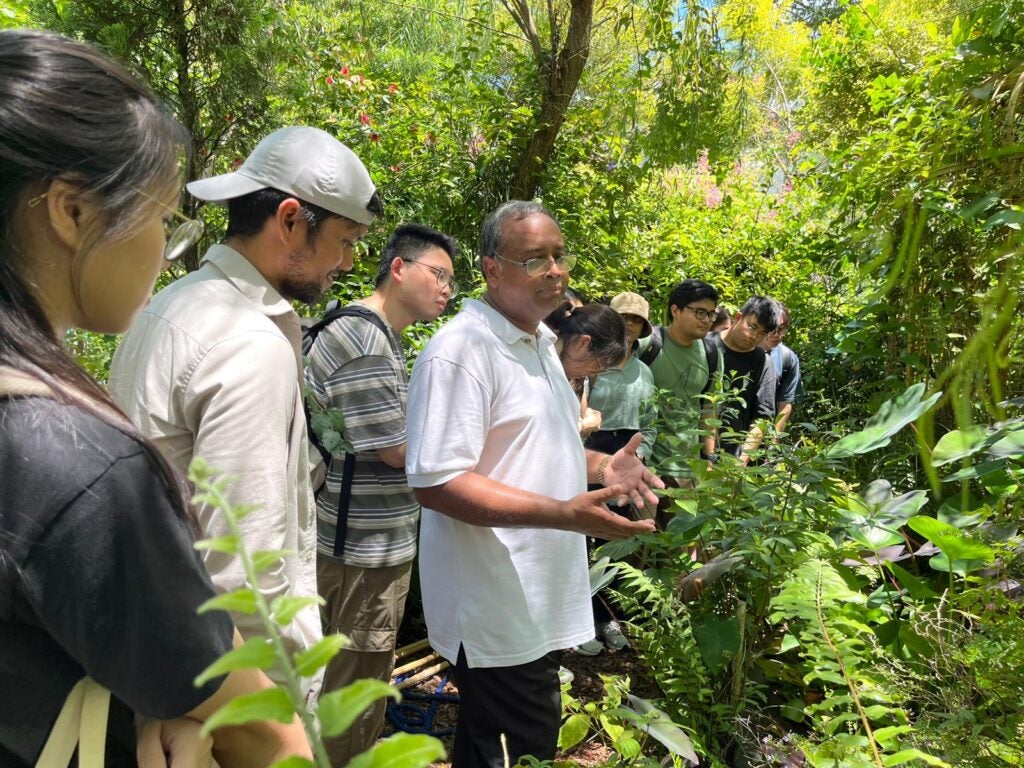 Ganesh leading a tour around the garden. Credit: Ganesh Kumar.
Emily: What do you think of high-tech vertical farming?
Mr Tang: Well, I think in Singapore, we can have those high-tech farms, but at same time, we should allow natural farming. Yes, Singapore is small, but we still have green spaces everywhere. We need to be more creative to see whether they’re suitable for gardening or growing food. Those who promote indoor farming would say that in a sealed environment, bugs and insects cannot come in, so the plants can be pesticide-free. I think this is conceptually wrong because the insects play a role. Plants need the natural environment, including pests, to stimulate their own immune system so that they can produce their phytonutrients, and when we eat plants we also consume those phytonutrients.
Emily: When you look at a green space, what are your criteria to see whether they're suitable to be transformed?
Mr Tang: Whether there's connectivity to other green spaces, because you need inputs from nature. The damselfly species that I am monitoring at this site is rare and vulnerable in Singapore. I think the reason they come here is that the nearest population is about 1.5 km away at Ulu Sembawang. So sometime in 2022, Ganesh found me creating ponds in different places. He told me that he wanted to create a pond to attract biodiversity. I came to take a look and gave him some suggestions. So, he created this pond [which we were standing before, which mimics a natural pond ecosystem]. It is very tiny, very shallow. I didn't have great hope, because there is a lot of restrictions from NParks: the water cannot be deeper than this, and so on. But he went on to create it. Then in February [five months before this onsite interview in 2024], he sent me a photo and asked me what insect that was. It was the rare damselfly, which is disappearing in Singapore. They show up here, I started to monitor them. Since March I have been coming to study the damselfly, their behaviour, and their habitat requirements. I'm writing a paper on it so hopefully, with this knowledge, we can protect the species in Singapore.
Ganesh: Another notable species here is the Birdwing butterfly. That's the biggest and the only internationally protected butterfly in Singapore. We are doing conservation efforts for that butterfly to try to increase their population… but I hope it's not too late. There are times when we have six or seven of them appearing together. We have the largest population of Birdwings in Singapore in our tiny garden, compared to even Lornie and Mandai, and everywhere else. So, these are the issues and we are trying to protect this space.
Shumeng: What do you do to promote conservation and biodiversity efforts of this garden, and to share knowledge?
Ganesh: Slowly as the garden grew, we got more media coverage. I'm very happy whenever people write about us because that gives us another layer of protection. We also have a lot of visits from community gardeners, and they have gone back and implemented what we shared. Once they walked through this garden, they have a change of mindset. So, it's wonderful. The community garden programme in Singapore actually functions like 2000 separate gardens, but it's not a community. So, two years ago, I invited all the Northwest gardeners here, and we had such a wonderful time. Because in different gardens, there'd be someone who specialises in something different. Let’s say one garden might be great at growing tomatoes, another might be good at sunflowers. So, we can all share and everyone learns. We gave away so much stuff. We are happy to give; we don't need to exchange.
Mr Tang: Now there are different people coming to help because the garden is better known. These young people are mostly from Republic Polytechnic [gesturing to student volunteers].
Ganesh: I had some lawyers who came to visit the garden, and it was supposed to be just one session. But they told me that they learned a lot of things from me that they were unaware of, and it inspired them. Subsequently they brought environmental lawyers in Singapore to come and meet me, and we are coming up with programmes to teach new lawyers on environmental and policy issues.
Like other visitors to the garden, we went away inspired by nature and our conversations. For a city that already has much greenery, a next step to enhancing it is to think not simply of green spaces but ecological spaces enriched with biodiversity. The Woodlands Botanical Garden is one such space where nature and ecological processes take precedence.
The views expressed in this forum are those of the individual authors and do not represent the views of the Asia Research Institute, National University of Singapore, or the institutions to which the authors are attached.

Emily Soh
Postdoctoral Fellow
Food Politics and Society
Asia Research Institute
Dr Emily Soh is a Postdoctoral Fellow with the Food Politics and Society Cluster at the Asia Research Institute at NUS. She received her PhD (D.Phil in Urban Planning) from the Technion–Israel Institute of Technology. Emily’s research at ARI focuses on emerging discourses and practices in Singapore’s food system including citizen-led food initiatives, urban food commons, food rescue, and reimagining pathways to food security.
https://doi.org/10.25542/vrm1-v579
Recent publications
Soh, E. (2026). Global city goes local? State ambitions and societal undercurrents of food localisation in Singapore. Geoforum, 168, 104484. https://doi.org/10.1016/j.geoforum.2025.104484
Soh, E., Feitelson, E., & Berry, E. M. (2025). Normative facets of transitioning food systems. Frontiers in Sustainable Food Systems, 9, 1648446. https://doi.org/10.3389/fsufs.2025.1648446