

Why “Gen Z” Protests Played Out Differently in Bangladesh and Nepal


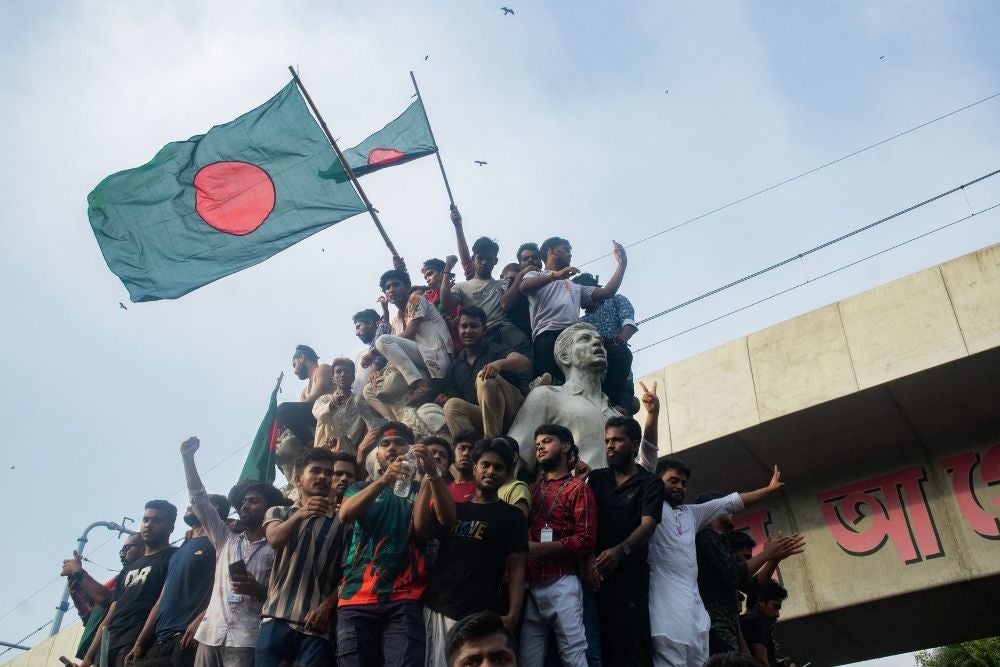
5th August 2024. Dhaka, Bangladesh. The people of Bangladesh celebrate the resignation of Prime Minister Sheikh Hasina. Shutterstock.
Over the past two years, protests in both Bangladesh and Nepal were widely described as “Gen Z movements.” Images of young demonstrators circulated across social media platforms, reinforcing the impression that South Asia was experiencing a generational wave of political unrest, echoing youth-led mobilizations seen from Hong Kong to Iran, rooted in economic insecurity, frustration with entrenched elites, and demands for accountability.
The “Gen Z” label was convenient, but analytically misleading. While youth were undeniably the engine of the movements in Bangladesh and Nepal, the protests differed fundamentally in their political logic, organisational life cycles, and ultimate consequences. Treating them as a monolithic phenomenon obscures how specific institutions and regime types dictate the path of youth mobilisation. What looks like a shared generational phenomenon is, in practice, driven by very different institutional contexts.
Now that these protest cycles have concluded and elections have been held, the contrast between Bangladesh and Nepal is clear. In Bangladesh, protests led to a political rupture, yet the uprising did not produce new electoral actors. Instead, power reverted to the established Bangladesh Nationalist Party (BNP) in the absence of the Awami League, Bangladesh’s dominant governing party since 2009. In Nepal, protests fed into electoral competition, with the movement’s grievances absorbed into the broader political system, enabling voters to reject traditional elites and hand a significant electoral victory to a reformist challenger in the Rastriya Swatantra Party (RSP).
The divergence between these two cases can be understood through differences in how political institutions and patterns of party competition structure the translation of protest into political power. In Bangladesh, elections continued to exist, but confidence in electoral competition had weakened and established parties retained overwhelming organisational advantages. In Nepal, despite significant political instability and extra-constitutional developments, elections remained the broadly accepted mechanism through which political conflict was ultimately resolved. These differences shaped whether protest energy produced rupture without substantial electoral renewal or was absorbed into party competition.
Bangladesh: From Student Protest to Political Rupture
In Bangladesh, youth participation in the protests was the consequence of a political system that had steadily narrowed space for competition and dissent. Over the past decade under Prime Minister Sheikh Hasina, political authority became increasingly centralised, elections lost credibility, and opposition activity faced mounting constraints. Although elections continued to take place, confidence in electoral competition as a mechanism for political change steadily eroded. The abolition of the caretaker government system removed an important source of electoral credibility, while legal pressure on opposition parties and restrictions on political activity further narrowed opportunities for meaningful contestation. As a result, dissatisfaction increasingly spilled into the streets, even though formal electoral institutions remained in place.
The protests began in June 2024 over public-sector job allocation and quickly expanded beyond university campuses, driven by unemployment, rising costs, and political exclusion. As protests intensified, the state responded with force. Curfews, arrests, and communication restrictions failed to contain the unrest. Student-led mobilisation widened into a broader uprising in July 2024 that ultimately forced Prime Minister Sheikh Hasina to step down and flee to India, ending her prolonged period of political dominance. The aftermath marked a clear political rupture as an interim government was installed, opening the path to elections. The motivation moved from specific quota grievances to systemic rupture because the state's repressive response left no middle ground for negotiation. With confidence in electoral alternatives already weakened, protesters increasingly came to view executive removal rather than policy reform as the most realistic route to political change.
The February 2026 general election provided the first test of whether youth mobilisation translated into electoral power. The protest-linked National Citizen Party (NCP), formed by leaders of the July 2024 uprising, won only six parliamentary seats and captured roughly 3 percent of the national vote, while the BNP and its allies emerged as the dominant national force. The outcome highlights a familiar pattern in comparative politics, where protest movements often struggle to convert street mobilisation into electoral success. Although the NCP emerged directly from the protest movement, it lacked the organisational depth, local networks, and electoral experience possessed by established parties. Protest networks proved effective in generating rupture, but once politics shifted to electoral competition, organisational advantages continued to favor traditional actors.
A constitutional referendum on the July Charter, a comprehensive reform framework developed after the July 2024 uprising and endorsed by much of Bangladesh’s political spectrum, was held alongside the election. The charter proposed broad governance reforms, including stronger rights protections and limits on executive power, and voters approved it by a clear majority. This result suggested continued public support for institutional change, even as electoral politics reverted largely to familiar actors.
While the July Charter outlines ambitious reforms, its implementation remains uncertain in a polarised post-uprising environment. Removing a dominant leader has not automatically resolved deeper governance challenges or guaranteed political stability.
The elections also highlighted limits to representational change. Although women and young activists were highly visible during the protests, they remained underrepresented among winning candidates, reflecting the dominance of established party structures.
In addition, the transition has exposed new fault lines. Reports of attacks on Hindu minorities and women following the initial uprising, along with the renewed visibility of Islamist parties such as Jamaat-e-Islami, underscore how periods of political change following rupture can create openings for identity-based mobilisation and generate new forms of contestation.
Taken together, the referendum and election outcomes suggest that the uprising produced a break in executive dominance without immediately restructuring party competition. Youth-led mobilisation created a moment of rupture, but electoral contest largely favoured actors with established organisational reach. This outcome reflected not the complete absence of electoral channels, but the continued dominance of established political organisations possessing greater institutional resources and electoral experience than newly created protest-linked actors. As a result, mobilisation generated rupture but struggled to reshape party competition.
Nepal: Protest as a Catalyst within Institutional Politics
Nepal’s protest cycle unfolded in a very different setting. Unlike Bangladesh, Nepal is an electoral democracy with regular leadership turnover, competitive parties, and constitutionally protected political freedoms. Although Nepal's crisis involved significant political disruption, opposition parties continued to compete, and elections remained the broadly accepted route through which political grievances could be translated into political change. These features enabled dissatisfaction with established elites to be expressed through electoral competition rather than requiring a complete breakdown of the political system. Protests operated alongside elections as a form of pressure within a political system where elections remained the primary mechanism for resolving political conflict, despite significant instability and extra-constitutional developments.
In the Nepal case, the immediate trigger for street protests was a sweeping government decision in September 2025 to restrict access to social media platforms, widely perceived as an attempt to curb expression and shield political elites from scrutiny. The ban touched a nerve, especially among those reliant on digital platforms, including younger citizens, families with members abroad, and small business owners. However, the social media ban was less a root cause than a catalyst to act on deeper, long-standing grievances regarding systemic corruption and the perceived stagnation of an aging leadership that had not addressed economic and governance failures.
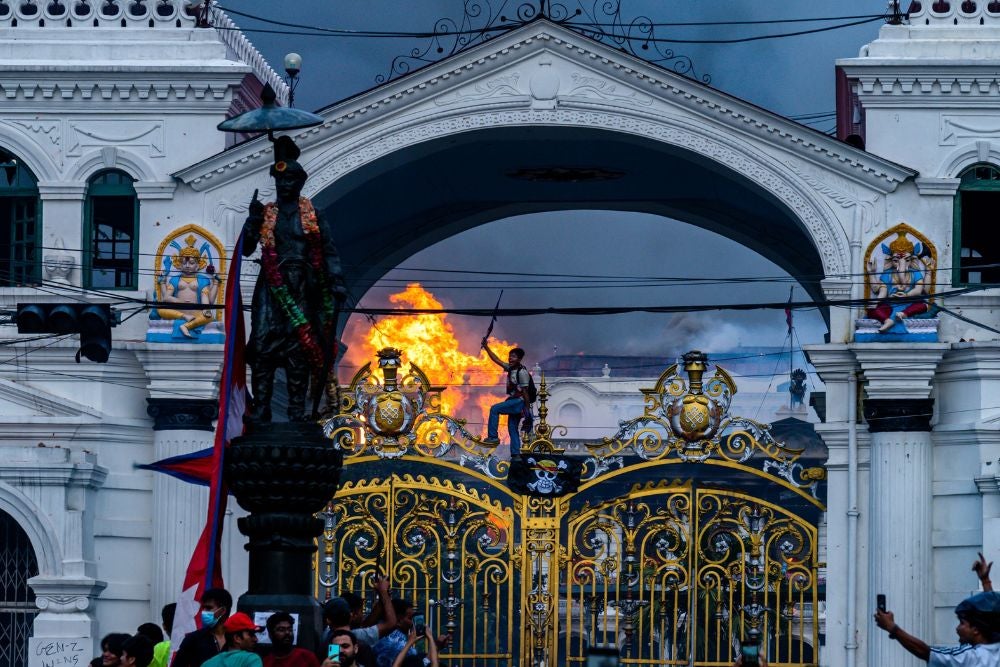
September 9, 2025: Demonstrators set fire to vehicles and public buildings in many places, including the Parliament Building in Kathmandu. Shutterstock.
Events escalated rapidly: Student-led protests in Kathmandu quickly spread to other cities, drawing in a broader cross-section of society. Confrontations with security forces intensified, deepening perceptions of government overreach. Over the course of the protests, and episodes of widespread arson that followed, more than 70 people were killed, underscoring the scale of the crisis.
Facing mounting pressure, Prime Minister K.P. Sharma Oli resigned, social media restrictions were lifted and parliament was dissolved. General elections were called for early March 2026 under an interim administration led by Sushila Karki, who was effectively chosen by representatives of the protest movement, even as established parties and new political actors jockeyed for position ahead of the vote.
The March 2026 general election illustrated how protest energy can be absorbed into electoral competition in a political environment where elections remained the accepted mechanism for resolving conflict. Unlike in Bangladesh, where the uprising removed a specific leader, but the well-established BNP ultimately returned to power, Nepal witnessed a broader rejection of the established political elite and a shift in electoral support toward new actors. This shift was driven by the Rastriya Swatantra Party (RSP), which absorbed the energy of the protests and expanded its ranks under Balen Shah, who struck a strategic deal to lead the previously scandal-plagued party. Following the party’s electoral victory, Shah became prime minister.
Unlike the newly formed NCP in Bangladesh, the RSP entered the election with an existing organisational structure and operated within a more fluid competitive environment. Dissatisfied voters therefore possessed a credible anti-establishment vehicle through which protest sentiment could be translated into electoral support. In Bangladesh, protest leaders formed the NCP but failed to gain electoral traction. In Nepal, by contrast, protest energy was successfully channelled into the RSP, contributing to a significant displacement of traditional political actors. The motivation remained channelled toward electoral rejection because the RSP provided a credible institutional outlet through which protest demands could be expressed electorally rather than through regime replacement.
Despite this upheaval, the broader party system in Nepal showed signs of resilience. The Nepali Congress Party and the Communist Party of Nepal (Unified Marxist-Leninist) remained central actors in parliamentary competition, together winning 25 percent of seats and 30 percent of the national vote. Oli’s surprise defeat in his own constituency signalled deep voter dissatisfaction with established leadership. At the same time, the endurance of these traditional parties, who are now focused on internal reform in the wake of their electoral performance, suggests that protest energy was channelled through existing democratic institutions, even as the balance of power within that system shifted significantly.
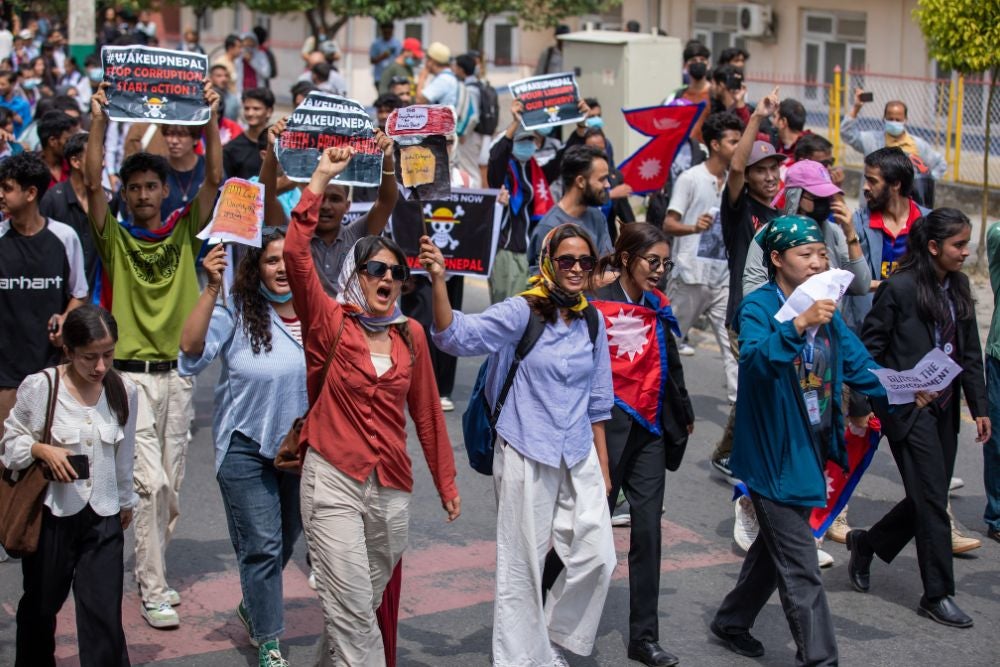
8th Sept, 2025. Kathmandu, Nepal. Gen Z Protest Against Nepalese Government. Shutterstock.
Nepal’s post-protest trajectory also reflects deeper structural differences from Bangladesh. Nepal has long experienced coalition instability, leadership turnover, and elite circulation. What makes the recent protests notable is not simply that they produced change, as Nepali politics has often been fluid. What stands out is the scale and intensity of that change, including widespread unrest, the dissolution of parliament, and a decisive electoral shift toward new actors. At the same time, it remains unclear whether these developments will lead to deeper structural transformation or represent another phase of political adjustment.
In contrast to Bangladesh, the presence of functioning electoral and party mechanisms in Nepal enabled protest demands to be channelled into institutional politics. Rather than producing rupture, mobilisation reshaped the distribution of power within the existing system.
Implications for Policy and Analysis
The “Gen Z” label is appealing because it captures visible demographic patterns and resonates with global narratives of youth activism, but it often distracts from the variation in institutional conditions that shapes actual outcomes. Seen together, these two cases show why the “Gen Z protest” label obscures more than it reveals.
In Bangladesh, youth mobilisation emerged in a system where established parties retained overwhelming organisational advantages, even as trust in electoral competition continued to erode. Protest disrupted executive dominance and forced a leadership transition, but electoral competition ultimately favored established actors. In Nepal, despite significant political instability and episodes involving extra-constitutional developments, elections remained the broadly accepted mechanism through which political conflict was resolved, allowing protest energy to be absorbed into party competition. Change came quickly in both cases, but the mechanisms through which protest translated into political outcomes differed significantly.
Importantly, the post-protest trajectory demonstrated that protest outcomes do not translate neatly into electoral outcomes. While the Bangladesh uprising reshaped the political environment and helped catalyse institutional reform, electoral competition favoured established parties. The limited parliamentary success of protest-linked candidates suggests that generational mobilisation may change political trajectories without immediately reshaping party systems.
For policymakers and analysts, this distinction carries practical implications. Misreading these protests as purely generational risks misunderstanding both their causes and their outcomes. What matters more is how political systems shape the political consequences of protest.
Bangladesh and Nepal demonstrate that similar protest movements can produce very different outcomes depending on how institutions and party competition shape the translation of protest into political power. In Bangladesh, protest disrupted executive dominance but established political organisations like the BNP retained decisive advantages once politics returned to the electoral arena. In Nepal, a more competitive environment enabled the RSP to absorb protest energy and translate it into electoral success. What mattered was not simply who was protesting, but how political institutions shaped the consequences of protest. Getting that distinction right is essential not only for understanding recent events, but also for anticipating what comes next.
The views expressed in this forum are those of the individual authors and do not represent the views of the Asia Research Institute, National University of Singapore, or the institutions to which the authors are attached.

Dr Arijit Mazumdar
Professor of Political Science
University of St. Thomas,
St. Paul, Minnesota, USA
doi.org/10.25542/dmkd-hh4f