Events
The Congress of Indonesian Women Ulama and the Future of Gender Justice in Muslim Southeast Asia and Beyond
| Date | : | 25 Nov 2025 |
| Time | : | 16:00 – 17:30 (SGT) |
| Venue | : | Hybrid (Online via Zoom & AS8 04-04) |
| Contact Person | : | LIM, Zi Qi |
CHAIRPERSON
Dr Nor Ismah, Asia Research Institute, National University of Singapore
PROGRAMME
| 16:00 |
WELCOME REMARKS |
| 16:10 |
PRESENTATIONS |
| 17:10 | QUESTIONS & ANSWERS |
| 17:30 | END |
ABSTRACT
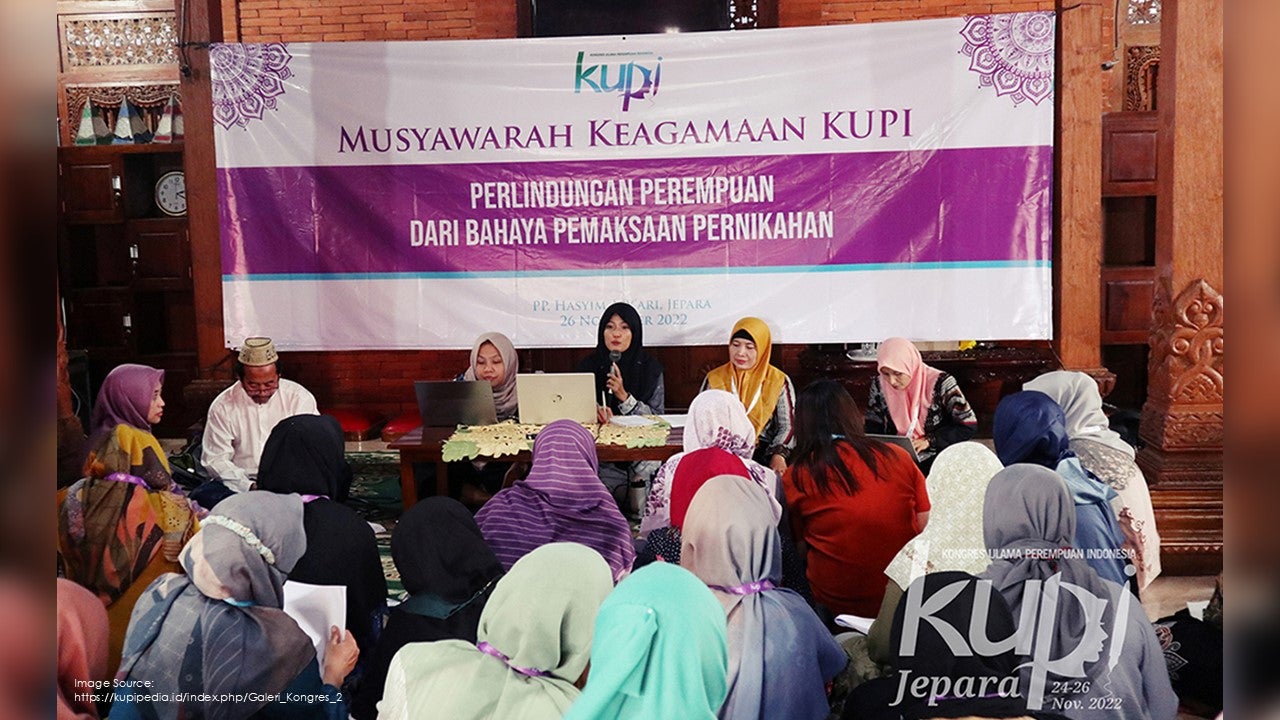
The Congress of Indonesian Women Ulama (KUPI) has emerged as one of the most significant developments in contemporary Muslim Southeast Asia, redefining women’s roles in Islamic scholarship and public leadership. Since its inception in 2017, KUPI has combined rigorous Islamic scholarship with grassroots activism, producing fatwas (Islamic legal opinion) and public statements that address urgent issues such as sexual violence, child marriage, environmental destruction, and the protection of marginalized communities. These interventions are grounded in both classical Islamic sources and lived social realities, positioning KUPI as a space where religious authority is exercised by women in direct response to community needs.
This roundtable will discuss a new special issue on KUPI’s work, published in the African Journal of Gender and Religion, covering topics such as the historical roots of women’s movements in Indonesia, new methodologies for interpreting Islamic texts, the role of fatwa as an internal innovation within social movements, the formation of Islamic counterpublics in digital spaces, and external perspectives on KUPI’s achievements and challenges. Applying an interdisciplinary approach to understanding KUPI, the special issue provides insights on Indonesia’s unique trajectory and offers methodological and conceptual tools that could reshape the broader discourse on gender justice in Muslim Societies.
Participants will reflect on KUPI as both a scholarly and activist project, addressing the ways it negotiates authority within male-dominated religious institutions, builds alliances across diverse social movements, and navigates political and cultural constraints. The discussion will also consider KUPI’s relevance beyond Indonesia, asking what lessons can be drawn for other Muslim-majority contexts in Southeast Asia and globally. The roundtable invites scholars, activists, and community leaders to engage in a critical conversation about how women’s religious authority can serve as a catalyst for social change, and what the future of gender justice in Muslim Southeast Asia might look like when shaped by voices like those of KUPI’s women ulama.
ABOUT THE SPEAKERS
Kamala Chandrakirana is a founding member of KUPI’s Deliberative Assembly. A prominent Indonesian feminist and human rights advocate, she has worked at the forefront of movements for gender equality, social justice, and democracy at local, national, and global levels. She co-founded influential initiatives such as Rahima, Alimat, Musawah, and serves as a trustee of Fahmina. Her work spans women’s human rights, democratic transitions, peacebuilding, transitional justice, and community philanthropy, combining activism with deep engagement in research and policy to advance justice and equality. She is also the guest editor and author of a special issue on the Congress of Indonesian Women Ulama in the African Journal of Gender and Religion.
Fatima Seedat is Associate Professor and Head of the Department of African Feminist Studies at University of Cape Town, and she holds a PhD in Islamic Law from McGill University. She is the editor of the special issue on the Congress of Indonesian Women Ulama. Her teaching and research sit at the intersections of sexuality, law, and religion, with a focus on Muslim feminist readings of gendered legal subjectivity, African feminism, and feminist decolonial research methodologies and design.
Azhar Ibrahim is Senior Lecturer at the Department of Malay Studies, National University of Singapore, where he teaches Malay-Indonesian literature and ideologies of development. His research interests include sociology of literature, social theology, Islamic thought, critical literacy, and Malay-Indonesian intellectual development. Among his published works are Emancipated Education (2020), Historical Imagination and Cultural Responses to Colonialism and Nationalism: A Critical Malay(sian) Perspective (2017), Contemporary Islamic Discourse in the Malay-Indonesia World (2014) and Narrating Presence: Awakening from Cultural Amnesia (2014).
Erica M. Larson is Senior Research Fellow in the Religion and Globalisation Cluster at the Asia Research Institute, National University of Singapore. Her research interests include education, religion, ethics, politics, and mobilities in Indonesia and Southeast Asia more broadly. Her current research focuses on the Indonesian diaspora in Singapore in terms of the construction of identity and belonging across various groups, including students and religious networks. She is also conducting research in Indonesia among university students active in religious organizations to understand their beliefs about corruption as a lens on normative state-society relations and related notions of ethics, piety, and responsibility.
REGISTRATION
Registration is closed, and instructions on how to participate in this hybrid talk has been sent out to registered attendees. Please write to ziqi@nus.edu.sg if you would like to attend the event.