Events
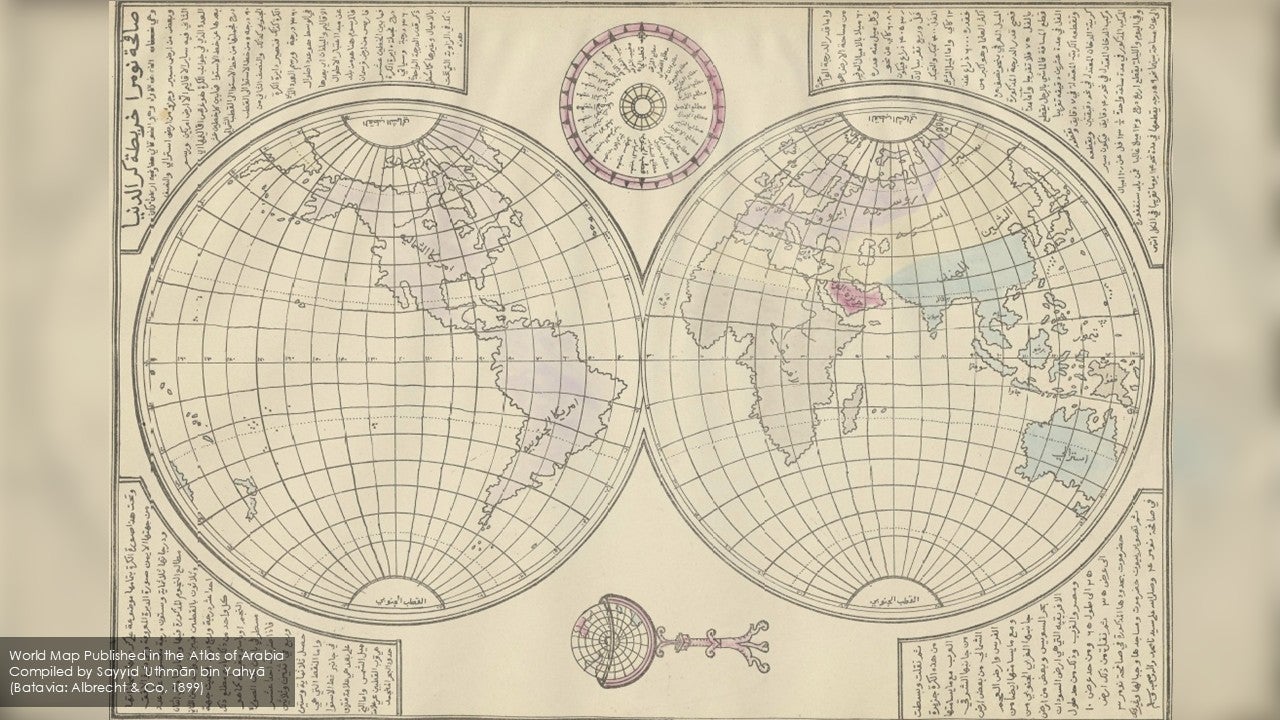
MUHAMMAD ALAGIL ARABIA ASIA STUDIES LECTURE – The Sacred is in Relatedness: Arabia-Asia as a Geography of Friendship
| Date | : | 04 Dec 2025 |
| Time | : | 18:00 – 19:30 |
| Venue | : | Ngee Ann Auditorium |
| Contact Person | : | TAY, Minghua |
This lecture is organised by the Muhammad Alagil Distinguished Professorship in Arabia Asia Studies at the Asia Research Institute, National University of Singapore. It is held in conjunction with the conference on “Exploring the Sacred: People, Place and Power in the Islamic Indian Ocean”.
CHAIRPERSON
Dr Sumit Mandal, Asia Research Institute , National University of Singapore
ABSTRACT
This lecture rethinks how we tell trans-regional Arabia-Asia histories by moving beyond familiar idioms of “flows,” “networks,” and “connectivity.” Such terms, while useful, often flatten the textures of historical life into technical metaphors, obscuring the moral and affective grammars through which people have made distant places meaningful to one another.
As a counterpoint, I turn to Tāj al-Aʿrās (The Crown of Brides), a capacious mid-twentieth-century Arabic hagiographical compendium composed in Indonesia, approaching it not as a static archive, but as a site for excavating alternative world-making schemes. Far from being a passive repository of stories, the text enacts a vision in which geography is not merely traversed but transfigured through moral relation. At its center lies the notion of wilāya—protective friendship—a complex idiom of relatedness that organizes connection through asymmetry, dependence, and generosity that exceed calculation. Within this grammar, hierarchy is not domination but a structure of hope; dependence is not weakness but a condition for dignity; and continuity is not inertia but a sacred inheritance.
The lecture explores how wilāya engenders geographical imaginaries not through coordinates or borders, but through bonds of affection, patronage, reciprocity, and care. The circulation of friends, the memory of their presence, and the ethical obligations they generate inscribe land/seascapes with meaning. Geography, in this frame, becomes a sedimentation of embodied relations—lived, remembered, and sanctified. Through this lens, Arabia-Asia emerges not simply as a space of mobility, but as a moral world shaped by remembrance, hospitality, protection, prayer, and blessing. To think with wilāya is to encounter a different conception of the trans-regional: one where relation, not connection, is primary; where surplus, not equivalence, generates value; and where historical time unfolds not in ruptures, but in the slow labor of maintaining friendship across generations. Ultimately, this lecture invites us to consider how histories of friendship might offer not only a distinct cartography, but an alternative ethics for imagining the world.
ABOUT THE SPEAKER & DISCUSSANT
Ismail Fajrie Alatas is Associate Professor of Middle Eastern and Islamic Studies, and History, at New York University, and a fellow of The Royal Aal al-Bayt Institute for Islamic Thought, in the Hashemite Kingdom of Jordan. He holds a PhD in Anthropology and History from the University of Michigan, Ann Arbor, and was formerly the associate editor of Journal of the Royal Asiatic Society. He is the author of What is Religious Authority? Cultivating Islamic Communities in Indonesia (Princeton, 2021) along with many articles, book chapters, and encyclopaedia entries. He is currently working on a new book project that explores wilāya as a form of friendship and protection in the Islamic tradition and in Muslim societies.
Harini Kumar is a postdoctoral associate at Yale University’s Institute of Sacred Music and a lecturer in the Department of Anthropology. Her research focuses on Islam and Muslim societies, material culture, gender, kinship, ethics, and mobility. She is currently completing her first book manuscript, Formations of Tamil Islam: Religious Belonging and Placemaking in South India, which is an ethnographic study of how Tamil-speaking Muslims construct Muslim subjectivity and modalities of belonging that exceed the essentializing categories of Hindu nationalist discourse. Her new project on transoceanic Muslim mobilities explores the connections between South and Southeast Asia and the Americas through the enduring legacy of a 16th century Sufi saint.
REGISTRATION
Registration is closed, and instructions on how to participate in this lecture has been sent out to registered attendees. Please write to aritm@nus.edu.sg if you would like to attend the event.