Events
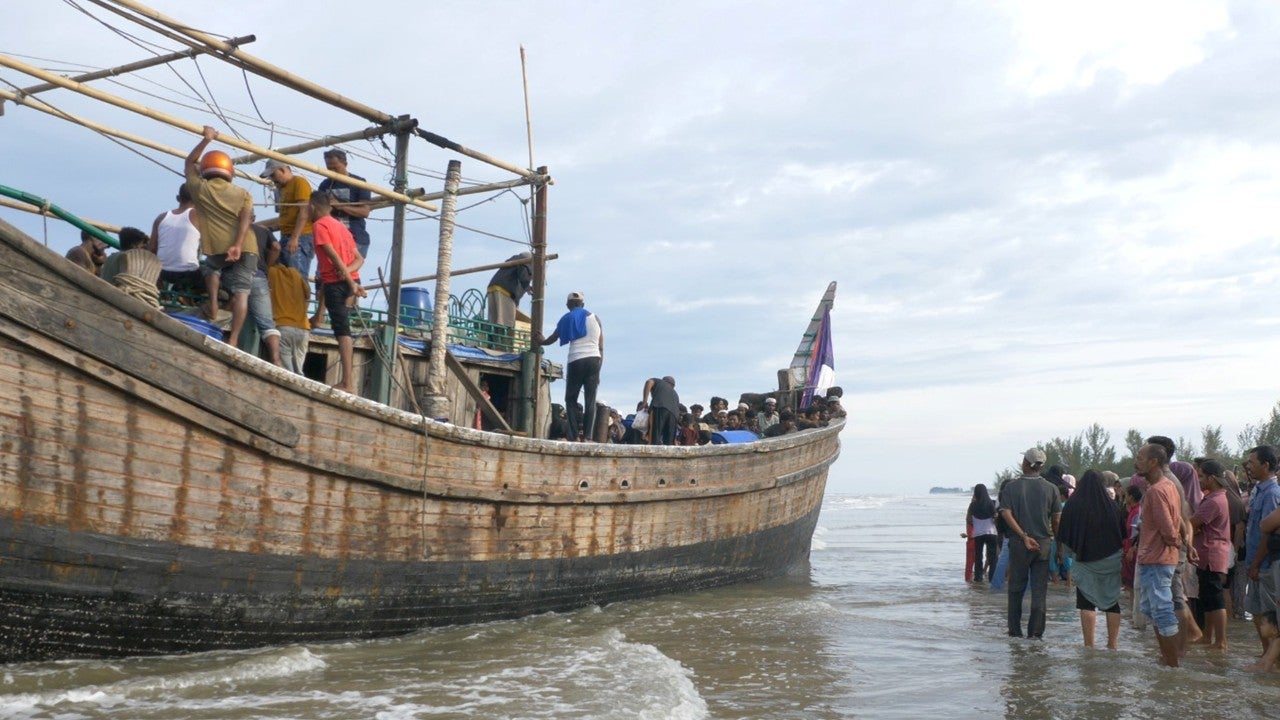
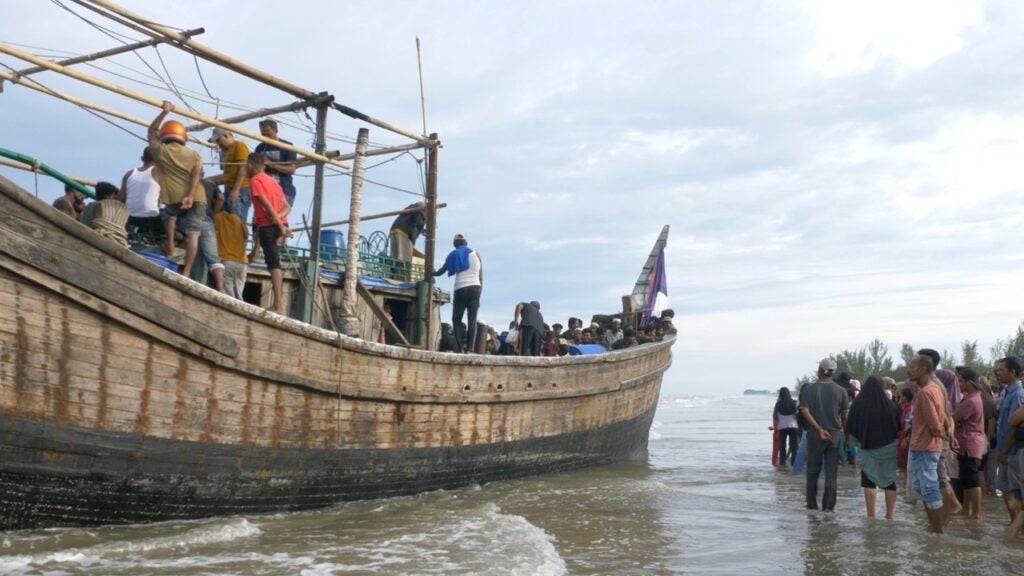
When the Water Horse Seeks a New Home
| Date | : | 24 Feb 2026 |
| Time | : | 15:30 – 17:00 |
| Venue | : | AS8, Level 4, Seminar Room 04-04 |
| Contact Person | : | LIM, Zi Qi |
Jointly organized by the Asia Research Institute, and Centre for Asian Legal Studies, National University of Singapore.
CHAIRPERSON
Prof Elaine Lynn-Ee Ho, Asia Research Institute, and Department of Geography, National University of Singapore
PROGRAMME
| 15:30 | WELCOME REMARKS Prof Elaine Lynn-Ee Ho | National University of Singapore |
| 15:35 | INTRODUCTION Prof Antje Missbach | Bielefeld University |
| 15:45 | DOCUMENTARY SCREENING When the Water Horse Seeks a New Home |
| 16:10 | COMMENTARIES Asst Prof Elliott Prasse-Freeman | National University of Singapore Assoc Prof Jaclyn Neo | National University of Singapore |
| 16:30 | RESPONSE
Mr Andrianus “Oetjoe” Merdhi | Filmmaker |
| 16:40 | QUESTIONS & ANSWERS |
| 17:00 | END |
ABSTRACT
People have travelled around the world by boat for centuries, often overcoming large distances sometimes with rudimentary means and equipment and surviving their challenging journeys by both skill and sheer luck. Maritime crossings attract more attention amongst academics and policymakers nowadays, due to their assumed and actual perilousness compared migration on land. Travelling across the sea takes place in spaces assumed to be specifically dangerous due to extreme weather and the disorienting remoteness from the mainland. Refugee boat journeys are more prone to disaster due to their lack of preparedness, technically insufficient equipment, lack of shelter en route and public oversight.
This documentary seeks to capture events that take place at sea: maritime passages of Rohingya refugees navigating the Andaman Sea. Reconstructing the events through narrative interviews with several protagonists reveals a number of uncertainties, interruptions and unexpected encounters at sea. Amidst their enforced strandedness at sea, passengers face hunger, dehydration, existential fears, and their health suffers rapidly. A specific focus of the documentary is directed at the hostile receptions of the refugees by the local population in Aceh, Indonesia, an area that itself used to produce large numbers of refugees. By following the newly arrived refugees and listening to their plans and aspirations, the documentary seeks to make plausible why Rohingya are prepared to undertake such risky journeys by boat. Besides introducing the audience to the human story behind the specific displacement of Rohingya, it also raises questions about human movement, loss, and resilience more generally.
ABOUT THE SPEAKERS
Antje Missbach is Professor of Sociology at Bielefeld University, specialising in the study of global migration and mobility. She is the author of The Criminalisation of People Smuggling in Indonesia and Australia: Asylum out of reach (Routledge, 2022) and co-editor of Refugee Protection in Southeast Asia: Between Humanitarianism and Sovereignty (Berghahn, 2024, with Susan Kneebone, Reyvi Mariñas and Max Walden). Together with Gerhard Hoffstaedter, she has been awarded a Volkswagen Foundation grant for “Theorising (im)mobilities at sea: Challenging the terra firma bias in Refugee Studies through human maritime movements”, which fosters collaborations with film makers and other creatives.
Elliott Prasse-Freeman is Assistant Professor at the Department of Sociology and Anthropology, National University of Singapore. He received his PhD from the Department of Anthropology at Yale University. He has conducted long-term fieldwork in Myanmar, and his first book, Rights Refused: Grassroots Activism and State Violence in Myanmar (Stanford University Press) on social movements in Burma was awarded the 2025 Chr Michelsen Institute’s Public Anthropologist Award. Prasse-Freeman is currently completing a book on Rohingya cultural identity and its fragmentation amidst dislocation and mass violence, with a particular focus on Rohingya maneuvers in the context of post-sovereign governmental regimes that incorporate human rights discourse, humanitarian care/exclusion, and biopolitical regulation.
Jaclyn Neo is Associate Professor at the Faculty of Law, National University of Singapore. She specializes in constitutional law, as well as law and migration. She is a recipient of multiple academic scholarships and competitive research grants. Her work aims to forefront Asian jurisdictions and mainstream them in comparative constitutional law. She currently serves on the Singapore Law Society’s Public and International Law Committee and the Singapore Academy of Law’s Law Reform Committee. She is an elected Council Member of International Society for Public Law (ICON-S) and the co-founder of the Singapore Chapter of ICON-S. Prior to joining the faculty, Jaclyn was a disputes resolution lawyer with WongPartnership and remains a consultant with the firm.
Andrianus “Oetjoe” Merdhi is a self-taught filmmaker from Jakarta. He was awarded documentary film scholarships by the Goethe-Institute in 2017 and the Robert Bosch Stiftung in 2019. Most of his films explore themes related to marginalized groups, social exclusion and racism in Indonesia. His work, Kayu Besi (2022), a film about the forests and Indigenous communities of West Papua, was screened at DOK Leipzig, and The Sole of the Flying Heron (2024), about a mystical Islamic minority group in Java, was shown at the Tokyo Documentary Film Festival. He is currently pursuing an MFA at the University of Fine Arts Hamburg.
REGISTRATION
Registration is closed. Due to limited seating capacity, this event is open to the NUS community and invited guests only.