Events
Transnational Families and Future-Making in Looming Crises
| Date | : | 04 Aug 2026 |
| Time | : | 16:00 – 17:30 |
| Venue | : | AS8, Level 4, Seminar Room 04-04 |
| Contact Person | : | LIM, Zi Qi |
CHAIRPERSON
Dr Bittiandra Chand Somaiah, NUS College, National University of Singapore
PROGRAMME
| 16:00 | WELCOME REMARKS Dr Bittiandra Chand Somaiah | National University of Singapore |
| 16:05 |
PRESENTATION 1 |
| 16:15 |
PRESENTATION 2 |
| 16:25 |
PRESENTATION 3 |
| 16:35 |
PRESENTATION 4 |
| 16:45 | ROUNDTABLE DISCUSSION |
| 17:15 | QUESTIONS & ANSWERS |
| 17:30 | END |
ABSTRACT
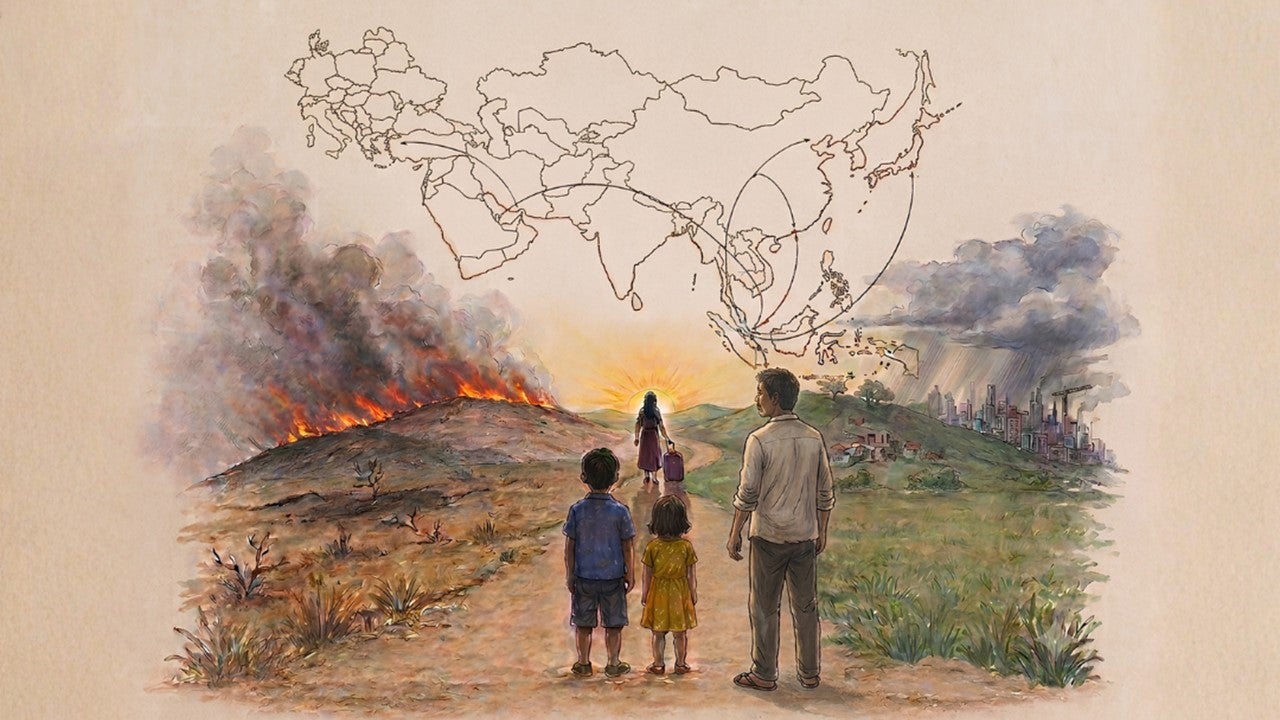
Pandemics, violent conflict and climate change have driven home a sense that the world is becoming not only uncertain but also dangerous. The apparent challenges to the post-world war liberal world order contribute to this sense of a world on the brink. Scholars talk about “polycrisis” to comprehend the entanglements of political, natural, and economic crises that converge and reinforce one another. In this roundtable, we dig into how polycrisis is experienced in the everyday lives of families and how they navigate such difficult times. We do so by exploring how crises affect futures and future-making, considering the multiple movements across borders and boundaries involved. While crisis may be analysed as chronic and mundane, climate change and other crises also hold within them the potential for disasters and even catastrophes. We ask how families and their members brace themselves for such volatile futures. We explore how they engage in future-making that is transnational, keeping options open across borders. Families tie individuals to the past through ancestry and kinship obligations. But families are also about investing in the future through various ways of caring for one another. We explore how ‘doing family’ is a means to make futures in the shadow of negative potentialities. Speakers will draw on empirical and ethnographic case studies from across Asia including Indonesia, Myanmar, Singapore, and Vietnam but will also contrast experiences from the region with ways of engaging with the future in other parts of the world, including in Burundi.
ABOUT THE SPEAKERS
Helle Rydstrom is Professor in the Division of Gender Studies, Department of Sociology, Lund University. She has a background in International Development Studies and Social Anthropology. Her research explores entanglements between crisis, precariousness, violence, and resilience with a special focus on Vietnam. She examines gendered life in various family constellations as shaped in rural areas, fishing communities, semi-urban/urban settings, and the industrial zones. She has been the PI of funded projects in which she with colleagues compares Vietnam with e.g. China, India, and the Philippines. Rydstrom has been a visiting scholar, e.g., at The Center for the Study of Gender and Sexuality, New York University, USA; The Max Planck Institute for Social Anthropology, Germany; and the Asia Research Institute, National University of Singapore. Rydstrom is the President of the Society for Critical Studies of Crisis.
Simon Turner is Professor in the Department of Sociology at Lund University. His research has focused on the experience of displacement on the one hand, and on how these displaced people have interacted with states and other public authorities (NGOs, churches, etc) on the other. Thematically, his research is concerned with the political anthropology of the state, governmentality, humanitarianism and sovereignty. Conceptually, his studies of the experience of displacement and confinement have led him to explore anthropologies of stuckness, anticipation, hope and anxiety, as well as issues of secrecy, conspiracy and invisibility. Geographically, he focuses on Burundi, Rwanda, Kenya and Tanzania.
Erica M. Larson is Senior Research Fellow in the Religion and Globalisation Cluster. She has a PhD in Anthropology from Boston University. Her book Ethics of Belonging: Education, Religion, and Politics in Manado, Indonesia (2024, University of Hawai‛i Press), draws on ethnographic fieldwork in North Sulawesi to demonstrate how schools become important sites for deliberating the ethics and politics of religious coexistence. Her current research focuses on the Indonesian diaspora in Singapore in terms of mobility and the construction of identity and belonging across various groups, including students and religious networks. She is also involved in long-term ethnographic research on Indonesian university students active in religious organizations. This research approaches young people’s attitudes and beliefs about corruption as a lens on normative state-society relations and related notions of ethics, piety, and responsibility.
Brenda S.A. Yeoh FBA is Distinguished Professor, Department of Geography, as well as a member of the Migration and Mobilities Cluster at the Asia Research Institute, National University of Singapore. She has a DPhil in Geography from University of Oxford. Brenda was awarded the Vautrin Lud Prize for outstanding achievements in Geography in 2021 for her contributions to migration and transnationalism studies. Her research interests include the politics of space in colonial and postcolonial cities, and she has considerable experience working on a wide range of migration research in Asia, including key themes such as cosmopolitanism and highly skilled talent migration; gender, social reproduction and care migration; migration, national identity and citizenship issues; globalising universities and international student mobilities; and cultural politics, family dynamics and international marriage migrants. She has published widely in these fields.
REGISTRATION
Registration is closed. However, we welcome walk-ins to join us if there are available seats.