
Events
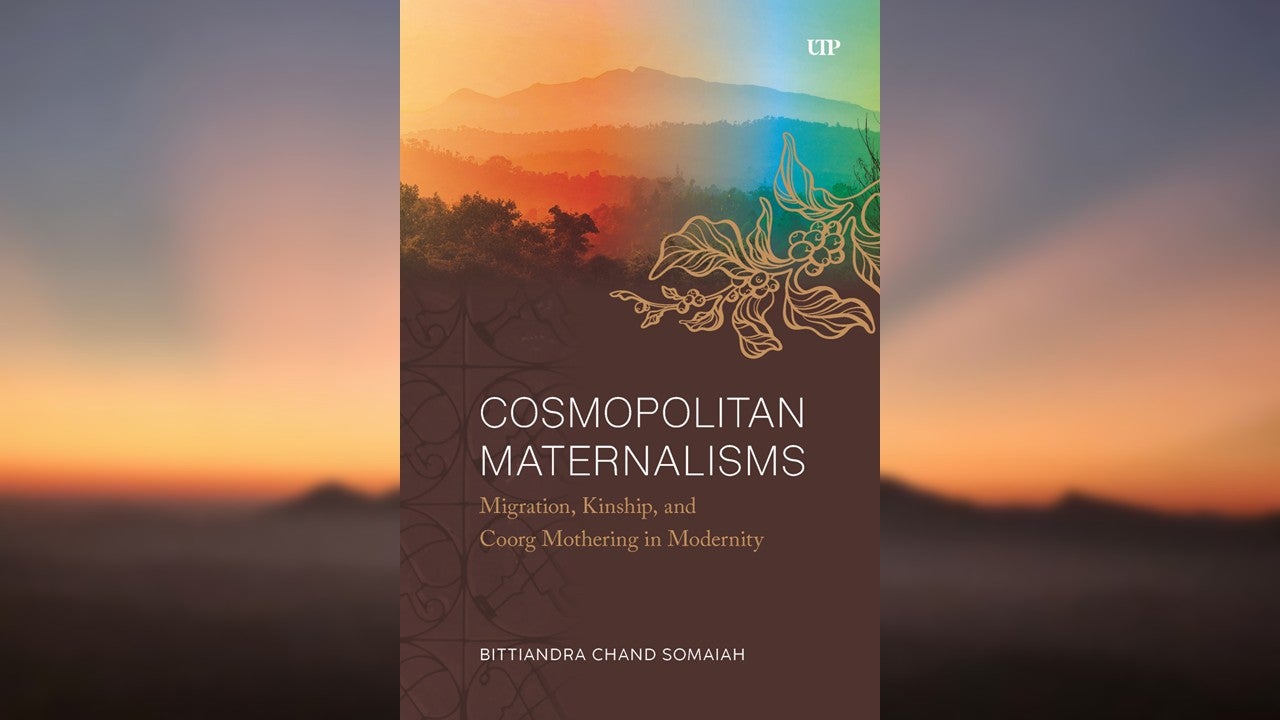
Book Discussion on “Cosmopolitan Maternalisms: Migration, Kinship, and Coorg Mothering in Modernity”
| Date | : | 12 Aug 2026 |
| Time | : | 15:00 – 16:30 |
| Venue | : | AS8, Level 4, Seminar Room 04-04 |
| Contact Person | : | LIM, Zi Qi |
CHAIRPERSON
Dr Exequiel Camarig Cabanda, Alice Lee Centre for Nursing Studies, Yong Loo Lin School of Medicine, National University of Singapore
PROGRAMME
| 15:00 | WELCOME REMARKS Dr Exequiel Camarig Cabanda | National University of Singapore |
| 15:05 | BOOK SUMMARY BY AUTHOR Dr Bittiandra Chand Somaiah | National University of Singapore |
|
15:15 |
COMMENTARIES |
| 16:15 | QUESTIONS & ANSWERS |
| 16:30 | END |
ABSTRACT
Through twofold conceptual handles new cosmopolitanisms and new maternalisms, this book discussion explores the journey of reflexive research used to make sense of social reconstructions of motherhood, migration, and kinship among first-generation Kodavathee im/migrants. Drawing on qualitative interviews with forty-three women across urban India, Singapore, and Sydney, the study examines early mothering practices done individually, relationally, and in community. The work highlights the labour of kin-keeping and peer support to pragmatically reconcile ancestral and clan commitments with the pressures of transnational modernity. Ultimately, the study foregrounds everyday adaptations of and the cultivation of selective traditions and social networks within globalized contexts. The book, Cosmopolitan Maternalisms: Migration, Kinship, and Coorg Mothering in Modernity (2025) argues that ‘cosmopolitan maternalisms’ serves as a site of negotiation, where new aspirations and culturework destabilize patriarchal middle-class gender hierarchies and transform transnational new Indian mothering. Commentators are invited to reflect upon the themes of migration, mobilities, and mothering, and the theoretical and empirical contributions of the book in relation to their own work, women’s studies, sociology, anthropology, and broader social scientific, multi-sited research in the Asia-Pacific.
ABOUT THE SPEAKERS
Bittiandra Chand Somaiah is a lecturer in the NUS College at the National University of Singapore (NUS). From 2017, she was a postdoctoral, and then a research fellow in the Migration and Mobilities Cluster at the Asia Research Institute, NUS, and remains an associate there. Her mixed qualitative methods and multi-sited research work is situated within the Asia-Pacific (Southeast Asia, India, and Australia) context. She is trained in sociology and has an enduring interest in migration, gender, and transnational families.
Vineeta Sinha is Professor of Anthropology in the Department of Sociology and Anthropology, National University of Singapore. Her research focuses on Hindu religiosity in the diaspora, religion-state encounters, religion, commodification and consumption processes, Hinduism’s entanglement with materiality and visuality, histories of sociology and anthropology, critical pedagogy, women’s structural location and leadership in academia and decolonising knowledge production. As an ethnographer, her research has focused on how Hindu communities in Singapore and Malaysia negotiate inherited traditions even as they creatively produce novel religious imaginaries in urban, diasporic sites.
Bhoomika Joshi is Assistant Professor of Contemporary South Asia at the National University of Singapore. Bhoomika is an anthropologist of the Indian Himalayas, development, mobility, caste, and gender. She is currently working on her book manuscript Attachments to Hurt, which examines the claims to ‘hurt’ and its social, economic, political, and cultural life in India. She has published her work in American Anthropologist, Cultural Anthropology, South Asia: Journal of South Asian Studies, among others. Her debut novella is Lachchi: The Newness of Nostalgia, published by Vani Prakashan in 2020.
Shivani Gupta is a lecturer in the NUS College at the National University of Singapore (NUS). She is an anthropologist interested in examining how everyday gendered experiences, in urban settings, are articulated and negotiated by marginalised genders through precepts of violence, surveillance, mobilities, fear, morality, and honour rooted in social structures. She uses ethnographic, feminist, and phenomenology approaches to investigate social issues of gender, sexuality, violence, urbanism and subversions. She has been recently awarded a grant by NUS-Sciences Po to study experiences of South Asian and Chinese migrant women in Singapore and Paris. Her primary ethnographic fieldsites are India, Singapore and Paris.
REGISTRATION
Registration is closed. However, we welcome walk-ins to join us if there are available seats.