Events
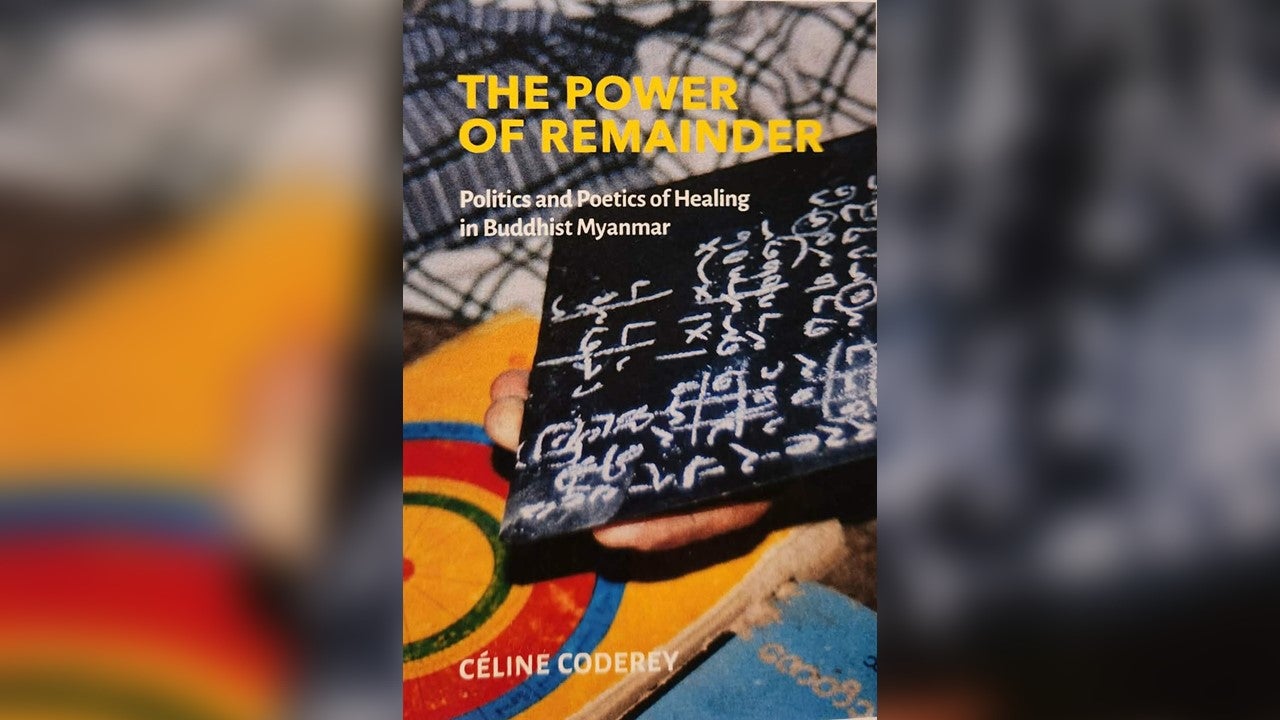
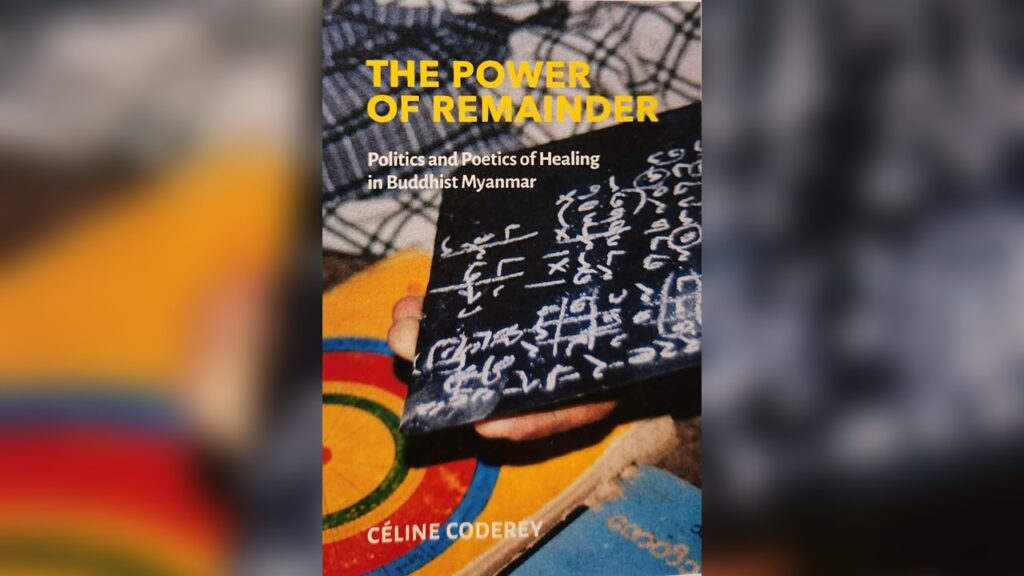
Book Discussion on “The Power of Remainder: Politics and Poetics of Healing in Buddhist Myanmar”
| Date | : | 08 Sep 2026 |
| Time | : | 16:00 – 17:30 (SGT) |
| Venue | : | Online via Zoom |
| Contact Person | : | LIM, Zi Qi |
CHAIRPERSON
Dr Catherine Smith, University of New South Wales
PROGRAMME
| 16:00 | WELCOME REMARKS Dr Catherine Smith | University of New South Wales |
| 16:05 | BOOK SUMMARY BY AUTHOR Dr Céline Coderey | University of Hawai’i at Manoa |
|
16:25 |
COMMENTARIES |
| 17:05 | QUESTIONS & ANSWERS |
| 17:30 | END |
ABSTRACT
In this talk Céline Coderey will present her recently published book The Power of Remainder: Politics and Poetics of Healing in Buddhist Myanmar (University of Hawai’i Press, 2026), which offers an innovative lens to think about health, healing, and marginality in Myanmar, addressing a significant gap in our understanding of the country’s health system and of medical pluralism more broadly. Grounded in extensive ethnographic research conducted between 2004 and 2019 among the Buddhist communities of Rakhine, the book explores their rich and diverse “medical repertoire,” and suggests that the necessity for diverse healing approaches is driven not only by the desire to live and thrive, but also by the categorizations and hierarchies imposed on medical practices, knowledge, and people. Shaped by governance and nation-building, these categorizations affect how healers deploy resources and how users access them—ultimately influencing their effectiveness.
At the heart of the work lies the concept of the “remainder,” which reimagines healing as a process of navigating what is left behind, left out, or left unresolved. Far from being merely constraining, these remainders open a creative space for resilience, adaptability, and hope—a duality where marginalization gives rise to innovation.
By bridging religious studies and medical anthropology, Coderey dismantle traditional disciplinary silos, showing how the boundaries of medicine and Buddhism are locally constructed, negotiated, and transcended, reflecting and affecting values and therapeutic action.
ABOUT THE SPEAKERS
Céline Coderey is Visiting Researcher and Lecturer at the Department of Anthropology, University of Hawai’i at Mānoa, and Research Associate at the Asia Research Institute, National University of Singapore. Since 2005, she has studied medical pluralism in Myanmar, examining healthcare limitations amid political violence, the circulation of pharmaceuticals, and the roles of Buddhism and astrology in local healing, as well as HIV, mental health, and reproductive health. Her current project explores cultural revival in Oceania through dance and traditional navigation, engaging with Oceanic epistemology in relation to decolonization and ecological sustainability. Her publications appear in Medical Anthropology, Modern Asian Studies, and the Journal of Southeast Asian Studies, among other venues. Her humanitarian work spans psychosocial support, education for displaced youth, gender-based violence research in Myanmar and Bangladesh. In Hawai’i, she volunteers with the Polynesian Voyaging Society and participates in Mālama ʻĀina activities.
Maitrii Aung-Thwin is Deputy Director of the Asia Research Institute, Associate Professor of Myanmar/Southeast Asian history and Convener of the Comparative Asian Studies PhD Programme at the National University of Singapore. He has a PhD in history from the University of Michigan and his current research is concerned with nation-building, identity, public history, infrastructure, and Buddhist networks in South and Southeast Asia. His publications include: A History of Myanmar since Ancient Times: Traditions and Transformations (with Michael Aung-Thwin, 2013), The Return of the Galon King: History, Law, and Rebellion in Colonial Burma (2011) and A New History of Southeast Asia (with Merle Ricklefs et al, 2010). He served on the Association of Asian Studies Board of Directors (USA) and is currently a trustee of the Burma Studies Foundation (USA), and editor of Journal of Southeast Asian Studies.
Michael Stanley-Baker is Head of History, and Associate Professor at Nanyang Technological University, where he also teaches Medical Humanities in the Lee Kong Chian School of Medicine. He also serves as President of the International Association for Traditional Asian Medicine (IASTAM). An historian of Chinese medicine and religion, he holds a clinical degree in Chinese medicine. He is the editor of Situating Religion and Medicine in Asia, in which Dr Coderey published a chapter, as well as the Routledge Handbook of Chinese Medicine, and is the principal investigator of the Polyglot Asian Medicine project and website. His monograph, Religion and Medicine in Early Imperial China, examines the emergence of foundational structures of the early Chinese religiomedical marketplace.
REGISTRATION
Registration is closed, and instructions on how to participate in this online talk has been sent out to registered attendees. Please write to ziqi@nus.edu.sg if you would like to attend the event.