Yoga Prasetyo


I’m currently working with Prof. Brenda Yeoh on the third wave of CHAMPSEA, ARI’s longest-running research project that looks into the impacts of long-term parental migration on children who remain in their country of origin. The project began in 2008 and involved children aged 3-11 in various locations across four Southeast Asian countries. One of these study sites is the East Javanese town of Tulungagung, where I was born and raised.
I could’ve been an ideal participant in this study as I too was a “left-behind” child. My mom left for Singapore in 1997 to work as a domestic worker, so by the time this project began, I’d spent 11 years growing up in her absence. Such prolonged separation quietly settled into our everyday life, reorganising our familial roles. Unfortunately, I was never identified by the researchers, and even if I’d been, I would’ve fallen just outside the eligible age range as I was 13 back then. What continues to amaze me is that 18 years later, fate somehow led me to CHAMPSEA, now as a researcher studying the lives of individuals whose experiences closely echo fragments of my own.
 Taken in the early 2000s, mum stands in front of a housing complex on Singapore’s east coast.
I was barely two years old when my mom migrated to Singapore, a decision that seemed like the final turn in a long chain of misfortunes. She’d been deceived into marriage, only to discover after getting pregnant with me that her husband was already married and had two children. Then one night, her husband vanished without a trace, never to be seen again. My mom was absolutely shattered, yet she gathered herself with remarkable resolve. Just a week after giving birth, she found a job at a local factory to keep us afloat. After a long stretch of struggle, life slowly began to steady, but this didn’t last long. In 1997, a financial crisis swept through Asia, and the factory drastically cut back its operations. Production slowed, wages dropped, and my mother, like many others in the village, lost her job. Soon enough, our small family was pushed back into the depths of poverty.
As the crisis deepened, stories about overseas work began to circulate through the village. Along with other young women, my mother hurried to secure a job through a local calo (agent). When she finally learned that she’d been offered a job as a domestic worker in Singapore, she arranged for me to stay with my uncle, a security guard at a local high school, and my aunt, who was lucky enough to keep her job at a cigarette factory. My mom had no real choice but to leave me behind. Indeed, for low-paid migrant workers across Asia, migration regularly means stretching a family across borders, or more painfully, splitting it apart. Children like me are left with few options: to remain behind and obediently absorb the disruptions of parental absence or to be transported irregularly across borders in search of a fragile sense of family life. And although these separations are clearly produced by institutional constraints, it is individual parents who are left to carry the guilt and moral weight of being physically absent.
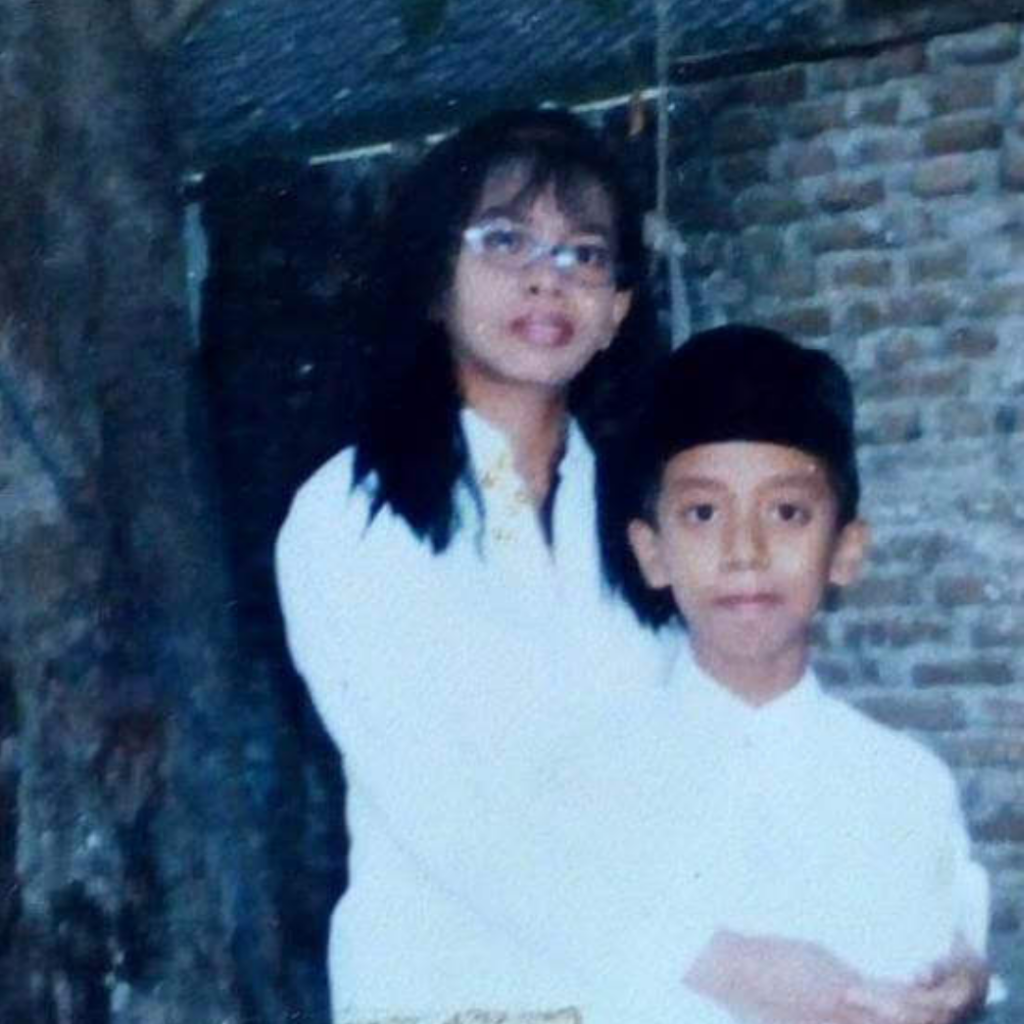 With mum during her second short visit back to Indonesia in 2006.
My mother assumed that once she started her job abroad, our lives would somehow begin to improve. Life, however, was still as difficult as ever. My mom recounted that within the first 10 years, she had to endure harassment, gnawing insults, wage cuts, and starvation. These would often push her to the brink, until leaving one employer for another became her only way of survival. Each change, though, came at a cost. New placements meant new debts, and thus large portions of her salary were deducted to repay them, so much so that for long periods, she could send nothing home at all. And because of these disruptions, I would work part-time with my aunt at a local cigarette factory just to have a little pocket money. By my first year of secondary school, I was also selling toast and snacks, teaching myself early that survival often meant finding small ways to make do.
Beyond this financial strain, those years were especially difficult because of the persistent bullying I faced. I was often singled out and targeted for not fitting my peers’ narrow expectations of masculinity. Over time, I became more withdrawn and began to find comfort in spending time on my own. In those quieter spaces, I taught myself how to bake and to write, and I began to lean toward education as a space where I felt like I could rebuild a new sense of confidence and purpose. With the unending support of my teachers and the kindness of other friends, I persevered. I worked very hard and eventually won several competitions that eventually opened the door to my undergraduate studies at the University of Indonesia.
 Some cakes, bread, and cookies I’ve made.
At university, I majored in English literature. It wasn’t because I was especially good at English or already loved books. At the time, I didn’t really speak much English and had never read a literary work of any substantial length. I chose this major for practical reasons. Back home, English proficiency was, and still is, widely seen as a route to promising employment. I guess when you grow up in poverty, education rarely feels like a space for critical thinking or abstract reflection. It is more often viewed as an exit, however narrow, from hardship.
Yet, slowly and unexpectedly, literature began to claim me. In my first two years, I struggled through the works of Nathaniel Hawthorne, Charlotte Brontë, Chinua Achebe, Ernest Hemingway, and many others, reading voraciously despite the difficulty. As I read these texts alongside writings on postcolonialism, gender, and critical theory, something shifted. I started to sense the weight of injustice, not only in the lives of the characters on the page, but also in the power structures that had hugely shaped my own life as a “left-behind” child of a low-paid migrant worker. It was during this period that my interest in migration research first took shape. From then on, I immersed myself in the field, building experience through research projects and further sharpening my skills during my MA at the University of Sussex.
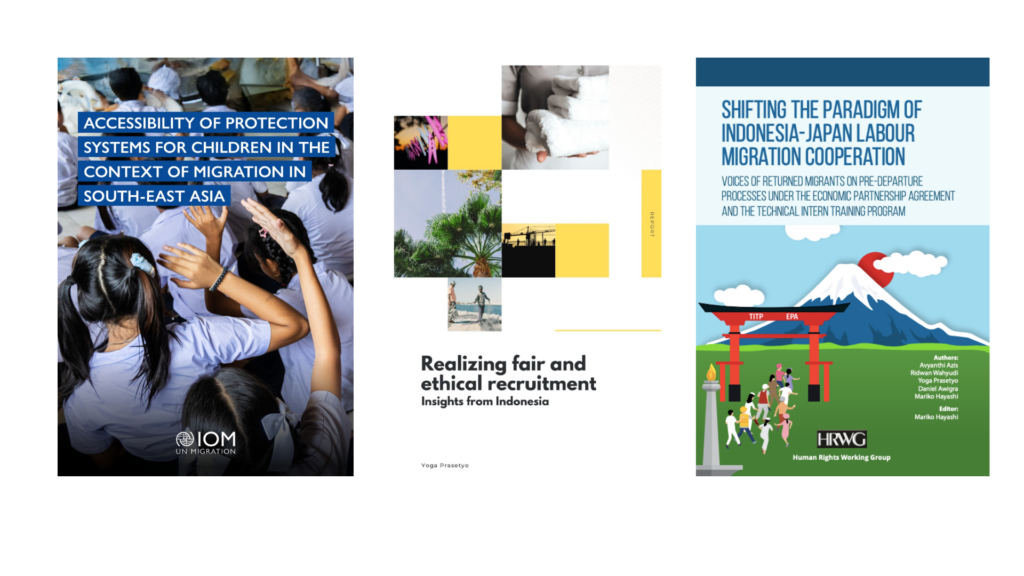 Some of my published works.
In hindsight, my turn toward migration research has never only been academic. It emerged from the uneasy overlap between personal history and scholarly inquiry. In this context, research has become my way of revisiting and exploring the questions and realities I had once lived through but couldn’t articulate yet. This overlap between lived experience and scholarly inquiry has shaped how I approach migration research—today at ARI, and soon the University of Oxford, where I’ll step into a new role as a DPhil student in Geography and the Environment in October 2026. My work as an aspiring human geographer will explore how the state uses urban infrastructure to create conditions of irregularity and precariousness for children of migrants in the Malaysian state of Sabah, and how these children, in turn, carve out spaces for learning, play, and work as they grow up.
While I am very excited about this project, I also feel a sense of quiet apprehension. In many ways, this doctoral project mirrors my own childhood: both my early years and the lives of these children have been shaped by temporary migration regimes. However, I am no longer the bullied, poor, and scared child trying to make sense of absence and loss. In fact, I now have the ability to speak, write, and learn within the walls of elite universities like NUS and, later, Oxford, benefitting from institutional support and some degree of security that these children do not. As I move forward, I hope to be keenly aware of how this shift in my social position might shape what I notice or overlook, the questions I ask, and the ways my new privilege might influence how I interpret the world. I will strive to keep that awareness alive, so that my research remains honest to the experiences of the children I aim to understand.
The views expressed in this forum are those of the individual authors and do not represent the views of the Asia Research Institute, National University of Singapore, or the institutions to which the authors are attached.
 Yoga Prasetyo is a member of the Migration and Mobilities cluster at the Asia Research Institute, National University of Singapore. His research interest lies in how illicitness is constituted and contested through urban infrastructure under Southeast Asia’s temporary migration regimes.
Yoga holds a Bachelor’s in English Literature from the University of Indonesia and an MA in Migration Studies from the University of Sussex. His Master’s dissertation has won the UK Royal Geographical Society’s PopGRG Bob Woods Postgraduate Dissertation Prize, the Journal of Ethnic and Migration Studies (JEMS) Best Dissertation Prize, and the UK Development Studies Association Master’s Dissertation Award (Highly Commended).
CHAMPSEA Publications
https://ari.nus.edu.sg/champseapublications/
Prasetyo, Y. (2025) Migration and the traps of legality. Perth: Portside Review.
Prasetyo, Y. (2025) Integration-transnationalism nexus in the context of enforced transience: Managing racial harmony and temporary labor migration in Singapore. SCMR Working Paper Series No. 105.
Prasetyo, Y. (2024). Accessibility of Protection Systems for Children in the Context of Migration in Southeast Asia. Geneva: International Organization for Migration.
Prasetyo, Y. (2024) ‘How do we study the social integration of temporary migrants’, in Horwood, C. and Frouws, B. (Eds.), Mixed Migration Review 2024. Geneva: Mixed Migration Centre.
Sutrisno, A., and Prasetyo, Y. (2022) ‘Education and the lack therefore: Indonesian transnational identity and migration journey’, in Sahoo, A. K., Routledge Handbook of Asian Transnationalism. 1st edn. London: Routledge, pp. 157–170. doi:10.4324/9781003152149-15.
Prasetyo, Y. (2022) Realizing fair and ethical recruitment: Insights from Indonesia. Brussels: International Trade Union Confederation.
Prasetyo, Y. (2020) ‘Pre-departure processes of nurses and care workers’ migration under the Indonesia-Japan Economic Partnership Program’, in Hayashi, M (Ed.) Shifting the paradigm of Indonesia-Japan labour migration cooperation. Jakarta: Human Rights Working Group, pp. 29-42.