

Catholic Older People in Indonesia and Hybrid Mass Post-COVID
contributed by Valentina Yulita Dyah Utari, 28 July 2025
On June 21, 2023, Indonesian President Joko Widodo (Jokowi) issued a presidential decree declaring the end of the COVID-19 pandemic status in Indonesia. This decree ended the Large-Scale Social Restrictions (Pembatasan Sosial Berskala Besar, PSBB) that had been in place since April 2020. These restrictions included a) closures of schools and workplaces, b) limitations on religious activities, and c) restrictions on public gatherings and activities in communal spaces.
The PSBB was in effect when the Catholic Church in Indonesia was preparing to observe the Holy Week rituals in 2020. To comply with government regulations, the Church decided to celebrate these events in a simplified manner without gathering congregations. Catholics participated in the Holy Triduum (the three solemn days leading to Easter) by attending live-streamed masses on platforms such as YouTube. The masses were also aired on government TV and radio stations: TVRI and RRI. Gradually, Catholic churches across Indonesia began broadcasting regular online masses to follow PSBB guidelines; “liturgical televisuality” started to become a norm in the Catholic Church in Indonesia. Non-mass services were also conducted online; for instance, groups like the Komunitas Mondial Meditasi di Indonesia (Christian Meditation) held their regular meetings and Christmas celebrations over Zoom.
Now that Indonesia has transitioned to endemic COVID, people are slowly returning to their pre-pandemic routines. However, they have also adopted some aspects of their pandemic routines. The Catholic churches in major cities, for example, have retained practices established during the pandemic, such as offering hybrid masses or Bible classes online. This article discusses the experience of my aging parents, who have benefited from these post-COVID arrangements. While their experience may not represent all Catholics in Indonesia, it highlights the positive impact of hybrid masses on the lives of older Catholics in the country. In this post, online mass (in the post-pandemic situation) refers to a hybrid mass. There has been no exclusively online mass since Indonesia lifted the pandemic status.
This article presents an anecdotal investigation of older people attending online mass post-COVID in Indonesia. However, comments posted by people attending online masses held by Catholic parishes in Indonesia suggest that my parents’ experiences are shared among other older Catholics. This investigation is situated in a broader-focused study that includes observations and primary and secondary source data. My primary data comes from my parents’ written answers. I wrote nine questions to my parents and asked them to answer them in writing so that they could answer my questions at their convenience. In addition, writing down the answers was very helpful for my mother, who has hearing problems.
My parents: living arrangements and church activities
My parents, father (82) and mother (76), are former Catholic school teachers. They lived alone in Surabaya, East Java, until my brother's family moved back in with them seven years ago. Two years ago, I also returned home. While my brother and I provide some assistance, they remain largely independent. Our sister, living in Kalimantan, stays connected through weekly family video calls with our parents and her daughter.
My mother fills her retirement life with taking care of domestic chores, particularly cooking and gardening. She will finish the day's newspaper and complete her daily Bible reading before busying herself with care work. In her early retirement days, she taught Sunday School for Catholic children who lived in our housing complex at our home, so that the children did not have to travel far to the church parish's Sunday school. The church parish is 7.5 kilometres from our house, and the transportation is unreliable.
Meanwhile, my father has scheduled prayers and meditations in the morning, noon, and early evening. He takes up some house chores, particularly ironing. Before the COVID-19 pandemic, he regularly attended Christian Meditation meetings at a Catholic church 12 kilometres from our house, on the outskirts of Surabaya. This Christian Meditation group has switched to a fully online meeting over Zoom since the pandemic.
My parents’ home is 10-15 minutes by taxi to one of our parish’s five chapels. They were previously central to the chapel's older people group, which has been dormant since their last meeting in 2020 before the pandemic restrictions went into effect. My mother was the group's leader, and my father was the group's secretary.
Active participation in social activities, whether within the church community or the non-church community, is an integral part of the communal life principles upheld by my parents. They set an example by engaging in activities within our urban neighbourhood and church groups, while also dedicating themselves to their profession as teachers.
How do my parents describe their experience in attending online mass?
My mother remembered clearly that on March 17, 2020, there was an announcement that Catholic churches in Indonesia were closed because COVID-19 was spreading widely. My mother wrote, “We had the (first online) mass in the open area near our kitchen. Father Dodik from the Church of Christ the King celebrated the mass.” During the Holy Triduum in April 2020, my parents attended masses online. My brother set up the laptop and internet connection to ensure my parents could observe the Triduum celebration smoothly. As in other places where many community members cannot afford the technology, my parents and brother shared the laptop with two older neighbours. These neighbours went to my parent's place and attended the mass together with my parents and brother. Much later, the son of one of these neighbours occasionally helped my parents with the internet connection when my brother was not around.
My father wrote that he appreciates attending daily mass online because this option is cost-effective and less exhausting for older people. This habit began during the pandemic and continues today, although my parents still prefer in-person mass when possible. I once teased my father, saying he was “rich” enough to visit churches across Java and beyond—just by moving the computer mouse!
Over time, my parents have become regular viewers of two church YouTube channels: Pusat Pastoral Samadi Jakarta (PusPas) and Kapel Gotong Royong Surabaya. They attend PusPas’s 6:30 AM daily mass, which fits my mother’s routine, and my father enjoys its Thursday evening variety show spotlighting parishes across Indonesia. He finds the channel easily using search terms like “misa 27 April 2025 pagi 06.30.” Although PusPas is in Jakarta—eight hours by train—they follow it closely and even ‘rate’ the priests’ homilies like regular parishioners.
For online Sunday mass, my parents join the 10:00 AM livestream from Kapel Gotong Royong Surabaya—a time that feels just right, not too early or too late. If they miss the Kapel Gotong Royong Sunday morning mass, they will attend the late afternoon mass on another parish's YouTube channel. They typically exchange their thoughts about the masses they are attending. They are excited, for example, to see the long queue of children waiting to get the priests’ blessings or the number of communion assistants at the masses.
An online mass seems to offer my parents a different level of intimacy with God because they have fewer disruptions when preparing themselves to attend the mass. After the mass, my parents would reread the mass readings or pray in silence. Sometimes my mother shares her thoughts on the homily they have just listened to with my father, connecting the main points of the homily with, for example, the previous night’s news on corruption cases in Indonesia. For my father, online mass helps him to be at the mass on time. Meanwhile, my mother feels that attending daily online mass supports her in expanding her understanding of God’s words because she has the time to read the mass readings before and at the mass and contemplate them after the mass.
Speaking of disruptions, before leaving our house to attend an in-person mass, we are likely to experience some ‘dramas.’ My mother would be busy checking various things in the house, e.g., whether the stove is off, the doors are properly locked, or the rice cooker is on. My father would be relentless in seeing my mother take her time attending to that stuff. My father does not like to be late for church. My father’s impatience would make my mother feel annoyed; she would be telling him to order a taxi and wait for it at the porch rather than “standing in the middle of the living room and making me (my mother) anxious.” After an in-person mass, instead of having extra time to pray in silence or exchange ideas about the priest’s sermon, my parents would greet and talk to other members of the church, especially fellow older people.
On Christmas Eve 2024, we were ready to leave for 6 PM mass at our chapel. My sister’s family had traveled from West Kalimantan to be with us, and my parents were excited. But with heavy December rain and no taxis available, we stayed home and joined the PusPas online mass instead. My brother set up the speakers and internet, and at some point, we all changed into casual clothes—perhaps choosing comfort and togetherness. Still, we sat quietly and followed the Eucharist with focus.
Are there disadvantages to attending online masses?
Although grateful for online mass, my parents feel something is missing. This virtual face-to-face lets them see and hear the priest—almost like he is in the same room—but it cannot replace being physically present. They miss going to church, greeting others, and having brief conversations after mass.
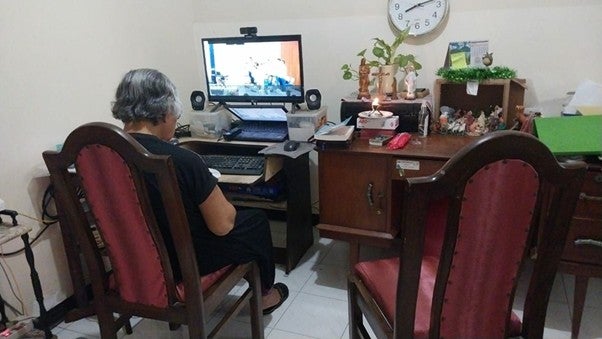
Figure 1. My mother participated in an online morning mass by herself because my father was sick. She sat in the chair where he usually sat. (Credit: author)
The loss of the opportunity to receive Holy Communion is also a shortcoming of online mass. However, Doa Komuni Batin, or the Spiritual Communion Prayer, helps them to maintain their connection with God during the Eucharist. In 2020, Pope Francis encouraged Catholics to say the prayer from home when many could not attend mass in person. In Indonesia, a musical version of the prayer is often used in online and hybrid masses—sometimes just the text is shown, other times the music is also played. My parents read the text on the screen and sing along, though my mother feels that reciting the words helps her connect more deeply with God, Jesus, and the Holy Spirit. Still, she always sings the song with her full voice.

Figure 2. My parents sing the spiritual communion prayer. Different cover versions of the song can be found on YouTube. (Credit: author)
Another shortcoming of not attending an in-person mass is that my parents often miss the death announcements of members of the church congregation. When they join online masses from other parishes, the names are often unfamiliar, so the announcements feel distant. Our family discusses death in quite a relaxed way, such as talking about whether my parents will choose to be buried or cremated—a conversation that might be considered taboo for other Indonesians. Nevertheless, missing the death announcements of their close friends or fellow older people sometimes makes my parents sad.
The Indonesian Catholic Church’s decision to offer online mass post-COVID-19 pandemic: what’s next?
In Indonesia, Law No. 13/1998 guarantees the rights of older persons, including the right to spiritual and religious services. The formation of the Commission of Older People in Catholic Dioceses in Indonesia is a crucial step for the Catholic Church in Indonesia in providing care for older individuals. The attention of the Catholic Church at the global level was drawn to older people at the 2020 International Congress on the Pastoral Care of Older People, with the theme "The Richness of Many Years of Life."
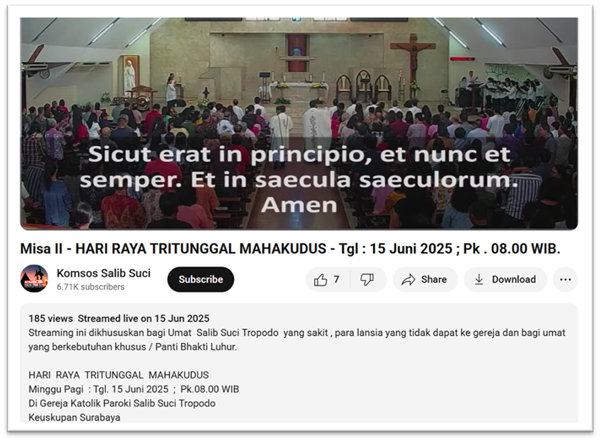
Figure 3. The description of this livestreamed Sunday mass reads: This livestream is intended for the Salib Suci Tropodo congregation members who are ill, older people who cannot go to church, and those with special needs/Panti Bhakti Luhur. (Source: Komsos Salib Suci Youtube Channel)
In 2021, Pope Francis established World Day for Grandparents and the Elderly. The day is celebrated annually on the fourth Sunday of July, near the memorial of Saints Joachim and Anne, Jesus' grandparents. Pope Francis emphasised the importance of restoring the dignity of older persons and building bridges across generations. The Pope also reminded the Catholic Church that there should be a significant change in caring for older people. Besides providing temporary assistance or programs to older people, the Catholic Church must involve older people in playing an active role in the Church and in society. The decision of the Catholic Church in Indonesia to continue offering a hybrid mass to its congregation represents the Church’s intention to involve older Catholics in Church life.
To my father, the Indonesian Catholic Church's decision to hold online masses "fulfills the hopes of older people [and] those unable to go to church, [as well as those who are] sick." My father hopes that healthy people will choose to attend mass in person at church, as he prefers to attend mass in person at church. My mother appreciates the Indonesian Catholic Church's decision to offer online mass. In her opinion, this decision signifies that the Catholic Church understands the physical and psychological conditions of older people. My mother is a diabetic and needs her insulin shot every day between 6 PM and 8 PM. Depending on people’s situation and preference, online mass offers flexibility for people to continue their medication routine during the mass. If she must attend a mass at our chapel at 6 PM, for instance, my mother might choose not to get her shot until the mass is over.
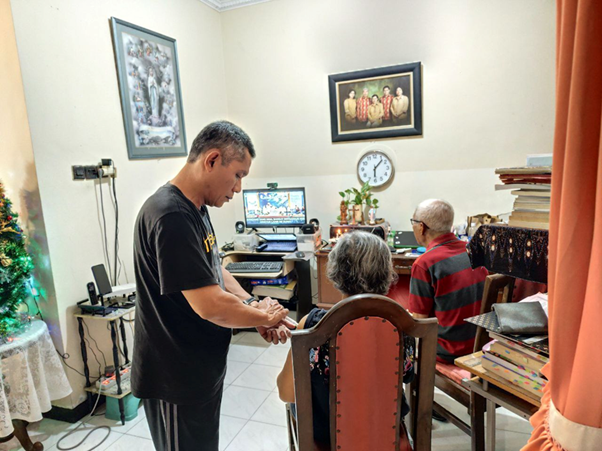
Figure 4. My brother gave my mother her daily insulin shot during our Christmas Eve mass in 2024. The mass started at 6 PM. (Credit: author)
The decision of the Indonesian Catholic Church also shows that they stand with people with limited economic resources. In the context of our family, a monthly internet subscription is much more affordable than transportation to church for daily and Sunday mass. My parents admit they have privileges because we, their children, support them to access the internet, which is crucial in attending online mass.
The next question is how the Catholic Church in Indonesia can reach other older people who do not have resources and privileges like my parents. How can we ensure that the right to spiritual and religious services of older Catholics in the country is fulfilled? Some voices in the WhatsApp groups I follow say a “good Catholic” attends mass in person. But that view often overlooks the realities of aging, illness, or financial hardship. The Church’s online mass during the pandemic opened a door—one that should stay open for many. Spiritual care must be shaped by compassion and context, not a one-size-fits-all expectation.
Disclaimer: The views and opinions expressed in this article are those of the authors and do not necessarily reflect the position of the blog editorial team or the Asia Research Institute.
South Asia | Southeast Asia | East Asia | Other Places | Hinduism | Buddhism | Islam | Christianity | Other Religions | Pandemic Leftovers | All Posts
Valentina Yulita Dyah Utari is currently working as a senior researcher at the SMERU Research Institute. She graduated with a PhD in Asian Studies from the University of Western Australia. She is also involved in LETSS Talk, a knowledge community fighting for equality. You can find her at https://www.linkedin.com/in/valentinautari418212/ or email vutari@smeru.or.id or valentina.utari@gmail.com.