
A (brief) case of legal geography: Money changers and licences in Chungking Mansions, Hong Kong


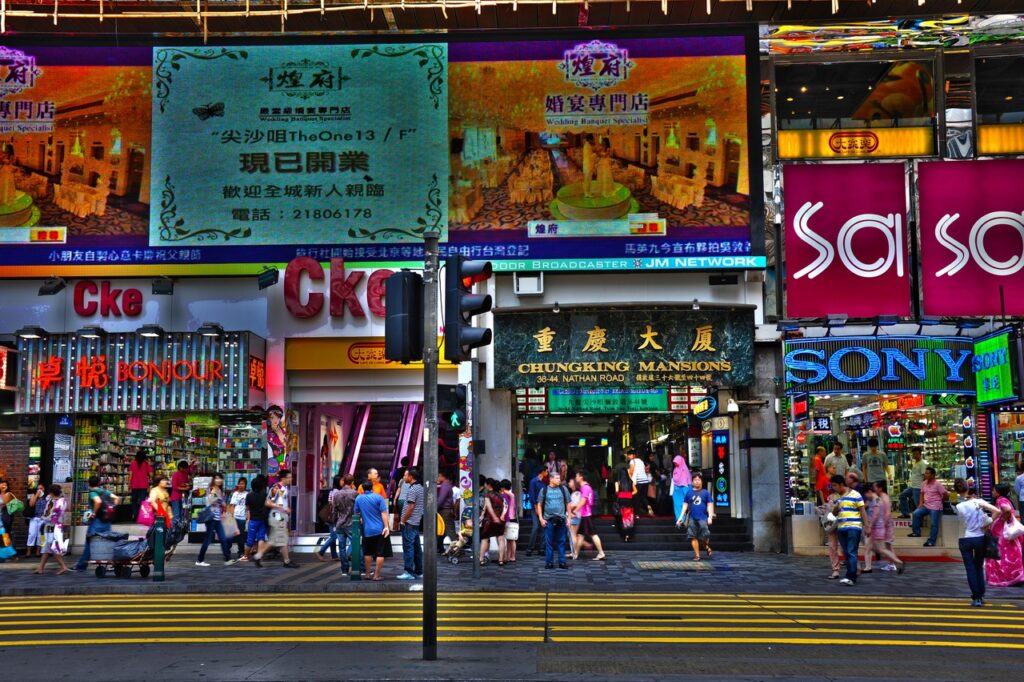 Blink and you might miss it: the entrance to Chungking Mansions.
Located in the heart of Tsim Sha Tsui (one of Hong Kong’s two central business districts) is Chungking Mansions, a place like no other. Built in 1961, the mixed-use or composite building complex consists of five apartment blocks linked by common ground and mezzanine stores. While these common floors house South Asian and African restaurants, ethnic supermarkets, electronics shops, barbershops, and sari boutiques, the apartments have largely been converted into cramped yet largely clean guesthouses and hostels. An estimated 4,000 people (almost all of them South Asian or African) live or work in the building complex, and while its façade is no longer as dilapidated or worn down as it once used to be, it certainly sticks out like a sore thumb compared to the luxury hotels and swanky malls that surround it. Small wonder, then, that its colourful history and unique atmosphere have made it a source of inspiration for filmmakers (e.g., Wong Kar-wai’s Chungking Express), food critics (e.g., Anthony Bourdain’s Parts Unknown), academics (Gordon Mathews famously deemed it a “hub of low-end globalisation”), and artists (Nana Chen has termed it “Hong Kong’s last ghetto”).
As a South Asian Hongkonger, Chungking Mansions has long fascinated me. Almost every South Asian individual with established roots in Hong Kong possesses some link to the building complex; for example, my own father worked there in an electronics trading company after he emigrated from India in the 1980s. While he had moved out of Chungking Mansions by the time I was born, we would visit it frequently to pick up groceries or visit his old acquaintances who still had businesses there. It was during these visits that I became attuned to other forms of trade – legal and otherwise – that flourished there: hotels and restaurants, garments and electronics, and bootleg Bollywood movies and counterfeit watches and handbags.
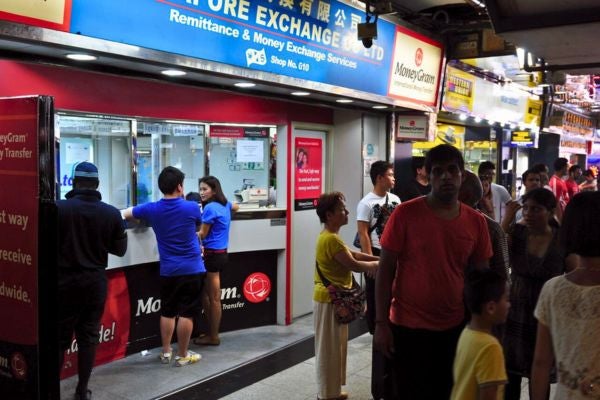
The ground floor of Chungking Mansions is filled with money exchange shops.
Therefore, in my ethnographic study of Chungking Mansions, I wanted to go beyond seeing the law as the traditional domain of legislation, courtrooms, and crime. Instead, I wished to understand how the law can be used as a tool to not only build and maintain the built environment but also govern those inhabiting it, especially if the inhabitants could be considered as “others” belonging to the urban periphery. At the same time, I also sought to learn how these “others” may—through their own normative practices and spatial behaviours—constantly conform to, replicate, or even resist such techniques of legal governance. In essence, I wanted to understand how law and urban space shape each other and how this affects power relations between the state and its populace, and Chungking Mansions was the perfect “laboratory” to investigate this.
To demonstrate this, this article looks at how one community of traders within Chungking Mansions—money changers—engage with the state through its use of the licence. While the state grants them a licence as proof that their business can be considered legally compliant, and maintains conditions and criteria under which their licence may be renewed or revoked, the money changers of Chungking Mansions do not always “adhere” to the law in entirely expected ways. Instead, for them the licence becomes a spatio-legal mechanism through which the power of the state can be validated, bypassed, and even replicated.
A licence to bill(s)
“As long as you are careful, it is okay,” says Wasim[1]. He and I are sitting at a restaurant a few metres away from his money exchange business. “You have to be able to trust people, you cannot just give it to anybody.”
“But if you know the person?”
“Yes, see, some people we know for like 20-30 years,” says Wasim, taking a careful sip of his chai. “Those people are no problem. They just let us know in advance and we are able to arrange it for them.”
“And how much are you able to transfer?”
Wasim grins. “At one time? Maybe one million, two million?”
Under Hong Kong law, money changers are required to hold a Money Service Operator License in order to own and operate a money exchange business. In order to be granted such a licence, money changers must demonstrate their compliance with the Anti-Money Laundering and Counter-Terrorist Financing Ordinance, Chapter 615 (AMLO). The AMLO grants the Customs and Excise Department the authority to decide whether anyone applying for such a licence is “a fit and proper person to operate a money service” (s.30(3)(a)(i)(A)), and enables such businesses to be routinely inspected as necessary (s.9).
Money changers who are successfully granted a licence must also adhere to the Money Changers Ordinance, Chapter 34 (MCO). Among other things, the MCO stipulates that money changers must “maintain a board displaying the current net rate of exchange offered by him to customers for both buying and selling the currencies” (s.6(1)). Furthermore, money changers, “before completing an exchange transaction by handing any currency to a customer in exchange for currency tendered by the customer, shall legibly make out in duplicate a transaction note” (s.4(1)) for their clients. Failure to comply with these arrangements can lead to a revocation of a licence, a fine, or even imprisonment.
In Chungking Mansions, money exchanges line the ground floor entranceway, and are often the first thing that people see when they step inside the building. Perhaps unsurprisingly, Chungking Mansions is often frequented by tourists and locals as a reliable place for obtaining competitive exchange rates. All of the money exchange shops have some sort of a large billboard that lists their various currencies available for exchange, which can include currencies that may be hard to find elsewhere in Hong Kong (such as Nigerian nairas or Kenyan shillings). Furthermore, although there is no legal requirement for them to do so, most money changers display their licences prominently on their shop windows as well.
Yet in addition to the conventional exchange services offered, certain money changers—but by no means all of them—also offer hawala services for certain trusted clients, who are mostly South Asian businessmen based in Hong Kong and involved in the wholesale trading of certain goods (such as electronics or garments). Instead of using bank transfers or licensed money remittance agents, such clients approach money changers to help them send or receive large amounts of money to or from individuals in countries that may be listed under rigorous anti-money laundering and terrorism financing laws (such as Cameroon or the Philippines).
As Wasim and other money changers explained to me, the process is simple. For example, if a client gives them a certain amount of money in a specific currency (e.g., Hong Kong dollars), the money changer in Chungking Mansions speaks to another money changer in their “network” who resides in the country that the money needs to be transferred to. The second money changer then arranges for the equivalent amount in funds in another currency (e.g., Philippines pesos) to be released to the recipient of the Hong Kong client’s remittance. The two money changers then add this exchange to an ongoing tab, and settle it whenever they meet next.
This raises three intriguing spatio-legal implications of the licence. Firstly, while serving as a material signifier of the state, the license simultaneously affirms and engenders a level of trust in prospective clients, whether they are interested in “counter services” or “other services” (as Wasim carefully distinguishes). While the hawala system is offered only to trusted clients who have been engaging with the money changers for some time, a number of clients have informed me that it is the licence that allows them to trust the exchangers to begin with. It is this that allows them to feel comfortable to hand over entire briefcases filled with money to the exchangers (which, unsurprisingly, also makes them targets for robberies). In this way, it is the spatial and legal association between the state and the money changer, granted by the “screening” power of the state, that paradoxically allows an undocumented transaction to take place.
The second implication is the limits of the licence in being able to contravene certain undesirable actions or behaviours. Although hawala networks are considered low risk in Hong Kong, they have long been considered a viable source of illegal or unauthorised cash transfers in other countries, whether for money laundering, terrorism financing, or even the contravention of currency export controls. Even if no contravention of the AMLO occurs in such transactions, the money changers in Chungking Mansions that do offer hawala services risk violating the transaction display or reporting requirements set out by the MCO. While there was consensus amongst the operators that certain money exchanges had been shut down or did not have their licences renewed due to short-changing clients, they confidently affirmed that nobody had been prosecuted for engaging in hawala services—even with the threat of routine inspections.
At the same time, numerous money changers informed me that they have turned away clients who they felt might misuse such services for illegal purposes, even if they offered higher amounts. The clients they knew and trusted, they said, were legitimate businessmen who wished to avoid unnecessary bank fees and delays while maintaining their low overheads. “Unknown players”, as Wasim called them, came in without any recommendation from trusted clients, seeming eager to engage in swift transactions at higher commissions. In these instances perhaps the most surprising aspect of the licence arose: in proudly (and repeatedly) referring to themselves as “licensed”, money changers replicated the role of the state by denying access to hawala services to those who would potentially abuse it. Having worked hard to earn their licence, they considered it part of their legal obligations to serve as an extension of state surveillance in regulating capital flows. Otherwise, they said, what would be the point of getting one?
The “how” and “where” of the law
Although legal geographers such as myself have long been fascinated with understanding the “how” of the law by locating the “where” of it, scholarship in the discipline has almost entirely situated itself in the West, especially North America. It is only recently that the field has sought to break away from this “placelessness” by paying attention to the unique legal geographies of different regions. As an Asian Urbanist at ARI, I therefore seek to use my work on Chungking Mansions to understand what makes Asian legal geographies distinct.
I believe the answer to this lies in framing Asia—with its histories of conflict and colonialism, its rapid large-scale development and vast inequalities, its multitude of populations and cultures, and its array of spatial typologies—as a place of spatial and legal pluralism. Legal pluralism, as a concept, suggests that there has to be more than just one “map” of the law: not just the overwhelmingly Western legal systems that dominate the modern world, but also the indigenous, religious, customary, normative, and traditional legal systems that persist alongside it, albeit at different scales and registers. What other legal geographers and I wish to bring to this is the consideration that because a space can contain multiple legal systems (often in messy and contradictory ways), it can also be simultaneously inhabited in different ways.
I believe that the money changers of Chungking Mansions demonstrate a granular example of what this spatio-legal pluralism looks like. While the licence granted by the state provides them the legal mandate to offer money exchange services, it is the entanglement between the licence and their own normative practices and customs that provoke unique spatio-legal effects. Consequently, the humble money exchange shop can (simultaneously, even contradictorily) serve as a site of community, trust, surveillance, illicit activity, and transboundary capital exchange.
It is the charting of these types of spatio-legal effects—and the overarching desire to better understand the distinctiveness of Asian legal geography—that inspired Associate Professors Maitrii Aung-Thwin and Kah-Wee Lee and me to hold the first ever workshop on Law and Geography in Urban Asia at ARI in February 2025. Selected papers from the (incredibly rewarding and thought-provoking) workshop will also form part of a special issue on the same topic under our guest editorship in the Asian Journal of Law and Society, which will be published early next year.
Finally, the next time you find yourself wandering around Tsim Sha Tsui, please consider visiting 36-44 Nathan Road. You might just be surprised at what you find.
[1] In order to comply with privacy and ethics standards, all names in this article are pseudonyms.
The views expressed in this forum are those of the individual authors and do not represent the views of the Asia Research Institute, National University of Singapore, or the institutions to which the authors are attached.

Dhiraj Nainani
Postdoctoral Fellow
Asia Research Institute
Dhiraj Kumar Mohan Nainani completed his LLB and LLM at the London School of Economics and Political Science before earning his doctorate in law at the University of Hong Kong, where he was a Postgraduate Scholarship recipient and nominee for the Li Ka Shing Prize and Outstanding Research Postgraduate Student award. As a legal geographer, his current research focuses on examining and reframing the relationship between the law and the Asian city. He is also interested in the spatio-legality of (bio)surveillance and disease.