

Remote Choreographies: Contemporary Southeast Asian Performance Traversing Cultural and Cosmic Distance


https://doi.org/10.25542/h8wd-xa43
Abstract: Using remoteness as an analytic, this article analyses a recent work of Thai experimental dance, Mali Bucha, by Kornkarn Rungsawang, a performance piece that brings together traditional ritual with VR technology. Mali Bucha is prismatic of contemporary Southeast Asian performance in two ways. Firstly, this article contextualizes Asian arts funding models and compares Singapore and Thailand’s forms of artist support. Secondly, the use of human-centered computational technology in the piece that projects the virtual dancing Thai body into cyberspace suggests new directions for regional Intangible Cultural Heritage (ICH) projects. In Mali Bucha, remoteness becomes conceptually dynamic in considering the dispersal of contemporary Thai dance from its traditional site of production, in the transantional routes of that dispersal, and the mediation of cosmic distances between human and the divine through the use of VR technology in dance. In conclusion, the article reflects on what emerging regional dance experiments suggests about contemporary Southeast Asian culture and performance.
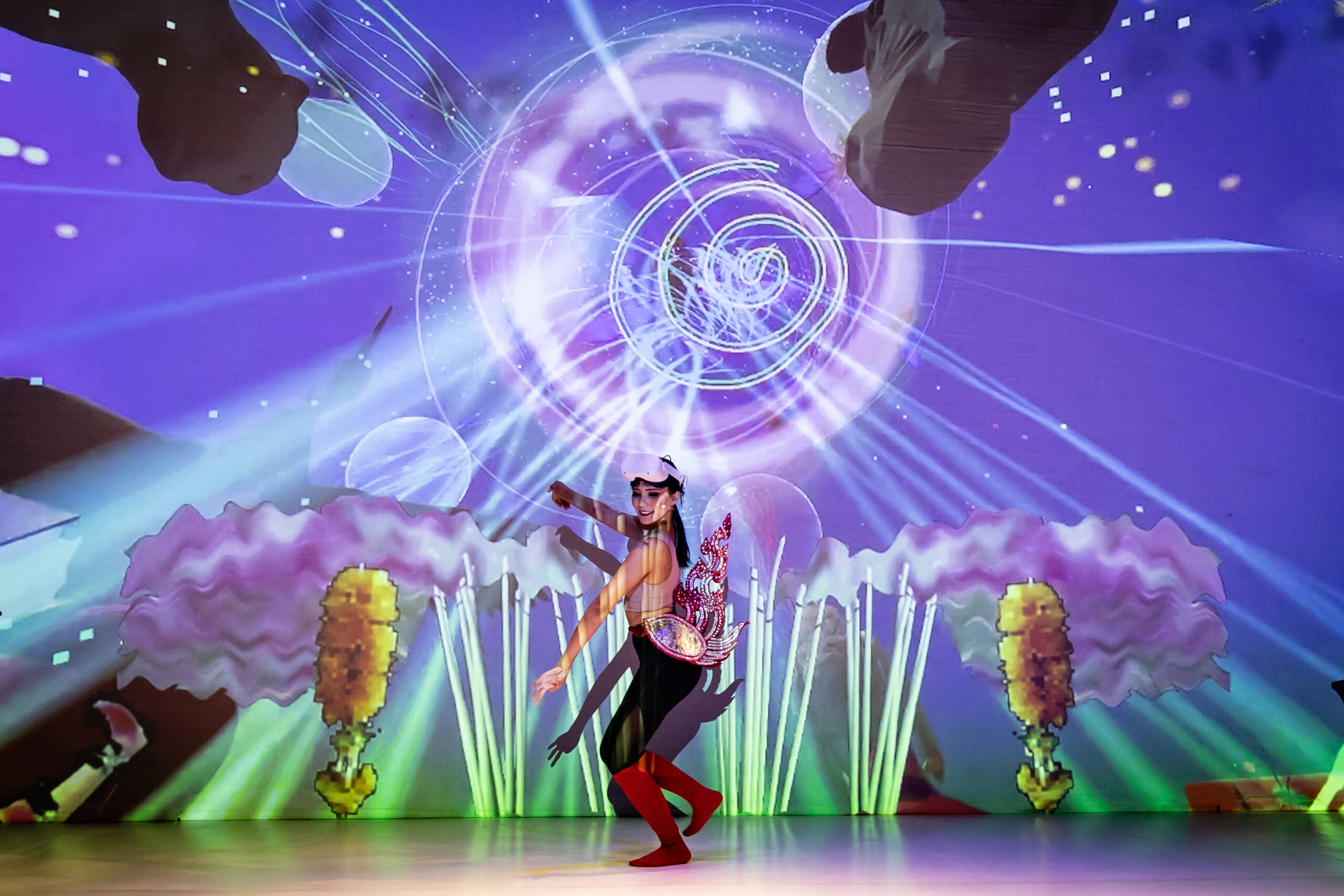
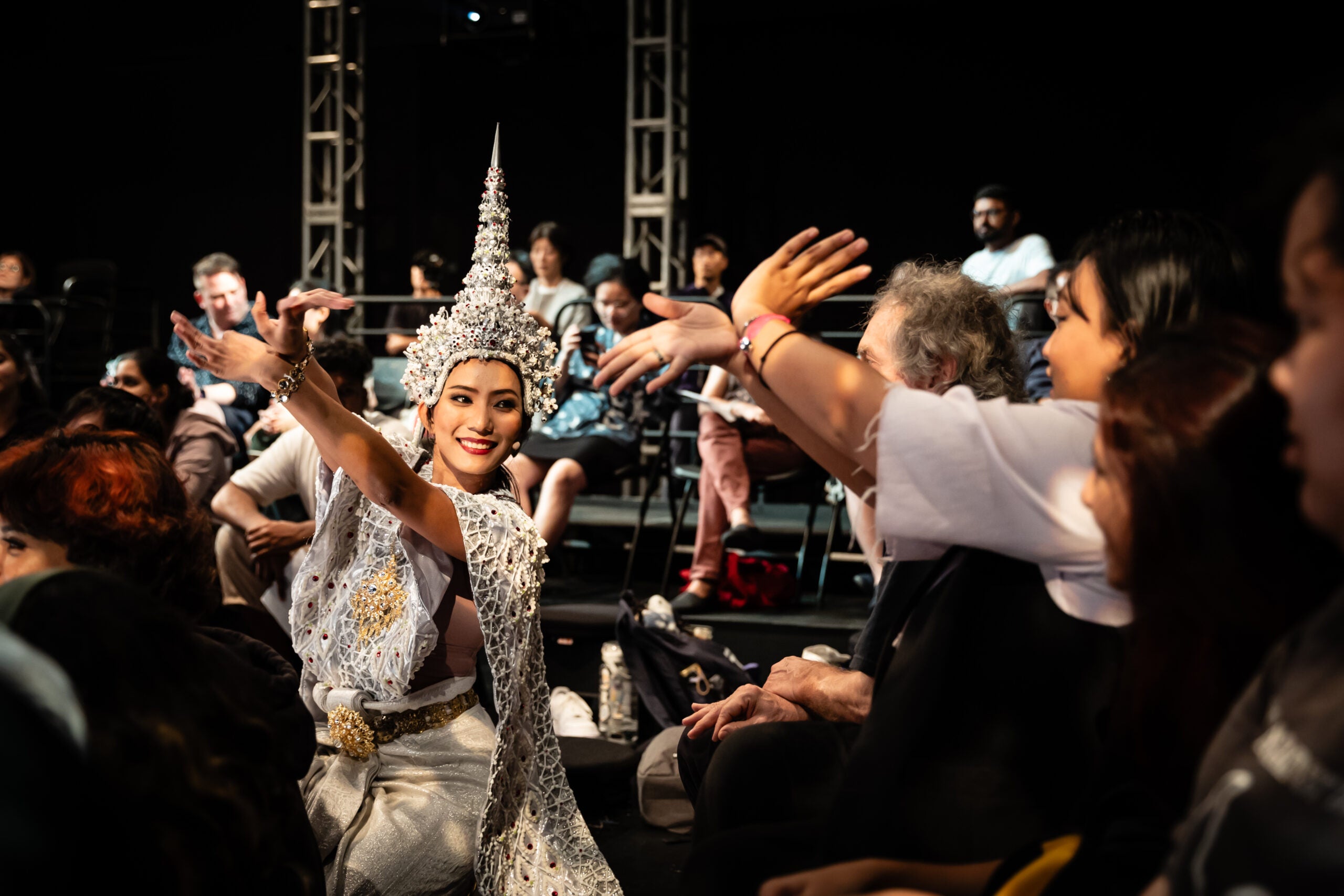
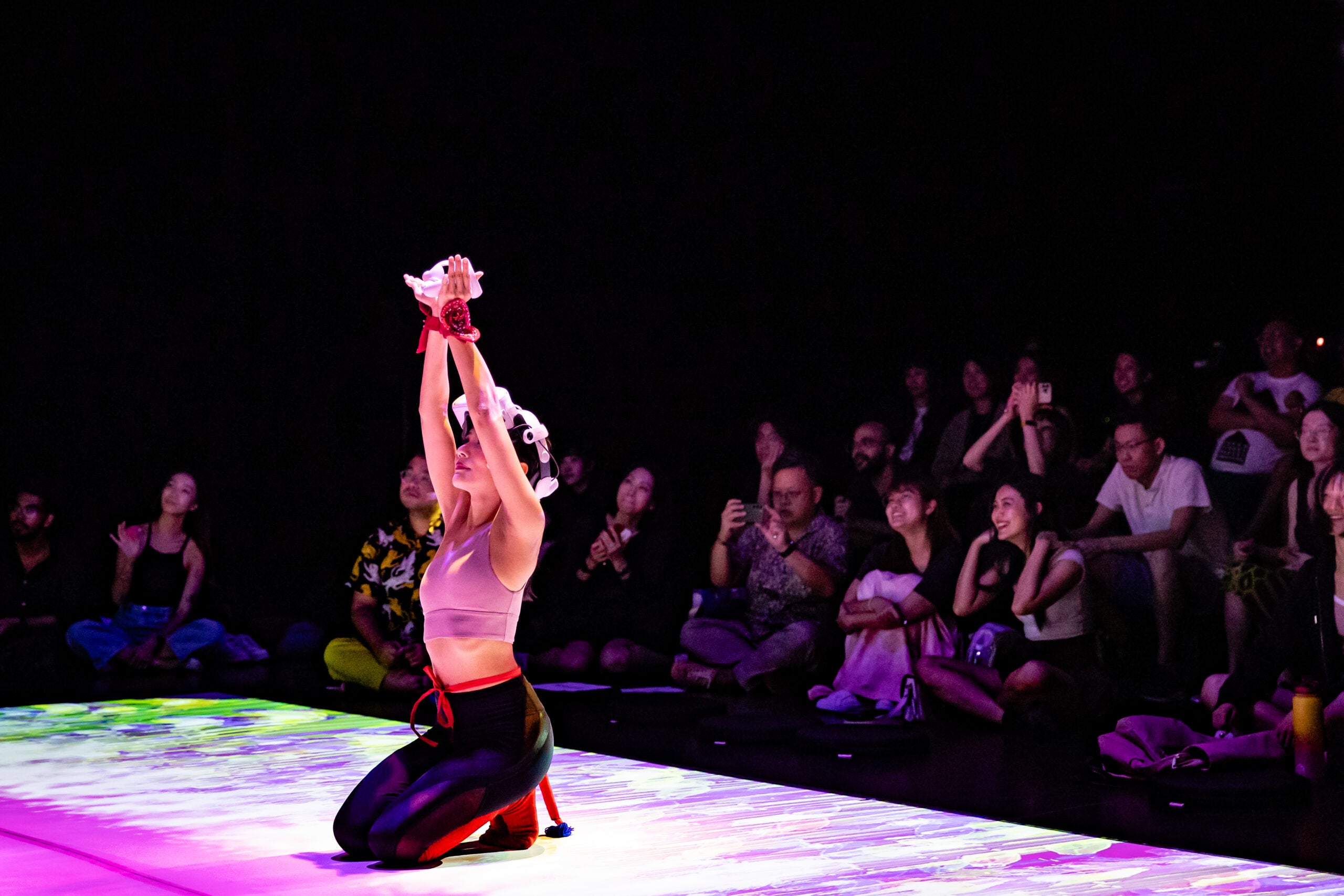
Above: Mali Bucha: Dance Offering by Kornkarn Rungsawang. Filmed on 15 October 2023 as part of da:ns focus 2023: Connect Asia Now (CAN) at Esplanade – Theatres on the Bay, Singapore.
In 2023, The Esplanade Theatres on the Bay, Singapore revamped their annual curated contemporary dance platform da:ns to five themed weekends focused on different genres of dance. These included participatory dance across a range of able and disabled bodies, Contemporary Dance, Flamenco, Ballet and Connect Asia Now (CAN). One of these genres was not like the others; CAN made explicit that its curatorial ambitions were not just to find and feature contemporary dance and performance by Asian artists, but also to “further develop Asia’s contemporary performance scene.” Asian contemporary performance is an emergent genre of western conceptual-meets-traditional Asian dance involving reflexive choreographic practices of reassembling Asian traditional dance with performance techniques derived from mid-to-late 20th century Euro-American genres of conceptual and postmodern performance (see also Kwan, 2017).
CAN as a platform was comparable, on a smaller scale, to National Gallery Singapore’s (NGS) multi-million dollar effort to acquire over 8,000 works of art in its collection from neighbouring countries to curate the genealogy of Southeast Asian art as framed by Singapore-based art industry experts. Similarly, the Asian Civilisations Museum (ACM) stages the regional history of Asia through its curation of historical artefacts. Singapore’s status as a regional art hub has been solidified through meticulously planned synergies of cultural policy, art and bureaucratic initiatives that have created appropriate physical and cultural infrastructure for the arts, such as friendly tax policies on the sale and purchase of art, collaborations between local art institutions and global auction houses, museums and art fairs, and the cultivation of a knowledge ecosystem that generates discourse around Southeast Asian art history and sets the value of new and old artistic works from the region.
Singapore’s performing arts scene has also transformed in the two decades since the construction of the Esplanade Theatres on The Bay, through a mix of programmes, including but not limited to the transformation of well-located, state-owned urban real estate into performing arts spaces, the incentivisation, through grant frameworks, of artists to reinvent themselves within the Creative Industries (CI) framework by creating not-for-profit or limited by guarantee companies, and the intensification and creation of networking platforms for artists in region. Consequently, the state apparatus seems to have effectively and improbably turned the damning sobriquet of “cultural desert” cast upon the country in the late twentieth century, and transformed it into a global culture hub. While hub status for the visual arts implies ease of circulation of art objects through museum and art fair networks for the performing arts, Singapore-as-hub allows for regional artists to create work in Singapore through curated residencies and commissions, as well as for Singaporean arts programme managers, primarily those based in the Esplanade to scout for, and actively develop regional artists and their ongoing performing arts projects for the global stage, through platforms like the aforementioned Connect Asia Now (CAN).
At Singapore Art Week 2024, the eminent Thai curator, writer, and artist, Dr Apinan Poshyananda, who directed the Bangkok Art Biennale, emphasised that Thailand’s cultural policymakers had much to learn from Singapore’s creative industries for its regional, as opposed to national focus: “if you want to learn something about the history and the genealogy of Southeast Asian modern art, we come to Singapore. Conversely, Thailand is very Thai centric.” Are Singaporean platforms setting the paradigm for Southeast Asian art? This essay considers a work of Thai contemporary dance, Mali Bucha, commissioned by CAN to think through choreography as both effect and a manifestation of intersecting, national cultural programmes.
Choreographing across cosmic distance
Mali Bucha: A Dance Offering was staged in October 2023 as part of the Esplanade Singapore’s da:ns: focus / CAN (Contemporary Asia Now) as an attempt to bridge technology, faith, and cultural production through the medium of contemporary Asian dance. Thai artist Kornkarn Rungsawang adapted the Rum Kea Bon, a 400-year-old Thai folk ritual which translates literally as a “dance offering” made at a “virtual shrine”, to a VR-AR (virtual/augumented reality) simulated environment. Here, the dancer acts as a medium to convey prayers of devotees to folk gods, who take the form of common animals such as chickens and monkeys.
During the Q&A session following the performance, Rungsawang stated that she had conceptualised the piece as an act of devotion, pledging her own body as a medium for dance offerings to the deities on behalf of the millions of people suffering through the pandemic. While disruptions to productive work for non-essential workers might have been minimised through cloud-based peer-to-peer software and video telephony, and via social and physical distancing temporarily, choreographer-dancer Kornkarn Rungsawang also reflected on how the pandemic had decimated the live-performing arts industry. Artists, particularly freelancers without the backing of full-time work in corporations or institutions, and considered non-essential workers, suffered tremendous financial hardship. Conceptualised in 2020, with an early version of the piece presented in 2021, Rungsawang described it as finding “a way to connect with other people online and find[ing] a way to pray or make wishes for the future in a digital world.” Since the COVID-19 pandemic dancing in virtual reality through various VR or AR gaming platforms has become a way to facilitate social connection without physical contact, to escape from mundane or distressing lived realities, and to experience performance of anonymous or alternate identities. While these affordances of cyber technology to facilitate social connection and identity are globally salient, scholars from Asia have also identified how users partake in virtual publics for religious gatherings, prayer meetings and ritual activities. Mali Bucha hence mediates the worlds of dance and religion in virtual space, the dancer’s body and the VR headset as a medium to transcend cyber and cosmic space.

On Remoteness
“Remoteness” is a useful analytic to capture how the choreographic exercise can juxtapose incommensurate things. Remoteness here works as a relational concept in at least three ways: cartographic distance that bridges localised cultural centres in Thailand, Java, India, Taiwan, Korea, China or other urban, cosmopolitan centres across the world through emerging contemporary art networks. It also refers to relays of motion commands from the physical to virtual world through virtual game-playing modes enabled by techno-dance experiments. It also works to consider the cosmic conveyance of prayers from the human to the supernatural relam with the dancer as medium.
In Mali Bucha cosmic distance between the dancer is traditionally bridged in Rum-Kea-Bon through the embodied ritual of dance. The practice is exemplary of the temple dancer in Hinduism and Buddhism, common in temple environs across pre- and late colonial Indian, Thai and Khmer domains, as a medium that can ferry devotees from this world to the next. There are further implications of relocating the site of ritual practice from the physical to virtual space and from the religious to the artistic domain by artists like Kornkarn who straddles both worlds, as both a hereditary practitioner of Rum Kea Bon and as a contemporary performing artist. With its promises of all-encompassing power, can technology substitute religion, or, at the very least, become the space where practices and communities of faith can experience an approximate experience of the divine in the future? The performance leaves the question unresolved. A turn towards the larger contextual framework of cultural politics in Thailand today might draw attention to this critique of technology embedded in choreography.
Remoteness appears as an analytic in my ongoing work on the transformation and adaptation of Asian cultural performance practices—both ritual and courtly, traditional and folk performance practices—into art. This is because dances that were once linked with place, practised by specialists, bounded by specific religious, social and political regimes of living, and available for ethnographic analysis as paradigmatic of these regimes, are now being radically transformed to prepare for, or because of, global circulation. Distributed funding networks for Southeast Asian performing arts also signal increasing distance between performing bodies and existing models of national cultural patronage, as the concerns of the latter recede in relevance to contemporary artistic concerns. As Singaporean dramaturg Lim How Ngean suggested a decade ago, many Southeast Asian artists, such as Thailand’s Pichet Klunchun and Cambodia’s Amrita Performing Arts, have developed their contemporary experiments in dance through residencies, incubators, and presentation platforms in Singapore. The cultural capital of artists from the region is thus processed and rerouted globally through Singapore’s financial and infrastructural resources.
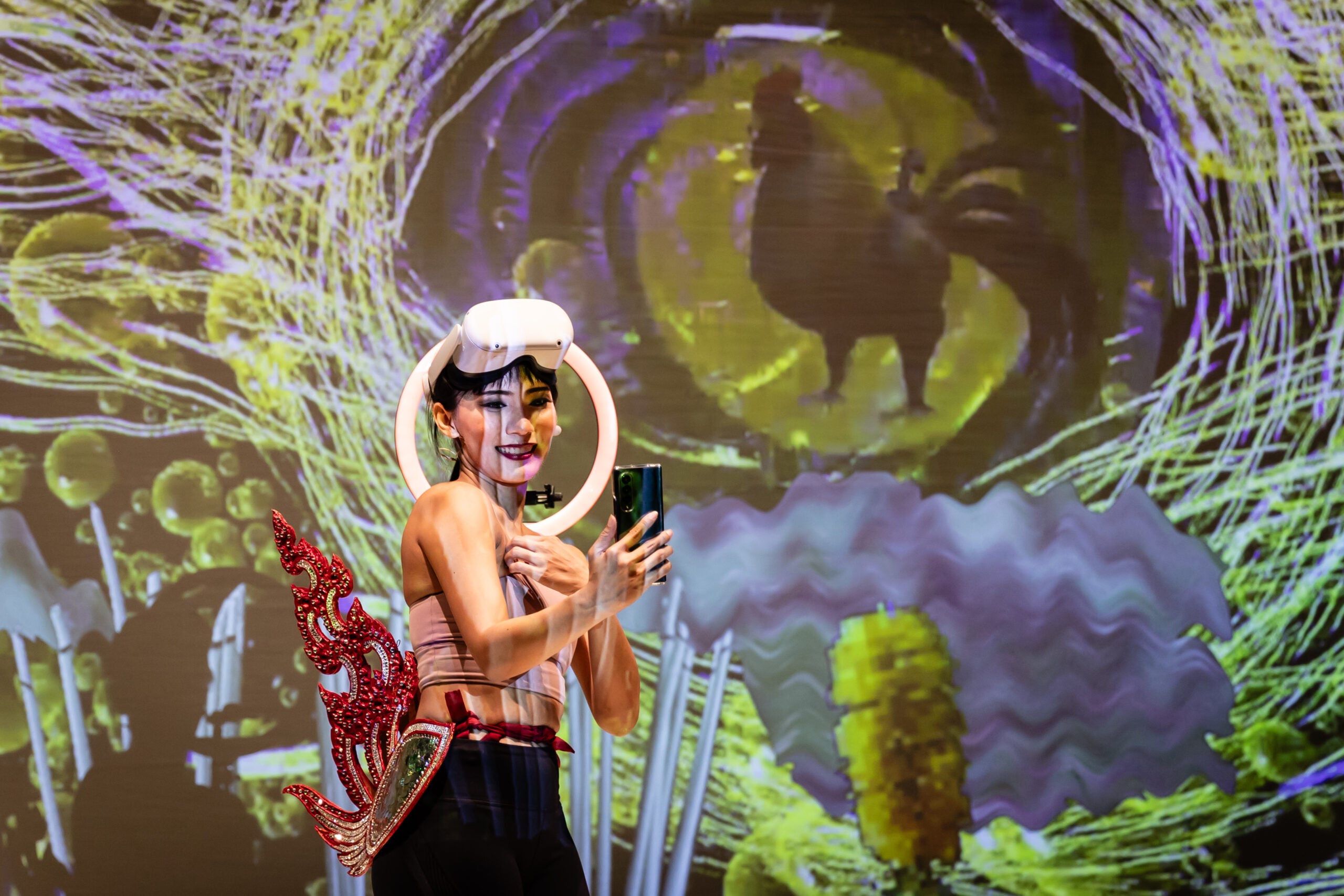
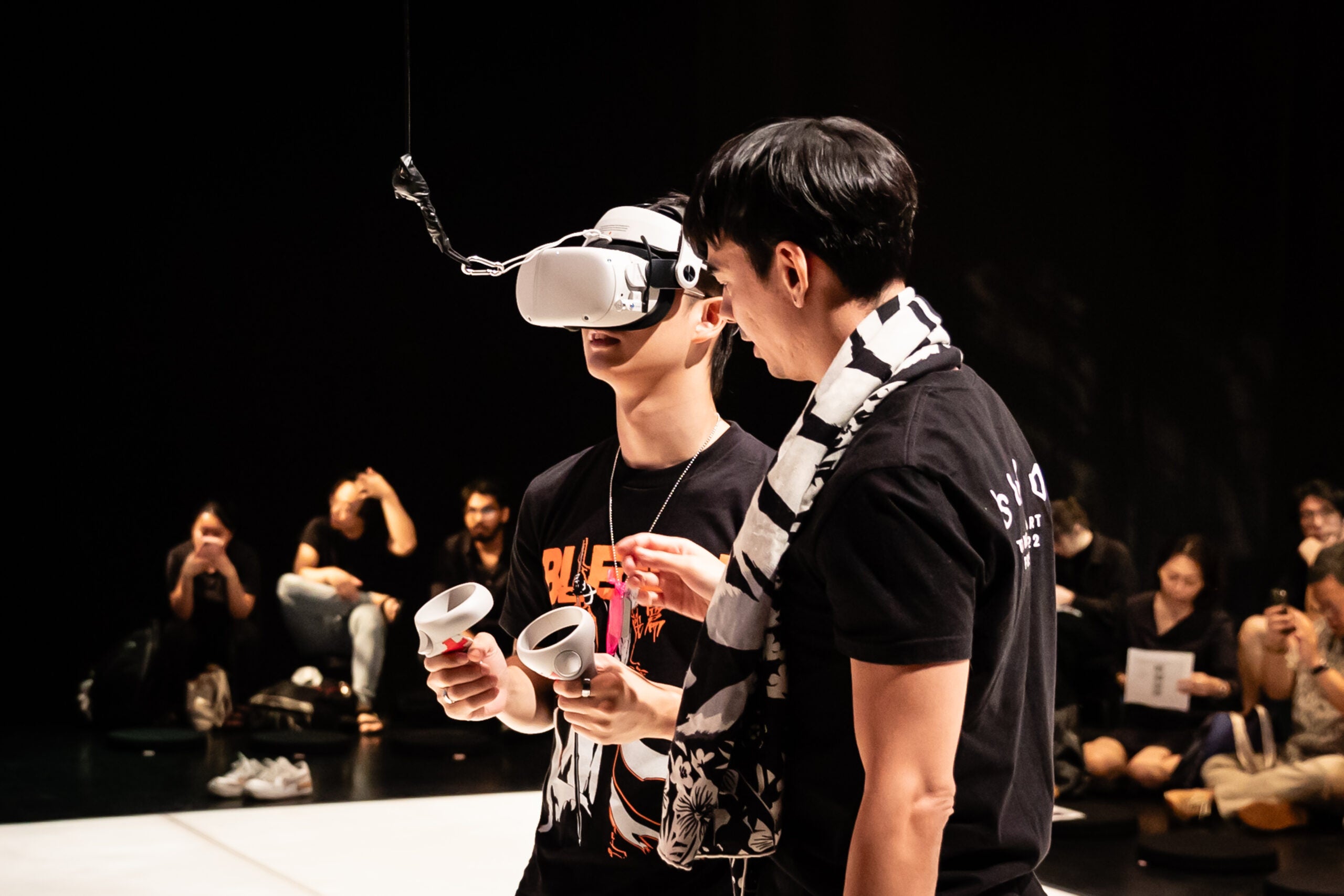
The virtual shrine in Mali Bucha can be viewed through two VR headsets, one of which is worn by Rungsawang herself at different points of the performance, while a few spectators volunteer to try the other one. The virtual topos of the “shrine” is projected as graphic imagery on the walls of the theatre space, a straddling of the real and the virtual that is a design feature of Mali Bucha. It is the shifting between these two terrains that draws attention to the impossible, perhaps absurd project of handing over practices of faith to technology.
The player/spectator does not go into the space alone but with Rungsawang, who continues her mediation work in an environment that is absolutely unfamiliar. She asks them questions, “what do you see?”, “look this way, which deity do you see?”, and “what would you like to ask them?” Technology can thus do what the cosmological imagination cannot; while the traditional medium goes alone on a dangerous journey to the other world to meet and pray on behalf of the devotee, the spectator as neophyte ferries alongside the dancer/virtual-assistant-as-medium. The remoteness of heavenly realms is bridged through technology. Yet, the performance is suspended in the shifty space between technological thrills, spiritual practice and self-reflexive parody of Thai culture, consumed as irreverent spectacle and kitsch by tourists.
Rather than lifelike or hyperreal imaginaries of the cosmic realm, the virtual scene projected on screen delivers pixelated graphic design aesthetics of the 1990s video games. Rather than the exquisite woodwork or the gilded stone carvings of Thai temples, there is infinite darkness in this virtual space. Iconic representations of the deities may be encountered as the player/spectator traverses this space—the chicken, zebra, monkey or elephant gods. They also see little avatar figures of other users simultaneously connected to the virtual shrine through a website accessible to the audiences through their mobile phone. Once they encounter a graphic animal god in the virtual shrine, they might, as one might do in a physical temple, become still and say a prayer.
In the last moments, the performance contrasts the limitations of the digital through a beautiful five-minute choreographed segment performed live in the physical space of the dance theatre. The segment closes with the dancer is absolutely still and meditative, as a hundred small bells ring among the audience. There is nothing to see and nothing to do, except go inward. The performance suggests effectively that technology cannot replace meditative co-presence in real time and space.
Choreographing across National Distance
Mali Bucha gathered positive reviews and interest from Singaporean viewers for its lighthearted, novel, and accessible approach about thinking through the interplay between technology, performance, and religion. From a scholarly point of view, Dr Cheng Nien Yuan focuses on incorporating VR technology into its dramaturgical design and implications of the performance for notions of embodiment, staging, immersion, co-presence and interactivity between users in live and virtual worlds. These responses suggest an unusual and perhaps overlooked development in Asian cultural worlds; for much of the 20th century, dance and theatrical forms were often performative exemplars and corporealised representations of postcolonial Asian nation-states, making them ideal objects of ethnographic analysis. The cultural ministries of India, Thailand, Indonesia, Singapore, and Malaysia invested in maintaining touring dance companies to represent the nation internationally and supported individual choreographers through schemes to protect their cultural and intangible heritage.
South and Southeast Asian performing arts forms, including dance, are deeply entangled in the representational politics of postcolonial nation-state—contests for UNESCO intangible heritage status, as well as other localised state-led projects. In the 21st century, however, soft power is linked to media forms that circulate through virality and multiply the dissemination and reach of national culture on a global scale. The Thai government’s recently launched cultural policy framework actively seeks to emulate Korea by focusing on the “5F cultural assets”–Food, Fight, Film, Fashion, and Festival. The state is also investing in upskilling its citizens in the gaming and animation fields to percolate global media streams with Thai-made content centred on the “5F” assets. This hard push to globalise Thai soft power has elicited a reassembling of new and old media forms in the world of dance and the performing arts. For instance, the Pichet Klunchun Dance company, Thailand’s premier contemporary Asian dance company of which Kornkarn Rungsawang is part, has partnered with a flexible exhibition-cum-play space to transform four best-known works from its repertoire into VR-AR experiences.
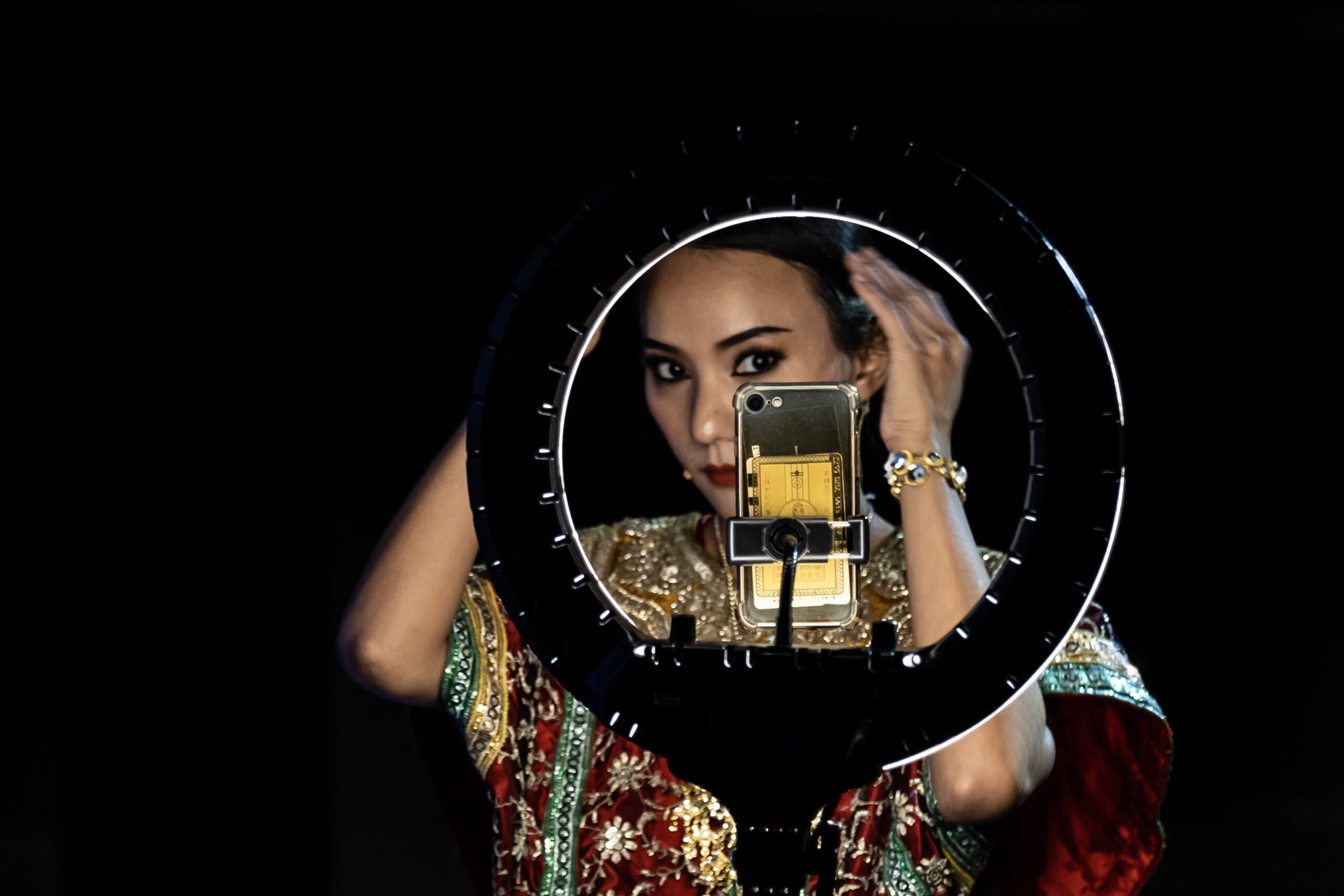
In this scenario, Rungsawang’s Mali Bucha can also be read as staging Thai dance’s increasing remoteness from the nation-state’s representational concerns. The choreographer’s question might be: what is the place of the dancer or the ritual specialist in a world where cultural diffusion through silicon and fibreglass networks is prioritised? Rungsawang relates how her funding applications to the Thai culture ministry were unsuccessful. Rungsawang actively embraces technology in her performance and stages a virtual dissemination of Thai culture, perhaps as a creative, tongue-in-cheek response to the Thai Creative Economy Agency’s minimisation of the dance in its agenda. As dance becomes defunded with recent state soft-power gambits, classical and courtly forms of Asian dance have lost their primary system of patronage, and choreographers of these forms today expend their efforts to secure funding and relevance on the transnational scale.
More recently, the corporate-backed arts visual-arts intelligentsia in Bangkok presented their own version of Asia on an international platform. The Bangkok Art Biennale foundation recently curated dancers into its pavilion at the Venice biennale through the medium of expanded cinema. A cinematic work titled, The Spirits of Maritime Crossing, incorporated iconic Asian performing artists, aforementioned Thai classical dancer Pichet Klunchun, Indonesian performance artist Melati Suryodarmo, alongside superstar Serbian performance artist, Marina Abramović, staging a globally savvy model of Asian culture curated in and by Bangkok. Here, the formal specificity dance forms in relation to the nations they represent are less important than the spectacular presence of bodies that can, through movement, stand-in for “Asia” in the global context more broadly.
Klunchun, who is also Rungsawang’s teacher, has further harnessed the power of artitfical intelligence to rethink the archival scope of Intangible Cultural Heritage (ICH), through a project titled Cyber Subin (2024). Besides merely archiving (and consequently perhaps stultifying) the repertoire of Mae Bot Yai (the Greater Fundamentals) of Thai traditional dance, Klunchun and MIT-based machine-learning experts have collaborated to create a living, digital archive that can understand the technical and energetic principles of Thai traditional dance, and respond to and intelligently play with human practitioners in real time.
The team reimagines the race for dominance between human and artificial intelligence as a dance-partnership, one that can create unforeseen entanglements of form, aesthetics and culture. In this project, experts of dance and machine learning work between Bangkok and Cambridge Massachusetts to launch Thai traditional dance in the future claiming cyberspace and the virtual body as a new domain of experimentation. This is consequential as it recentres the Thai dance, ethnically marked as particular to Thailand, as a universal standard to think about machine embodiment and human-mediated machine choreography movement in VR and AR. This experiment also effectively captures the intangible and ephemeral values accorded to traditional dance as predictable principles that can be comprehended by computational intelligence and returned as formal, poetic movement. If the experimental design of Cyber Subin are replicable across dance forms, this landscape for ICH stands as effectively transformed.
To call a contemporary Asian choreography remote is also to reflect on its conceptual distance from its traditional roots. The interdisciplinary forays of traditional Thai dancers into the world of virtual reality and artificial intelligence, render national, cosmic, secular distances as both more and less remote. Thai dance gains universal value as a site of knowledge production, rather than as an enclaved commodity attached to the Thai state or royal court and hence rendered remote from its traditional context. Yet technology, when artfully entangled with the living, moving, creative body of the dancer also becomes a tool for once-sacred knowledge to remain relevant to contemporary life and for the spiritual space of the temple to become accessible across time and space. Remote choreography emerges as a vital method in bridging these cartographic, cultural and cosmic distances.
The views expressed in this forum are those of the individual authors and do not represent the views of the Asia Research Institute, National University of Singapore, or the institutions to which the authors are attached.

Aparna Nambiar
Assistant Professor of Dance
Davidson College
Aparna Ramachandran Nambiar is Assistant Professor of Dance at Davidson College and former Postdoctoral Fellow in the Asian Urbanisms Cluster at ARI.
She has a PhD in Theatre, Dance and Performance Studies from the University of California, Berkeley (2022). Her dissertation project explored regional cultural and capital flows that shape dance in contemporary South and Southeast Asia. She applies theories from performance studies, contemporary anthropology and globalisation on performance genres that are broadly labelled as “traditional” and “contemporary Asian”. Her current book project explores the evolution of South and Southeast Asian traditional dance forms that now cater to urban, transnationally mobile and culturally cosmopolitan audiences in Singapore. Dr Aparna is trained in classical Odissi and Bharatanatyam dance and sustains an ongoing practice in experimental works rooted in these forms, working under prominent, Singapore-based choreographers.