

Temporal urbanism: Tools of/for “cities as sites and techniques of futuring”


Around two decades ago, the first thing that came to my mind when I heard the word “urbanisation” was the flow of people from rural to urban areas. Through my own life experience as an Indonesian, I am sure I was not the only one who held that view on what urbanisation is all about. At that time, I knew little about the fact that urbanisation is not only about movement of people, but also about space, and not least of all, time, entangled in urbanisation processes. Every spatial manifestation of urbanisation requires time, and conversely, every temporal manifestation of urbanisation requires space. As I have grown as a researcher of urbanisation, my work has been very much shaped by the spatial dimension but has engaged less with the temporal dimension. This piece aims to explicitly foregrounds the role of time dimension in urbanisation studies.
In terms of space, the sociospatial urbanisation theory – following its name: sociospatial – revolves around the spatial dimensions of horizontality and verticality. This is expressed, for instance, by the notion of extended urbanisation, introduced by the Brazilian scholar Roberto Luís de Melo Monte-Mór in his PhD dissertation two decades ago. The basic idea is that the urban is not confined to the city as a bounded spatial unit but involves distant environments – like the Amazon – that serve urban functions through material flows. Extended urbanisation was later taken up and reformulated into planetary urbanisation by Neil Brenner and Christian Schmid.
In my reading, neither Monte-Mór’s extended urbanisation nor Brenner and Schmid’s planetary urbanisation limit the urban into horizontal dimension but involves also verticality. The vertical dimension has recently been taken up by urban scholars, manifested in the upward growth of buildings and the exploitation of underground resources. Our work is included in this trend, exploring the concept of vertical extended urbanisation to explain the extraction of deep groundwater in its relationship with land subsidence and increased flood risks in Jakarta.
The horizontal dimensions (encompassing both concentrated and extended forms) and the vertical dimension (encompassing above- and below-ground that involve not only life such as humans but also nonlife of other-than-human such as groundwater and aquifers) have then explicitly incorporated into sociospatial urbanisation theories. There is then certainly a space for engagement with the temporal dimension.
As part of my attempt to have a deeper engagement with the time dimension of urbanisation, I have done an exercise. I analysed abstracts (available here) of Cities as Sites and Techniques of Futuring workshop to understand how the speakers engage with the temporal dimension of urbanisation – for the sake of simplification I will term “temporal urbanism”. I read the earlier version of this exercise as a closing remark for the workshop, which is part of Capitals of the Future research project. Specifically, I aim to identify what tools are used to operationalise the notion of “cities as sites and techniques of futuring.” I took benefit out of this exercise for it helped me engage with the broader notion of urbanisation, including its time dimension. Up until that point, as I mentioned at the opening paragraph, I had rarely paid proper attention to the time dimension of urbanisation in my research.
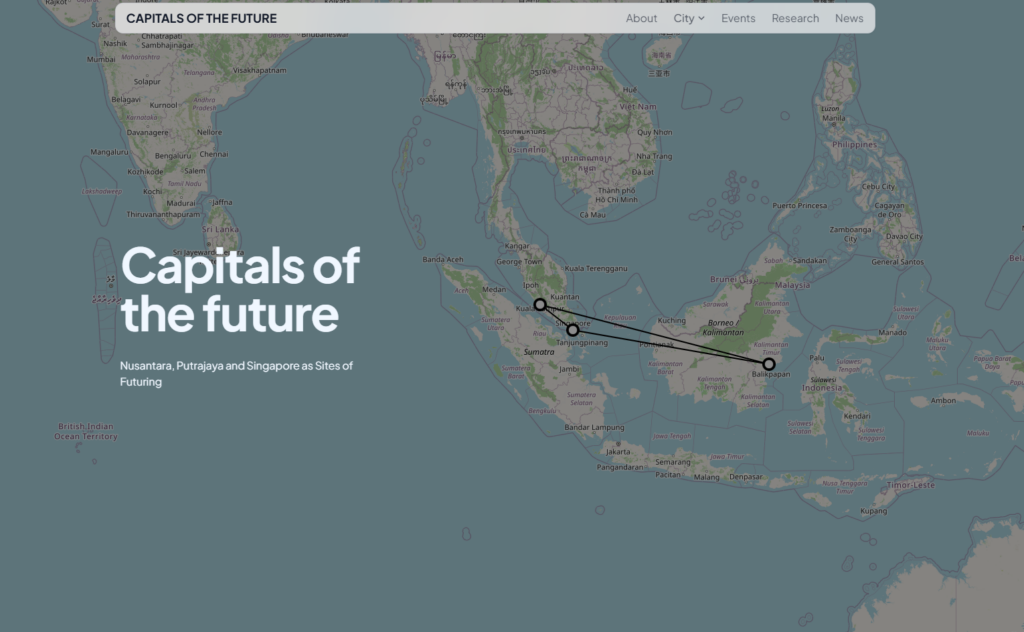
From the standpoint of sociospatial theories of urbanisation, this is exactly the point where the Capitals of the Future research project carves out its unique scholarly niche. The title itself explicitly foregrounds time. The project’s website declares it is “inspired by the work of Pierre Nora on lieux de mémoire (sites of memory) to understand their temporal counterpart, where some cities are imagined as instantiations of the future.” The Capitals of the Future plays with the temporality: to use the past to understand the future, or to analyse “cities as sites and techniques of futuring.” Articles published as part of or affiliated with the Capitals of the Future clearly foreground the role of temporality in their analysis, such as through the notions of “future city development” and “Project time.”
The workshop Cities as Sites and Techniques of Futuring was hosted by Asia Research Institute at the National University of Singapore, 19-20 August 2025. The time dimension is explicitly incorporated into conversations on urban theories, such as reflected in Professor Donald McNeill’s (one of the workshop’s participants, based in University of Sydney) words, that through the case study of Sydney’s Barangaroo, he aims to engage with the “spatial ontology of a site that brings an uneasy temporality.”
I have clustered my readings on how workshop’s speakers engage with temporal urbanism, and what tools they used, into four thematic groups, namely, narratives, technologies, planning documents, and infrastructure/production of space.
My first cluster focuses on narratives. Haeran Shin analyses how “a meticulously crafted urban space where physical design, narrative scripting, and scenographic choices” have been converged “to construct persuasive visions of the future” in Songdo, South Korea. In a related vein, Thuy Tran explores the construction of a “new narrative of capital futures” in Hanoi. As Xiang Li (Yenny) and Creighton Connolly show, such “narratives have become prevalent in the majority of large-scale urban development initiatives, promising that existing and potential environmental problems could be addressed while achieving economic growth.” Testriono, Khaidir Hasram, and Priza Mahendraputra demonstrate how the strategic “framing” of Indonesia’s capital city relocation “as a national pride project promising distributed economic opportunities for regions outside Java” successfully helped President Joko Widodo gain support to move the capital city from Jakarta to Nusantara on Borneo Island.
The second cluster examines technologies. Seng Boon Lim critiques how the “technology-driven method (TDM) worldview posits that technological advancements (or ICT) are believed to be an efficient tool for solving urban complexity and urbanisation problems, while subjugating the role of citizens.” Through the case of Singapore, Natalia Grincheva analyses how “AI-powered data intelligence can shape the future of cities in Southeast Asia.” Donald McNeill’s study of Sydney’s Barangaroo reveals the tools of temporal urbanism as “a complex spreadsheet of financial calculation and future prediction.” Finally, Duncan McDuie-RA uses “illegal street skateboarding performed and captured on video in Astana (Kazakhstan), Nay Pyi Taw (Myanmar), Putrajaya (Malaysia), and Ordos (China) to explore four possibilities for an aesthetic counter-politics of city futuring.”
The third tolls are planning documents. By examining 64 long-term development plans, Arif Budy Pratama and M Rifki Maarif provide “empirical evidence of uniformed urban futuring within a multi-levelled and decentralised system”. Various tools enable this futuring technique. In the case of Nusantara City, “planning documents” are a key tool. Friederika Trottier analyses planning documents to understand Indonesia’s aspiration to host the Olympic Games. Napong Tao Rugkhapan employs the maps attached to a city’s plan to uncover the “spatial controversies” in Bangkok. Similarly, Diana Zerlina and Sibarani Sofian use urban design development (UDD) guidelines to depict the “imagined future built environment” of Nusantara’s core area. Finally, “through a detailed examination of plans, texts, and Chinese commentary,” Andrew Stokols reveals the symbolic meaning of the Xiong’an New Area as a “testbed for constructing an emergent techno-industrial future in Xi’s China, in which the imperatives of digital innovation, cultural nationalism, and ‘ecological civilisation’ are reconciled.”
The fourth cluster of tools is infrastructure and production of space. Nick R. Smith examines “the creation of new space and institutions from which some residents of Shekou were excluded.” Xuyi Zhao demonstrates how “brand-new infrastructure provides a canvas on which the state can chart its planned urban future as an all-encompassing modernisation project with a speeding-up logic: rural landscapes disappeared in weeks, new apartment buildings rose in months, and a modern city that could house millions of people took shape in just a few years.” In a different context, Joshua Adam Comaroff uses “visual and architectural examples of Singapore’s “dark” youth subcultures” to argue for “the lack of a future-orientation” as “a generational phenomenon.” Conversely, George Wong Boon Keng “brings urban “undesirables” back into “serious discussion” to challenge the “revanchist discourses present in both academic and industry “future-cities””. Shifting focus, Agatino Rizzo and Simona Azzali investigate “how are visions of the future produced, represented, and materialised through Gulf megaprojects.” Finally, Pechladda Pechpakdee proposes integrating “flood management with urban development” as a core “vision” for the future of Bangkok.
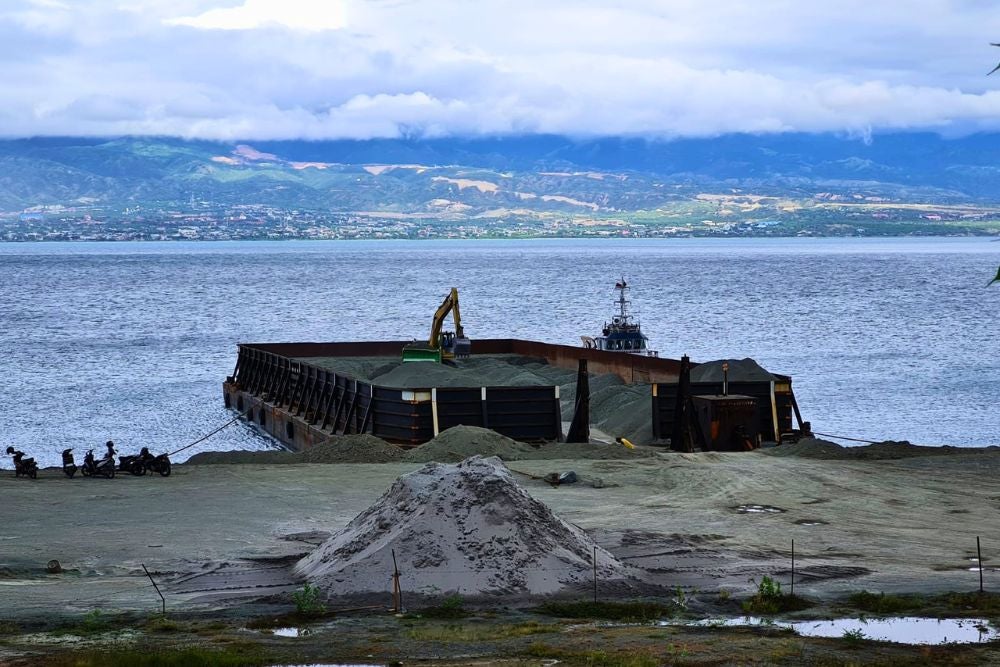 Figure 1: Loading stone in Palu Bay, Central Sulawesi, Indonesia, sent for urban development in Borneo Island. Picture by the author.
Given time is vital for capitalism in terms of “labour time” and “the turnover time of capital,” as a reader of capitalism, I expect a more explicit yet systematic examination of the relationships between time and capitalist urbanisation. This is one of our motivations in our current published article, where we engage with the latter (the turnover time of capital) to explain the shipping of rock from Central Sulawesi (Figure 1), Indonesia, mobilised for the development of Indonesia’s new capital city in Borneo Island.
To close, alongside spatiality, the temporal dimension is inherently attached to the processes of urbanisation and capitalism, yet it remains relatively invisible in the discussion of contemporary development in urbanisation theory, such as socio-spatial approaches. For an urbanisation reader/researcher like myself, the main challenge lies in not only consistently but also explicitly incorporating both dimensions into my research framework, and all the while continuously engaging with the perspective that spatiality is always temporal, and vice versa, that temporality is always spatial.
The views expressed in this forum are those of the individual authors and do not represent the views of the Asia Research Institute, National University of Singapore, or the institutions to which the authors are attached.

Bosman Batubara
Research Fellow
Asian Research Institute
National University of Singapore
doi.org/10.25542/71ph-2d71
Selected Publications
Books
Batubara B and Toding ET (2025) Reforma Agraria Perkotaan dan Koperasi Perumahan (Urban Agrarian Reform and Housing Cooperative). Yogyakarta and Jakarta: Kasan Ngali and Urban Poor Consortium.
Batubara B, Kausan BY, Handriana E, Salam S and Ma'rufah U (2021) Banjir Sudah Naik Seleher: Ekologi Politis Urbanisasi DAS-DAS di Semarang (Water is at the Neck: A Political Ecology of Urbanization in Semarang Watersheds). Semarang: Cipta Prima Nusantara.
Batubara B, Warsilah H, Wagner I and Salam S (2020) Maleh Dadi Segoro: Krisis Sosial-Ekologis Kawasan Pesisir Semarang-Demak (Turned into Ocean: Socio-ecological Crises in Semarang-Demak Coastal Area). Yogyakarta: Lintas Nalar.
Batubara B (2020) Teman Rebahan: Kapitalisme dan COVID-19 (Companion for Lockdown: Capitalism and COVID-19). Yogyakarta: Penerbit Gading.
Batubara B and Utomo PW (2012) Kronik Lumpur Lapindo: Skandal Pengeboran Migas di Sidoarjo (Chronicle of Lapindo Mudflow: Oil and Gas Drilling Disaster in Sidoarjo). Yogyakarta: INSIST Press.
Refereed Articles
Batubara B, Otsuki K, van Noorloos F and Kooy M (2026) Everyday land speculation without production in state-led urbanization: The case of Indonesia’s new capital city. Environment and Planning A: Economy and Space, 0(0). https://doi.org/10.1177/0308518X261447120
Batubara B, Otsuki K, van Noorloos F, Kooy M and Zoomers A (2026) Reproducing Operational Landscapes: The Rock Mining for Indonesia's New Capital City. International Journal of Urban and Regional Research. https://doi.org/10.1111/1468-2427.70102
Batubara B (2025) Subsumption of Landscape under Capital: Extended urbanisation at the location of Indonesia's new capital city. Capitalism Nature Socialism, 37(2): 40–60. https://doi.org/10.1080/10455752.2025.2523366.
Batubara B, Belland M and Kooy M (2025) Linking Up Degrowth in/From the South With Provincialised UPE: Mangrove and groundwater conservations in Semarang, Indonesia. Asia Pac. Viewp., 66(1): 105–114. https://doi.org/10.1111/apv.12440.
Batubara B (2024) The Pulse of the Earth: Political Geology in Java (Book review). Journal of Anthropological Research, 80(2): 243–244.
Batubara B, Guntoro, Rachman NF, Herlily and Adianto J (2024) Land Occupation, Re-occupation, and Housing Cooperative: Commune formation by Jakarta's urban poor. Agrarian South: Journal of Political Economy, 13(1): 89–109. https://doi.org/10.1177/22779760241226816.
Location: Palu Bay, Central Sulawesi, Indonesia to Nusantara, East Kalimantan, Indonesia. Visualisation via Google Earth Studio