

The case of the unsold carbon credits: Lessons from an early-REDD+ project in Southern Laos


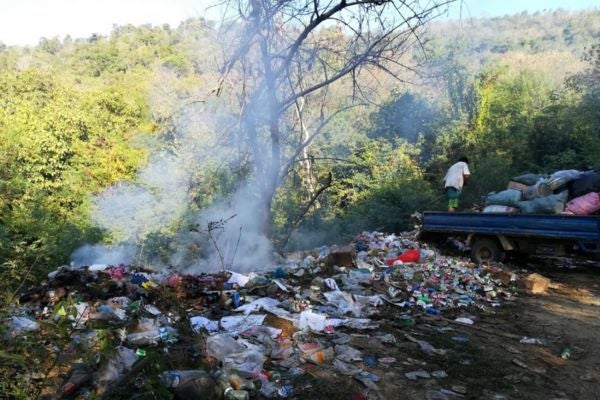
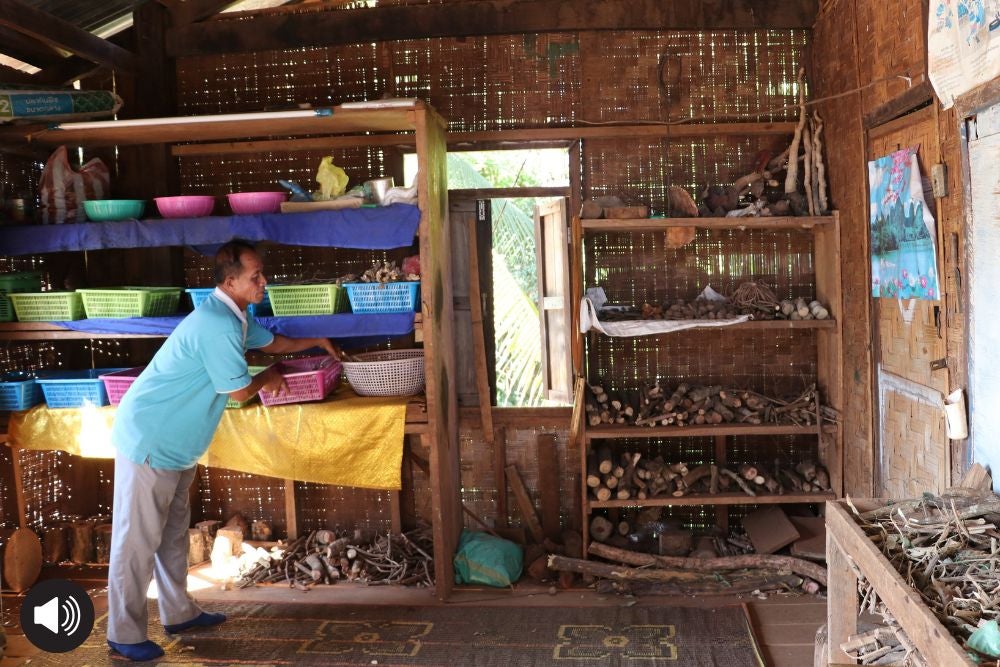
Located in Champasak and Attapeu provinces in southern Laos, the Xe Pian National Park is one of the top ten most biologically important protected areas in Southeast Asia (Images 1 and 2). Previously established as a National Protected Area in 1993, the area hosts large populations of elephants, cattle, deer, wild pigs, gibbons, and deer. It was the site of the “Reducing deforestation and carbon enhancement in the Xe Pian National Protected Area (NPA)” project (henceforth the Xe Pian REDD+ project), a nature-based climate mitigation project.
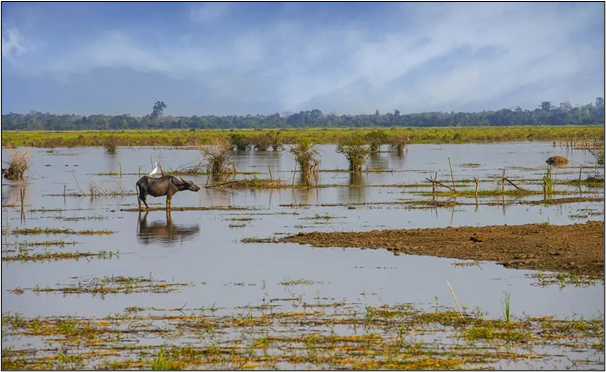
Image 1: The Kiat Ngong Wetlands, a Ramsar site, in Xe Pian National Park. (source)
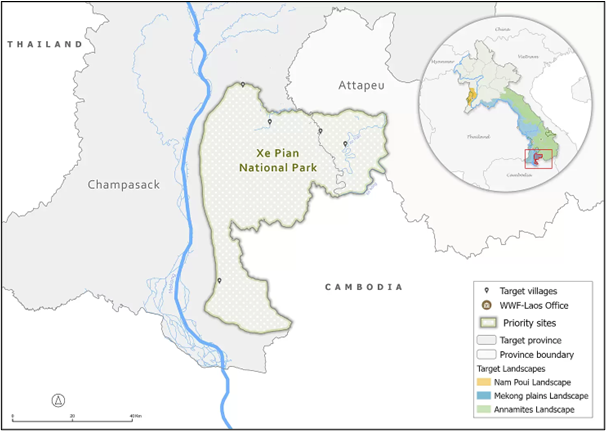
Image 2: Location of the Xe Pian National Park. (source)
Climate change mitigation and forests in Laos
Mitigating climate change necessitates the transition away from fossil fuels, but also requires forest conservation and restoration. Forest carbon schemes link finance to carbon emission reductions or removals, and have evolved since the early-2000s to encompass a variety of forest interventions at different scales and under different operating frameworks (Image 3). Significantly, REDD+ is a framework in which finance is channelled to tropical developing countries to reduce emissions from deforestation and forest degradation (REDD), plus to sustainably manage forests and conserve and enhance forest carbon stocks (+).
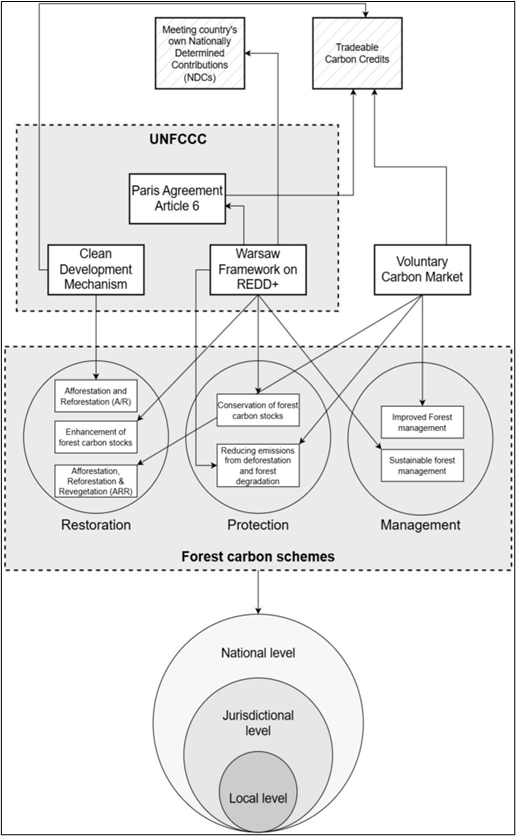
Image 3: Forest carbon schemes comprise a variety of forest interventions, operate under different frameworks for funding and emission reduction, and are implemented at various scales. (Source)
Forests cover 62 per cent of the Lao PDR, with expectations to graduate from the “least developed country” status in 2026, the country walks a tightrope between economic development and forest conservation. Since 2009, forest carbon schemes have been implemented across Laos, with the present landscape of projects comprising one donor-funded jurisdictional REDD+ project and four projects registered on Verra’s Verified Carbon Standard (VCS). More forest carbon projects are being planned.
Under the “Climate Governance in Nature-based Carbon Sinks in Southeast Asia” (CGSEA) project, we seek to understand the socio-political issues associated with how forests in Southeast Asia are used as instruments for mitigating climate change. The Xe Pian REDD+ project, initiated more than 10 years ago, is one of the four VCS projects listed in the government’s reports on REDD+. We were thus interested to find out more about its status, and conducted a two-day visit in October 2025 to the Xe Pian National Park to speak with key informants.
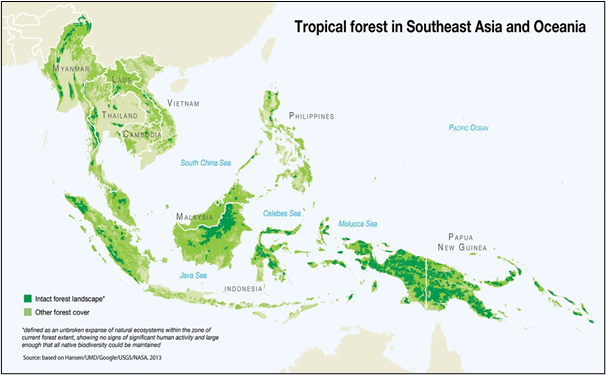
Image 4: Forests in Southeast Asia and the Oceania (source)
Xe Pian’s fruitless engagement with forest carbon
The idea of the Xe Pian REDD+ project was first mooted by the World Wide Fund for Nature (WWF) in 2010 as a pilot for the Government of Laos to engage with the voluntary carbon market, to generate long-term finance from carbon emission reductions. With initial assessments showing that deforestation was nominal, the plan focused on improving forest management and enhancing the livelihoods of the local people living in and around the forest landscape. The Champasak Provincial Agriculture and Forestry Office was identified as the project proponent. With funding support from WWF Austria and the Austrian government, the Austrian Federal Forests (ÖBf) developed the project with the involvement of the Xe Pian NPA staff.
The project was registered on the VCS in 2014 and was verified by TUV SUD in 2018. Project documents state that it is expected to sequester approximately 5.7 million tCO2e during its 30-year project period from 2014–2043, which includes approximately 650,000 tCO2e during its 1st baseline period (10 years) from 2014–2024. According to one informant, the revenue from the sales of carbon credits had been estimated to be USD70,000/year, although no guarantees were given.
However, as we discovered from our fieldwork, no carbon revenues have been earned since the project was initiated.
The case of the unsold carbon credits
“Who’s in charge of selling the carbon credits?” we asked at the end of our visit to the Xe Pian National Park office, with mixed feelings of disbelief and frustration.
Disbelief—because it was hard to imagine why a well-implemented forest carbon project never bore its envisioned fruits of long-term revenue from the voluntary carbon market. As we had learnt from our informants, significant work had gone into building the technical capacities (e.g., use of Geographic Information Systems) of the Xe Pian National Park staff and into engaging the leaders of the villages involved in the project. One Xe Pian National Park staff even felt that he had learnt so much from the project, that he could almost become an expert himself! Indeed, when the Xe Pian staff showed us their database of maps and reports (e.g., Image 5), we felt that they had a firm grounding of the science of forest carbon stock estimation. How was it possible that there were no buyers of the project’s carbon credits?
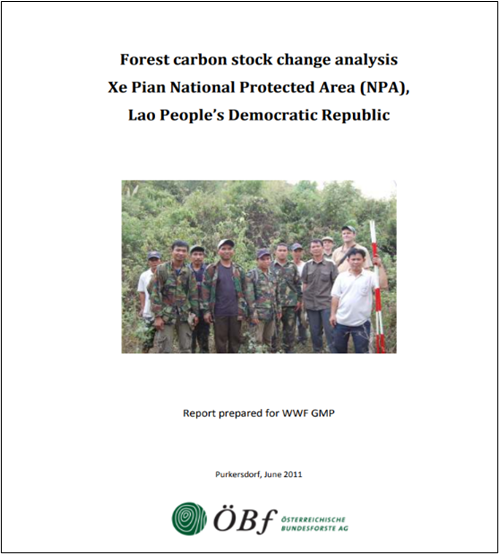
Image 5: The front page of a 2011 report, showing a photo of Lao team members.
Frustration—because of the stark contrast between what could have been, and the present situation. Villagers we spoke to lamented the absence of follow-up to the project activities since 2018, especially livelihood-improvement activities such as planting fruit trees and animal-raising. The Xe Pian National Park office is direly underfunded, working with a government budget of 60 million LAK/year (2,800 USD/year) and staff strength of 12 persons to manage 258,000 hectares of forest landscape. And with Covid-19 impacting eco-tourism, a central source of income for villagers, forest encroachment has resumed. Even if the 2018-verified carbon credits were to be issued now, this reversal would jeopardise their climate integrity, making their sales on the voluntary carbon market highly unlikely.
The present challenges confronting Xe Pian National Park have not gone unnoticed by the national government. In an upcoming forest carbon project set to commence in mid-2026 named the Governance of Forest Landscapes and Livelihoods - Southern Laos (GFLL-SL), the Xe Pian National Park has been identified as one of five key target conservation landscapes. The GFLL-SL proposal also confirms that the carbon credits from the Xe Pian REDD+ project will not be issued. While this may both bring closure and renew hope for the staff and local people of Xe Pian, it does not answer the question of why the Xe Pian REDD+ project’s carbon credits had not been issued.
Possible reasons
According to the Xe Pian REDD+ project’s documents, it was decided at that time that the Champasak Provincial Agriculture and Forestry Office would hold the carbon rights to the project. This means that this provincial-level authority would have the rights to sell and benefit from the project’s carbon credits. However, the Xe Pian National Park staff whom we spoke to expressed that it was the national-level government’s responsibility to sell the carbon credits. This was plausible, given that the national-level government is more capable of engaging international actors than the provincial-level government. However, national systems and institutions that govern REDD+ and carbon credit transactions were still in their early stages of development at that time. Reflecting the continued ambiguity over who holds the carbon rights, a recent funding proposal consulted both the provincial and national-level governments on the project.
When we inquired further in the national capital of Vientiane, a few interlocutors hypothesised that the Xe Pian REDD+ project’s carbon credits were not sold due to insufficient promotional engagement. This assumes that the Xe Pian REDD+ project’s carbon credits were on a carbon exchange for market buyers to choose from. However, this was not the case. Although the Xe Pian REDD+ project was verified in 2018 to be able to produce 130,842 tCO2e of tradeable carbon credits (verified from the period 1 September 2014 to 31 August 2017), we learnt that these carbon credits were not issued on the Verra registry (Image 6). This means that the carbon credits were not created or commoditised for sale. Why, then, were the carbon credits not issued?
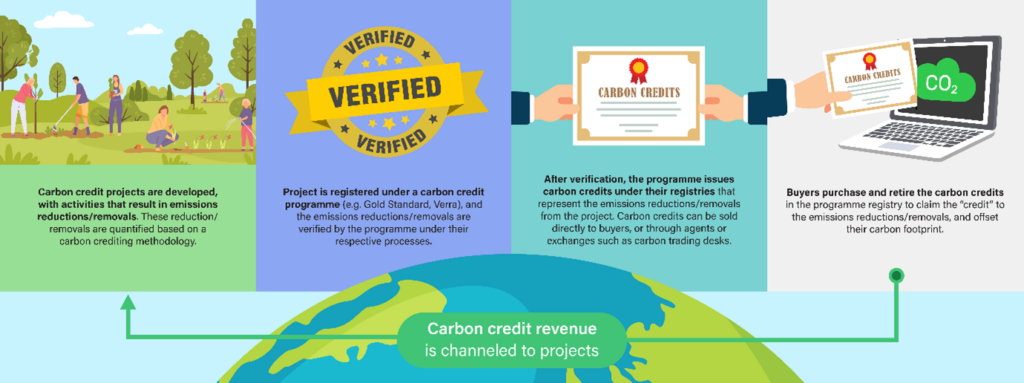 Image 6: The life cycle of a carbon credit. (source) In the Xe Pian REDD+ project, verification was completed but there was no issuance.
One likely reason is that issuing carbon credits comes with costs. With today’s issuance levy of USD0.23/carbon credit, the Xe Pian REDD+ project would have to spend an estimated USD30,000 for all its 2018-verified carbon credits to be issued. However, the project budget was “sufficient to cover all cash out until the first verification”, according to the verification report. With the funding timeline for the initial project implementation coming to an end, not having the budget for carbon credit issuance meant that the Xe Pian REDD+ project was thus treated as yet another once-off grant-funded project, rather than a business opportunity to finance forest conservation in the long-run.
A second, related reason is to do with institutional continuity. The Department of Forest Resources Management, under the Ministry of Natural Resources and the Environment, had been in charge of the National REDD Taskforce and worked on the Xe Pian REDD+ project. However, in 2017, this function moved to the Department of Forestry under the Ministry of Agriculture and Forestry. Key staff retired or changed portfolios, and there was insufficient handover alongside changes in leadership. This perhaps led to an institutional forgetting of the yet-to-be-fulfilled potential of the Xe Pian REDD+ project, such that there was no follow-up to request for the issuance of the project’s carbon credits.
Lessons for forest carbon schemes
The inclusion of the Xe Pian National Park into the country’s upcoming GFLL-SL signals the national government’s commitment to securing much-needed resources for the precious forest landscape. Nonetheless, by looking into the case of the unsold carbon credits from the Xe Pian REDD+ project, we can draw broader lessons for other forest carbon schemes around the world.
Firstly, one must remember that forest carbon schemes do not merely transfer finances for forest-based climate mitigation projects, but that the hosts of such projects are developing countries. This means that it is important to consider the political-institutional capacities of the host countries. For example, as a least developed country, the Lao PDR is accustomed to receiving grants from multilateral and bilateral development partners. Strong and continuous support from external sources is typically needed for successful project completion. However, forest carbon schemes are an attempt to create a business case for forest conservation. The case of Xe Pian REDD+ project’s unsold carbon credits suggests that a significant hurdle for forest carbon schemes is in shifting host countries’ mindsets away from a reliance on grant-funded activities, and towards thinking about business models for long-term finance.
Relatedly, for host countries to benefit from forest carbon schemes, they need to have a good understanding of how carbon credits work. Most capacity-building initiatives focus on the methodological aspects of designing a forest carbon project. However, as shown by how the verified carbon credits in the Xe Pian REDD+ project were never issued, process knowledge of the carbon credit life cycle should be as important as the technical knowledge of forest carbon stock estimation. We further contend that gaps in knowledge of how carbon credit schemes should work, as well as the attendant risks of forest carbon schemes to indigenous peoples and local communities, are important to address for developing carbon credit literacy.
Finally, it is important for carbon credit buyers to appreciate the circumstantial complexities that a host country needs to navigate domestically in order to sell a carbon credit internationally. The implementation of a pilot project at the provincial level needs to be in tandem with the development of adequate national governance mechanisms, which can be marred by bureaucratic complexity and vague institutional mandates. Restructuring at the national government level interfered with oversight and continuity, while the tragic collapse of the nearby Xe Pian-Xe Namnoy hydropower dam and the Covid-19 pandemic shortly after severely constrained the capacities of a lowly-paid government service to pursue the sales of carbon projects from the Xe Pian REDD+ project. Another layer of complexity is that host countries are disproportionately impacted by climate change, which they have hardly caused.
Together, these lessons lead us to an often-asked question in climate justice debates: Should developing countries be expected to bear the burden of climate change mitigation? The seemingly smooth and technologically-advanced transactions on carbon exchanges tend to belie the complex realities that host countries need to deal with, misleading us to think that merely transferring carbon-related finance, even if this is still desired in these countries, is enough.

Image 7: Many villagers in and around Xe Pian National Park have sold their elephants, a key attraction for eco-tourism, due to the impact of Covid-19 on tourism. (source)
Acknowledgments
This article benefited from financial support provided by the Ministry of Education, Singapore, under its Social Science Research Council (SSRC) grant “Climate Governance of Nature-based Carbon Sinks in Southeast Asia” (MOE2021-SSRTG-021). Any opinions, findings and conclusions or recommendations expressed in this material are those of the authors and do not reflect the views of the funding body.
The views expressed in this forum are those of the individual authors and do not represent the views of the Asia Research Institute, National University of Singapore, or the institutions to which the authors are attached.

Yingshan Lau
Research Fellow
Asia Research Institute
National University of Singapore

Khamsing Keothoumma
Lecturer
Faculty of Forest Sciences
National University of Laos

Yunrui Ren
PhD Student
Department of Geography
National University of Singapore

Sithong Thongmanivong
Dean
Faculty of Forest Sciences
National University of Laos
https://doi.org/10.25542/5fqy-mm80
The vast Xe Pian National Park spans Champasak and Attapeu provinces, Southern Laos. Source: Google Earth.