

Ports, politics, and peace: The engineering of stability
Guru Madhavan is a systems engineer and author of “Wicked Problems: How to Engineer a Better World” and “Applied Minds: How Engineers Think.”
Republished in The Straits Times: https://www.straitstimes.com/opinion/ports-politics-and-peace-the-engineering-of-stability
March 5, 2025
Infrastructure shapes global leverage, forging interdependence in ways both subtle and stark.
Civilisations don’t rise and fall by the sword alone. They are shaped – or shattered – by the infrastructure that anchors their networks. Infrastructure can foster peace and stability, but history shows it has also been a medium for influence. India’s ancient ports made this clear: the sea wasn’t just a barrier but a conduit for empires to expand, where mutual exchange and leverage coexisted.
On Tamil Nadu’s Coromandel Coast, Poompuhar (Kaveripoompattinam) flourished as a major port during the Sangam era (300 BCE to 300 CE). More than a trading hub, it was an engineered enclave of commerce, culture, and command, part of a maritime meshwork that linked South India to distant shores, weaving coastal economies into vast trade routes.
Under early Tamil dynasties and later the Cholas, Poompuhar thrived. Its layout reflected a hierarchy –fisherfolk and artisans worked by the shore, while merchants and rulers governed from inland quarters. Warehouses lined the waterfront, their goods marked with official seals, signalling a sophisticated regulatory system. A towering lighthouse beamed both welcome and watchfulness, ensuring commerce flourished – but on Chola terms. Tamil epics recount bustling ports where foreign merchants conducted business under local oversight, illustrating how infrastructure served as an economic enabler and an instrument of political control.
Nature, however, rewrote the script. As rising seas consumed Poompuhar in the early centuries CE, the Cholas turned their gaze southward. Over time, Nagapattinam’s deep harbour positioned it as the region’s dominant port, and by the medieval era, it had become a thriving nexus of commercial and cultural exchange. At its heart stood the Chudamani Vihara, a Buddhist monastery built in the 11th century with support from the Srivijaya empire of present-day Indonesia. Its soaring spires welcomed mariners from across the Bay, while its halls hosted monks from Sri Lanka, China, and South-east Asia, reinforcing Nagapattinam’s role as both a crossroads and a conduit of Tamil reach – which flowed not just through fleets but through ideas and institutions. The Chola-Srivijaya partnership wasn’t merely symbolic – it deepened regional stability through shared infrastructure and interconnected trade routes.
Today, infrastructure shapes global leverage, forging interdependence in ways both subtle and stark. The Greater Mekong subregion’s power grid synchronizes economies, yet its benefits remain unevenly distributed. Once divided by water disputes, Thailand and Laos now exchange electricity, intertwining their energy needs and reinforcing cooperation through both politics and engineering. Similarly, the Trans-Asian Railway stitches together China, Laos, and Europe, turning old frontiers into transit corridors. But mismatched rail gauges and ageing networks still pose hurdles, proving that infrastructure is as much about negotiation as construction.
Water itself has become a medium of diplomacy. The Indus Waters Treaty shows how engineering details can turn potential competing interests into cooperation. When Pakistan challenged India’s Kishanganga hydroelectric project in 2010, the resolution didn’t come through political posturing but through numerical negotiations – flow rates, reservoir capacities, and power generation schedules. Today, hydroelectric projects threading the Chenab and Jhelum rivers continue this approach, demonstrating that stability is often engineered, not just brokered. Such agreements depend not only on political will but on the technical infrastructure that makes cooperation possible – dams, grids, servers, and satellites.
In the South China Sea, key ports reinforce sovereign claims. Radar stations track naval movements. Deep-draft harbours accommodate warships and cargo vessels alike. Despite territorial disputes, commerce flows through shared shipping routes, standardised navigation systems, and cooperative security measures. As with Poompuhar, infrastructure anchors both strategic presence and partnership.
China’s Belt and Road Initiative (BRI) takes this further. While some projects in Pakistan have faced setbacks, the Jakarta-Bandung rail and Laos-China railway demonstrate successful partnerships. Beyond construction, these projects entrench long-term economic ties through maintenance agreements, operational protocols, and financial dependencies. Through the BRI, China transforms trade routes into economic strongholds during a pivotal period of regional competition. Similarly, as Arctic ice recedes, the Northern Sea Route and Transpolar Sea Route are redrawing access, with Russia expanding northern ports and deploying nuclear icebreakers to establish year-round control. Just as shifting coastlines altered Poompuhar’s fate, these changing pathways and corridors determine not just the patterns of collaboration, but the distribution of regional leverage.
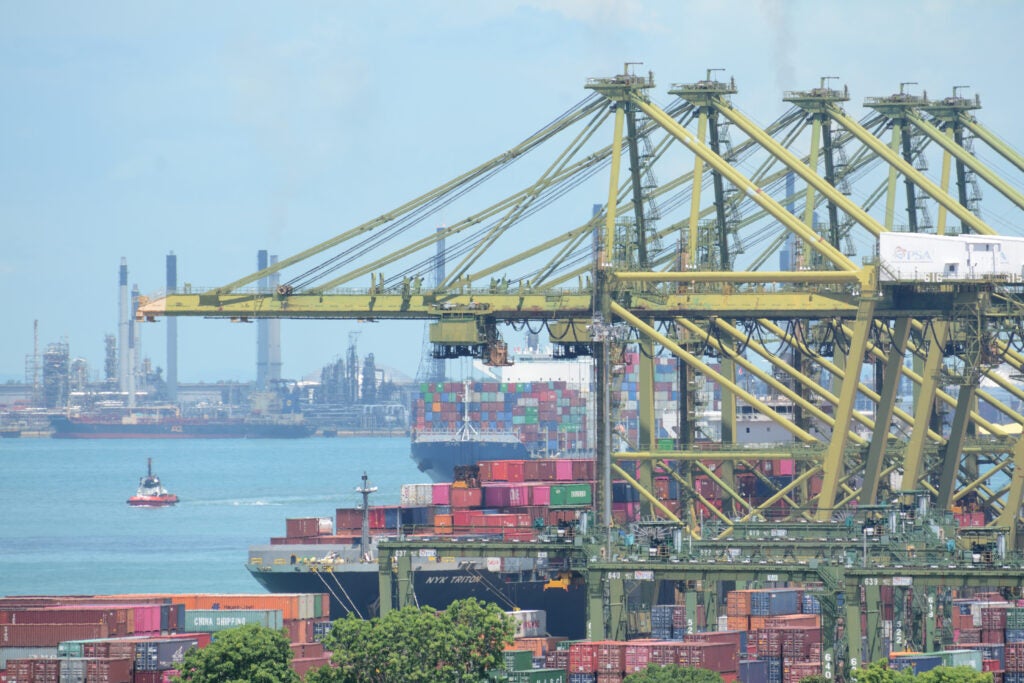
Infrastructure dictates far more than logistics in South-east Asia. The Johor-Singapore Causeway, for instance, does more than move traffic – emergency response teams share protocols, logistics systems operate in sync, and border controls function as one. Singapore’s Tuas Port embodies this precision, an automated marvel built for speed and scale. AI-powered cranes hoist containers with precision, autonomous vehicles zip across the docks, and intelligent berthing systems orchestrate seamless arrivals, handling 10 million shipping containers, or twenty-foot equivalent units (TEUs), since the start of operations in September 2022, with new capabilities to handle 65 million TEUs when fully operational in the 2040s, making it the world’s largest automated port. Every transnational project – whether a railway in Africa, an airport in Asia, or a data corridor in the Americas – rescripts influence without a single shot fired.
Like South India’s ancient ports, these choices outlast rulers and regimes, binding nations through networks of mutual reliance. Peace and geopolitical stability aren’t just diplomatic achievements; they are engineered, and infrastructure is often the stabiliser that endures – even outlives – shifting alliances.
The views and opinions expressed in this article are those of the author(s) and do not necessarily reflect those of the Asia Research Institute, National University of Singapore.
Latest
It's Time for Europe to Do the Unthinkable
Kishore Mahbubani
Can Young Americans and Chinese Build Bridges Over Troubled Waters?
Brian Wong
Trump 2:0: Getting US-China ties right despite the odds
Zhiqun Zhu
How Malaysia can boost Asean agency and centrality amid global challenges
Elina Noor
Why India-Pakistan relations need a new era of engagement
Farhan Hanif Siddiqi
Reconceptualizing Asia's Security Challenges
Jean Dong
Asia should take the Lead on Global Health
K. Srinath Reddy and Priya Balasubramaniam
Rabindranath Tagore: A Man for a New Asian Future
Archishman Raju
Securing China-US Relations within the Wider Asia-Pacific
Sourabh Gupta
Biden-Xi summit: A positive step in managing complex US-China ties
Chan Heng Chee
Singapore's Role as Neutral Interpreter of China to the West
Walter Woon
The US, China, and the Philippines in Between
Andrea Chloe Wong
Crisis Management in Asia: A Middle Power Imperative
Brendan Taylor
America can't stop China's rise
Tony Chan, Ben Harburg, and Kishore Mahbubani
Civilisational Futures and the Role of Southeast Asia
Tim Winter
US-China rivalry will be stern test for Vietnam's diplomatic juggle
Nguyen Cong Tung
Coexistence: The only realistic path to peace
Stephen M. Walt
Cyclone Mocha in conflict-ridden Myanmar is another warning to take climate security seriously
Sarang Shidore
Doubts about AUKUS
Hugh White
Averting the Grandest Collision of all time
Graham Allison
India Can Still Be a Bridge to the Global South
Sanjaya Baru
U.S.-China Trade and Investment Cooperation Amid Great Power Rivalry
Yuhan Zhang
Managing expectations: Indonesia navigating its international roles
Shafiah F. Muhibat
Caught in the middle? Not necessarily Non-alignment could help Southeast Asian regional integration
Xue Gong
It’s Dangerous Salami Slicing on the Taiwan Issue
Richard W. Hu
Navigating Troubled Waters: Ideas for managing tensions in the Taiwan Strait
Ryan Hass
The EU and ASEAN: Partners to Manage Great Power Rivalry?
Tan York Chor
Countering Moro Youth Extremism in the Philippines
Joseph Franco
India-China relations: Getting Beyond the Military Stalemate
C. Raja Mohan
America Needs an Economic Peace Strategy for Asia
Van Jackson
India-Pakistan: Peace by Pieces
Kanti Bajpai
HADR as a Diplomatic Tool in Southeast Asia-China Relations amid Changing Security Dynamics
Lina Gong
Technocratic Deliberation and Asian Peace
Parag Khanna
Safer Together: Why South and Southeast Asia Must Cooperate to Prevent a New Cold War in Asia
Sarang Shidore
Asia, say no to Nato: The Pacific has no need of the destructive militaristic culture of the Atlantic alliance
Kishore Mahbubani
Can Biden bring peace to Southeast Asia?
Dino Djalal
An India-Pakistan ceasefire that can stick
Ameya Kilara
An antidote against narrow nationalism? Why regional history matters
Farish A Noor
Can South Asia put India-Pakistan hostilities behind to unite for greater good?
Ramesh Thakur
Nuclear Deterrence 3.0
Rakesh Sood
The Biden era: challenges and opportunities for Southeast Asia
Michael Vatikiotis