

Building Resilience for a New World
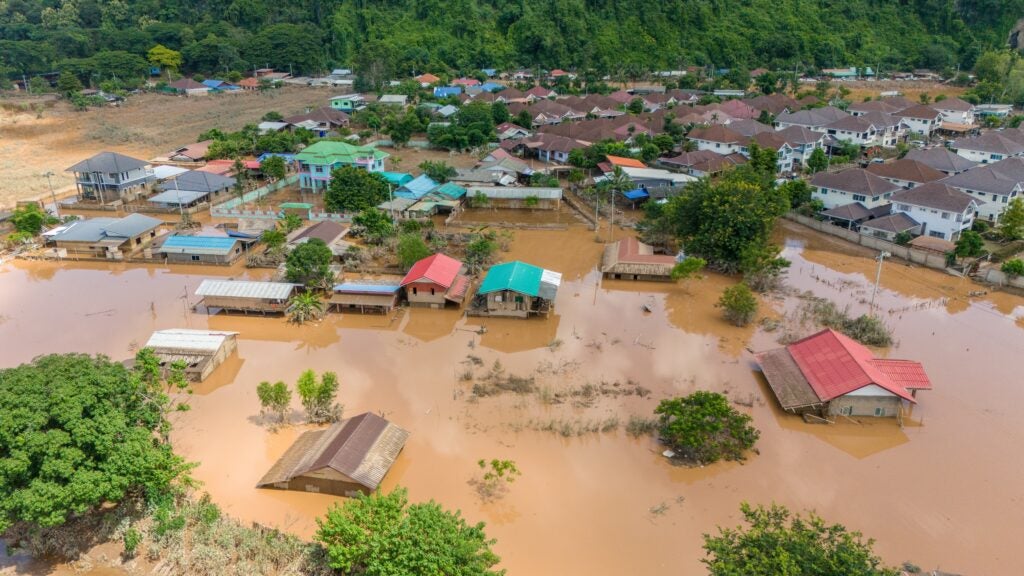
Torrential rains in Darjeeling, India and Nepal, where landslides have swept away lives and bridges; successive typhoons submerging Hanoi's streets; floods in Chad, where thousands of rural homes have been destroyed — and this was just October. 2025 has rung loud sirens on climate extremes. Though the climate crisis grabs headlines with delegates meeting for COP30 in Brazil, it jostles for attention amidst geopolitical upheavals and geoeconomic disruptions. Unfortunately, developing countries, in general, and fast-growing emerging economies in Asia, in particular, do not have the luxury to deal with one crisis at a time. They must create jobs, upgrade standards of living, maintain economic dynamism, and grab new technological opportunities, all the while looking for new sources of investment, new trade partners, new security guarantees, and new buffers against a worsening climate. In short, Asia needs a new mantra: Resilience for a new world.
A decade since the Paris Agreement was signed, the United States whas chosen to withdraw, the European Union is revealing cracks in its climate consensus, and the United Kingdom’s climate legislation is under attack. Self-appointed climate leaders have often failed to meet domestic climate targets and repeatedly postponed their international obligations to provide climate financing. One can hope for a change of heart but hope is not a strategy. Instead, Asia must assume control of its climate (and economic) destiny. For China, India, and the Asia-Pacific—a region that has borne over half of all global climate change-induced disaster-related deaths and nearly USD 2.7 trillion in economic damages since 1970—the mandate is different. Recent analysis already ranks India among the top 10 countries for climate-induced financial losses. For Asia's economies, climate resilience is not a theoretical exercise. It is the critical buffer between hard-won development gains and their erosion by climate shocks.
Our work at the Council on Energy, Environment and Water (CEEW) in India has taught us four core principles to building this resilience.
First, resilience must be hyperlocal, protecting lives and livelihoods.
Vulnerability is not a national statistic but a localised reality. We must shield those on the frontlines of climate extremes. The systemic shocks witnessed across Asia recently — from floods in Thailand that claimed lives and affected 370,000 people across 19 provinces to Typhoon Halong that forced hundreds into evacuation centres in Japan — are not isolated incidents. They represent a pattern of escalating risks.
In India, three out of every four districts are now extreme climate event hotspots with multiple, overlapping hazards, affecting 80 per cent of the population. In Thane, a coastal city of 2.5 million people, we developed hyperlocal heat action plans that layer temperature and humidity data with health and socioeconomic metrics to target interventions neighbourhood by neighbourhood. Such heat action plans have been developed for over 50 cities and now cover 60 million people. Similarly, hyperlocal flood mitigation strategies and air quality monitoring systems are helping such cities respond more equitably and with more precision despite their limited resources. Resilience for 1.5 billion people can only be built granularly, one locality at a time.
Second, resilience must be wired into our evolving power grids.
Emerging markets are projected to drive 88 per cent of global electricity demand growth by 2040. India has been steadily building up its clean energy capacity over the past 15 years, and has now become the third-largest producer of electricity from wind and solar in 2025. It is aiming for 500 GW non-fossil capacity by 2030 with a rapidly expanding grid that transmits nearly 485 GW of electricity through more than 490,000 circuit kilometres of lines. This momentum is mirrored across the region. Sri Lanka, for instance, is targeting 70 per cent renewable generation by 2030, building on a grid that already connects 98 per cent of households and sources over half its power from renewables. It is investing in new transmission lines which could harness a potential 56 GW of offshore wind and 6 GW of solar power. China also added over 212 GW of solar and 51 GW of wind capacity just in the first half of 2025—pushing its solar capacity past 1.1 TW and further cementing its global leadership in clean energy expansion.
But size alone does not guarantee resilience, as the summer grid failures in Europe have shown. Maintaining and updating existing components of our power grids is just as important as expanding them.
Our research has also found that, contrary to entrenched belief, injecting more renewable energy into India’s power grid would increase the availability of reserves, resulting in superior reliability. This is critical as peak power demand in hot, humid Asia is outpacing average electricity growth. In fact, scaling India’s non-fossil capacity to 600 GW would yield the most reliable grid at the lowest cost, requiring no new coal and avoiding idling capacity. Overdependence on fossil fuels exposes us to volatility in their price and availability. Instead, we must develop intelligent systems that can optimally store and dispatch power from diverse fuel sources in response to fluctuations in supply and demand.
Third, resilience must define our supply chains.
The clean energy transition hinges on supply chains that are dangerously concentrated, a vulnerability which has now been exposed by geopolitical shocks and tariffs. A critical question now is how Asian economies and emerging markets should distribute these clean energy supply chains, whether for products, minerals, or tech. Over the last decade, the number of countries with concentrated control of battery manufacturing jumped from 19 to 49. For solar photovoltaic, it increased from 38 to 71. Meanwhile, 15 countries control over half of critical minerals globally and 70-90 per cent of the mine production, while five G20 economies hold 85 per cent of cleantech patent applications and grants.
This asymmetry creates strategic choke points for emerging economies. Asia’s cleantech resilience depends on countries working together to ensure supply chain diversification. Ideally, Asian economies would move beyond competition to a nuanced analysis of comparative advantage, component by component: from aluminium foil to silver paste, from electrolytes to junction boxes. China’s minerals manufacturing and processing prowess and India’s strengths in software and circular economy models can be complementary. This partnership should move beyond trade to co-develop the architecture of resilience itself: through joint mineral consortia for exploration, a global shared minerals exchange platform, and blockchain-based traceability to comprehensively track clean energy supply chains. Such cooperation could turn resource competition into shared energy security in the region.
Fourth, resilience must integrate the energy-water-food nexus.
The energy transition is not just about optimising the flow of electrons; it is inextricably linked to land, water, and food security. A UN report now warns that excessive heat is already harming worker health and productivity globally. The scramble for tech dominance and the exponential power demands of AI add further complexity. Systems thinking is needed to optimise across these domains.
At CEEW, we modelled India’s renewable energy potential after layering in constraints like water stress, land use conflicts, and social factors. Even then, we found potential for over 7,000 GW of renewable power capacity for net zero alone and to produce 56 million tonnes of green hydrogen. This same integrated, nexus-driven approach must guide regional policy to optimise for solar and wind potential, land use, biodiversity, water, and socioeconomic co-benefits. Cross-border cooperation on managing shared river basins, developing climate-resilient agriculture, and building interconnected green grids can turn potential conflicts into areas of collaborative resilience. When countries are bound by shared infrastructure and mutual interest in climate stability, the foundations for regional peace, and more importantly prosperity, grow stronger.
The world continues to navigate a polycrisis. Asia’s leadership will be judged not by rhetoric, but by its ability to deliver tangible security—economic, energy, and human—in an increasingly unstable world. By rewiring our economies to be resilient (from the local household to the regional grid), India and Asia can offer a new, compelling model of climate leadership: one that is pragmatic, solution-oriented, and injects new forms of cooperation for collective security in the challenging times ahead.
The views and opinions expressed in this article are those of the author(s) and do not necessarily reflect those of the Asia Research Institute, National University of Singapore.
Latest
India, Pakistan, and Breaking out of the 'Continent of Circe'
by Akbar Ahmed
Southeast Asia's "Anatomy of Choice" Between the Great Powers
by Joseph Chinyong Liow & Yuen Foong Khong
Integrated Supply Chains - A Posible Citadel for Peace in Southeast Asia
by Cameron Johnson
How to Fix the Cracks in the Nuclear Dam
by Adam Thomson
Persuading for Peace, Protecting Its Interests: China’s Conflict Diplomacy
by Andrew Cainey and Chengkai Xie
US ASEAN Policy Must Be Rooted in Economics, Not Just Defense
by Abhinav Seetharaman
South Korea: Is it time for a more balanced strategy?
by Soon Ok-Shin
A nuclear war started by AI sounds like sci-fiction. It isn’t
by Sundeep Waslekar
Ports, politics, and peace: The engineering of stability
by Guru Madhavan
It's Time for Europe to Do the Unthinkable
Kishore Mahbubani
Can Young Americans and Chinese Build Bridges Over Troubled Waters?
Brian Wong
Trump 2:0: Getting US-China ties right despite the odds
Zhiqun Zhu
How Malaysia can boost Asean agency and centrality amid global challenges
Elina Noor
Why India-Pakistan relations need a new era of engagement
Farhan Hanif Siddiqi
Reconceptualizing Asia's Security Challenges
Jean Dong
Asia should take the Lead on Global Health
K. Srinath Reddy and Priya Balasubramaniam
Rabindranath Tagore: A Man for a New Asian Future
Archishman Raju
Securing China-US Relations within the Wider Asia-Pacific
Sourabh Gupta
Biden-Xi summit: A positive step in managing complex US-China ties
Chan Heng Chee
Singapore's Role as Neutral Interpreter of China to the West
Walter Woon
The US, China, and the Philippines in Between
Andrea Chloe Wong
Crisis Management in Asia: A Middle Power Imperative
Brendan Taylor
America can't stop China's rise
Tony Chan, Ben Harburg, and Kishore Mahbubani
Civilisational Futures and the Role of Southeast Asia
Tim Winter
US-China rivalry will be stern test for Vietnam's diplomatic juggle
Nguyen Cong Tung
Coexistence: The only realistic path to peace
Stephen M. Walt
Cyclone Mocha in conflict-ridden Myanmar is another warning to take climate security seriously
Sarang Shidore
Doubts about AUKUS
Hugh White
Averting the Grandest Collision of all time
Graham Allison
India Can Still Be a Bridge to the Global South
Sanjaya Baru
U.S.-China Trade and Investment Cooperation Amid Great Power Rivalry
Yuhan Zhang
Managing expectations: Indonesia navigating its international roles
Shafiah F. Muhibat
Caught in the middle? Not necessarily Non-alignment could help Southeast Asian regional integration
Xue Gong
It’s Dangerous Salami Slicing on the Taiwan Issue
Richard W. Hu
Navigating Troubled Waters: Ideas for managing tensions in the Taiwan Strait
Ryan Hass
The EU and ASEAN: Partners to Manage Great Power Rivalry?
Tan York Chor
Countering Moro Youth Extremism in the Philippines
Joseph Franco
India-China relations: Getting Beyond the Military Stalemate
C. Raja Mohan
America Needs an Economic Peace Strategy for Asia
Van Jackson
India-Pakistan: Peace by Pieces
Kanti Bajpai
HADR as a Diplomatic Tool in Southeast Asia-China Relations amid Changing Security Dynamics
Lina Gong
Technocratic Deliberation and Asian Peace
Parag Khanna
Safer Together: Why South and Southeast Asia Must Cooperate to Prevent a New Cold War in Asia
Sarang Shidore
Asia, say no to Nato: The Pacific has no need of the destructive militaristic culture of the Atlantic alliance
Kishore Mahbubani
Can Biden bring peace to Southeast Asia?
Dino Djalal
An India-Pakistan ceasefire that can stick
Ameya Kilara
An antidote against narrow nationalism? Why regional history matters
Farish A Noor
Can South Asia put India-Pakistan hostilities behind to unite for greater good?
Ramesh Thakur
Nuclear Deterrence 3.0
Rakesh Sood
The Biden era: challenges and opportunities for Southeast Asia
Michael Vatikiotis